


WASHINGTON: The United States has reaffirmed its support for Pakistan’s right to defend itself against terrorist attacks, as Islamabad says terrorism and cross-border attacks have surged since the Afghan Taliban returned to power in Afghanistan in 2021, accusing Kabul of providing safe havens to anti-Pakistan terrorist groups.
The spokesperson of the US State Department said Washington recognised Pakistan’s security concerns and the heavy toll terrorism has taken on the country.
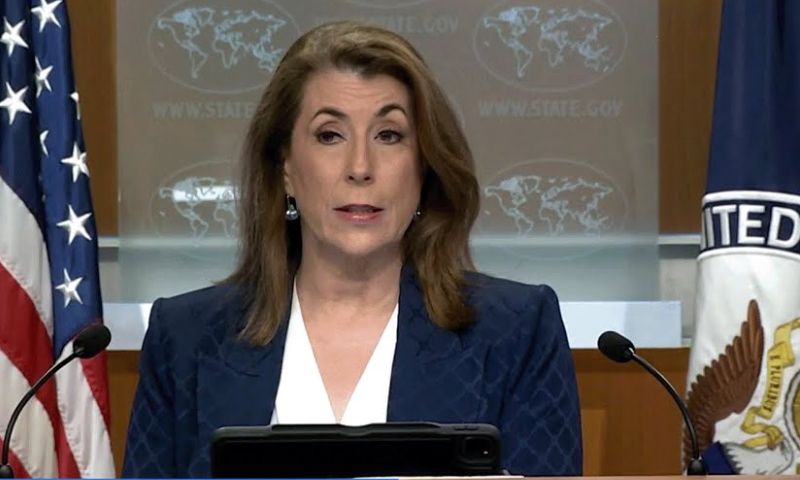
Asked about the recent Pakistan-Afghanistan tensions during the State Department’s daily press briefing, spokesperson Tammy Bruce said Washington “supports Pakistan’s right to defend itself against terrorist attacks,” adding that “the Pakistani people have suffered greatly at the hands of terrorists.”
The remarks represent a clear expression of US support for Pakistan’s counterterrorism efforts amid renewed cross-border tensions with neighbouring Afghanistan.
Terrorism Since 2021
Pakistan has repeatedly said that militant violence has risen sharply since the Afghan Taliban returned to power in Afghanistan in 2021 following the withdrawal of US-led forces.
Islamabad accuses Kabul of allowing militants from the banned Tehreek-e-Taliban Pakistan (TTP) to operate from sanctuaries inside Afghanistan.
Pakistan has long maintained that the TTP shares ideological roots and historical links with the Afghan Taliban.
Islamabad has repeatedly urged the Afghan Taliban administration to dismantle TTP safe havens, arrest its leaders and prevent Afghan territory from being used to launch attacks inside Pakistan.
Relations between the two neighbours have deteriorated sharply in recent months as Pakistan has repeatedly raised concerns over the presence of terrorist groups operating from Afghan territory. In February,
Pakistan and Afghanistan engaged in their most serious military confrontation in years, underscoring growing security tensions and fuelling concerns about stability along their shared border.
Strengthening US-Pakistan Ties
The State Department’s comments come as relations between Washington and Islamabad have improved under President Donald Trump.
Pakistan remains a major non-NATO ally of the United States and has continued to cooperate with Washington on regional security and counterterrorism issues.
Washington also continues to designate the Afghan Taliban as a terrorist organisation.
Pakistan has additionally played a diplomatic role in recent regional efforts aimed at reducing tensions involving the United States, Israel and Iran.The
EU and the UK voiced support for Pakistan
Earlier in June, the European Union and the United Kingdom voiced support for Pakistan’s right to defend itself against cross-border terrorist threats while expressing concern over the continued presence of terrorist groups operating from Afghan territory.
In separate interviews, European Union Special Envoy Gilles Bertrand and United Kingdom Special Envoy Richard Lindsay reaffirmed that the Tehreek-e-Taliban Pakistan (TTP) remains a serious security threat and continues to benefit from safe havens, logistical support and operational space inside Afghanistan.
The diplomats stressed that the authorities currently exercising control in Kabul bear responsibility for preventing Afghan soil from being used to launch attacks against neighbouring countries.
They called for effective measures to dismantle terrorist infrastructure and address regional security concerns.
TTP remains a major regional security threat
According to the envoys, the TTP continues to exploit cross-border networks, training facilities and sanctuary areas to evade Pakistani security operations, posing a persistent challenge to peace and stability in the region.
Addressing Pakistan’s response to these threats, both diplomats acknowledged that states have the right to self-defence when confronted with credible and imminent security dangers. They noted that any government facing active terrorist threats is entitled to take appropriate measures to protect its citizens and territorial integrity.
Recent assessments by the United Nations Security Council’s monitoring mechanisms have highlighted the continued presence of multiple terrorist organisations in Afghanistan.
These groups include the TTP, Al-Qaeda, Daesh-Khorasan (ISKP), the East Turkestan Islamic Movement (ETIM), the Islamic Movement of Uzbekistan (IMU) and Jamaat Ansarullah.