KEY POINTS:
- Afghanistan ranked “extremely high risk” for torture by OMCT, with Taliban accused of legalizing abuse in criminal code.
- Female detainees more than doubled from 840 in 2021 to 1,825 in 2025; 52% of all prisoners held without trial.
- Women subjected to electric shocks, flogging, sexual abuse; judicial system collapsed with no independent courts.
- Human rights groups urge UN to establish accountability mechanism as Taliban denies allegations of torture.
- OMCT Global Torture Index 2026 exposes systematic abuse, surge in female detainees, and collapsed judicial system.
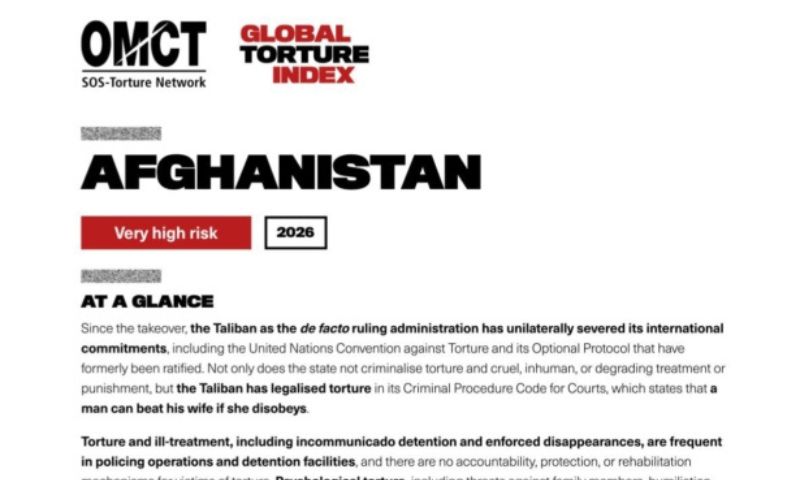
ISLAMABAD: Afghanistan has been placed in the “extremely high risk” category for torture, inhumane treatment, and state repression, according to the Global Torture Index 2026 released by the World Organisation Against Torture (OMCT), exposing a grim reality of systematic abuse under Taliban rule.
The report, which assessed conditions in 39 countries, found Afghanistan at the highest level of concern across nearly all indicators, including political commitment against torture, ending impunity, victims’ rights, and civic space. The OMCT said the Taliban, since returning to power in August 2021, have effectively severed Afghanistan’s international commitments, including the United Nations Convention Against Torture.
“Not only does the state not criminalise torture and cruel, inhuman, or degrading treatment or punishment, but the Taliban has legalised torture in its Criminal Procedure Code for Courts, which states that a man can beat his wife if she disobeys,” the report states.
OMCT World Torture Index 2026: Report Reveals Sexual Violence and the Rape of Women and Girls in Afghan Taliban Detention Centers:
The report presents a detailed assessment of torture risks and detention practices in 39 countries, identifying Afghanistan among the countries… pic.twitter.com/KOdywj22HS
— Khorasan Ghag (@Khorasanghag_) June 25, 2026
Female detainees surge as women become targets
According to official and monitoring reports cited in the index, the number of women held in Taliban custody has increased dramatically, rising from 840 in 2021 to 1,825 in 2025 – more than double in just four years.
Afghanistan currently holds approximately 23,000 detainees in prisons and detention facilities, representing an incarceration rate of 54 per 100,000 people. The report further states that 52 percent of detainees have not been convicted of any crime and remain in custody without formal sentencing or legal resolution.
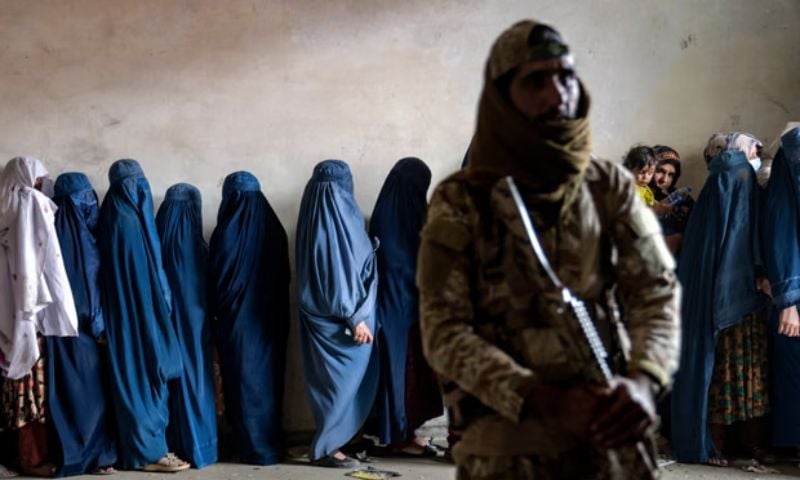
Among the prison population are around 1,000 women, accounting for approximately 4.3 percent of all prisoners. These women are reportedly being held in official and unofficial detention facilities operated by the Taliban’s intelligence agency, the Ministry of Interior, and the Ministry for the Promotion of Virtue and Prevention of Vice.
Systematic torture and abuse documented
Independent monitoring organisations and United Nations observers have documented severe human rights abuses inside these facilities. Reports claim that female detainees are subjected to:
- Physical violence
- Electric shocks
- Flogging
- Sexual abuse
Detainees are systematically denied access to legal representation and due process. Physical abuse including flogging and waterboarding, along with psychological torture such as threats to family members, humiliation, and forced religious conversion, are commonly reported. Some detainees have been held in shipping containers for days with inadequate food and water.
In its quarterly reports, the United Nations Assistance Mission in Afghanistan (UNAMA) documented 414 cases (327 men, 83 women, three girls, and one boy) of corporal punishment involving public lashings, mostly on accusations of “moral” crimes like adultery. The Taliban have also carried out public executions of at least four men in Nimruz, Badghis, and Farah provinces.
Judicial system collapses under Taliban rule
According to the OMCT report, Afghanistan’s judicial system has effectively collapsed under Taliban rule, with:
- No independent courts
- No meaningful separation of powers
- Limited access to legal representation, particularly for political detainees
Convictions are often based on confessions and testimony, raising concerns that admissions may be obtained under torture or coercion. The abolition of the former Afghanistan Independent Human Rights Commission has further weakened oversight, while victims of torture rarely file complaints due to fear of retaliation.
Women’s rights systematically dismantled
Human rights advocates argue that after restricting women’s access to education, employment, and freedom of movement without a male guardian, the detention and alleged mistreatment of women for so-called “moral crimes” has increasingly become a tool of political control and social enforcement under Taliban governance.
Taliban authorities maintained a ban on secondary and higher education for girls and women throughout 2025. The Ministry for the Propagation of Virtue and Prevention of Vice imposed further restrictions on women’s freedom of expression, banning women’s voices from being heard in reciting the Quran or singing in public. Women who defied the rules faced abuse and arbitrary detention.
In September 2025, Taliban officials prohibited universities from teaching books written by women. The law stipulates strict rules on dress and behaviour, especially for women and girls, with local enforcement committees carrying out raids on workplaces, monitoring public spaces, and establishing checkpoints to inspect mobile phones.
Minorities and civil society under attack
The OMCT report said women, children, and ethnic and religious minorities remain among the most vulnerable groups under Taliban rule. The Taliban have systematically targeted minorities including the Hazaras, Ismailis, Sikhs, and Hindus, who continue to face discrimination, harassment, and forced displacement.
UNAMA reported that Taliban authorities in Badakhshan province forced at least 50 male members of the Ismaili (Shia) community to convert to Sunni Islam, and those who refused were subjected to physical assaults, coercion, and death threats.
The report also described Afghanistan’s civic space as “closed,” saying human rights defenders and activists now operate in secrecy or exile as dissent has been heavily criminalised. Journalists and other critics face arbitrary detention and torture.
Afghanistan has been placed in the “very high risk” category in the 2026 Global Torture Index, among the world’s worst rankings, with the World Organization Against Torture saying Taliban authorities have legalised certain forms of torture and ill-treatment under their laws.… pic.twitter.com/wEbgtAONfM
— KabulNow (@KabulNow) June 26, 2026
International calls for accountability
The OMCT has called for the urgent establishment of an independent torture prevention mechanism with unrestricted access to all detention centres, including those run by Taliban intelligence, as well as an international review of the Taliban’s criminal code.
Human rights organisations and the International Commission of Jurists have urged the UN Human Rights Council to establish an independent international accountability mechanism to investigate, collect, and preserve evidence of past and ongoing crimes under international law and other human rights violations committed in Afghanistan.
Since their return to power, the Taliban have faced repeated allegations by the United Nations, international rights groups, and former detainees of torture, arbitrary detention, and enforced disappearances. The group, however, denies the allegations, dismissing them as “propaganda” and saying its actions are in accordance with Islamic law.
What is the World Organisation Against Torture (OMCT)?
The World Organisation Against Torture (OMCT) is an international non-governmental organisation based in Geneva, Switzerland, dedicated to combating torture, summary executions, forced disappearances, and other forms of cruel, inhuman, or degrading treatment.
The OMCT publishes the Global Torture Index annually, assessing countries based on their political commitment to preventing torture, the state of their judicial systems, and the protection of human rights.