Key Points:
- Uttar Pradesh mosque demolished following revenue court order.
- Police register FIR over “I Love Muhammad” posters.
- Seven Muslims booked; no arrests made so far.
- Residents allege intimidation and fear of police action.
- Legal experts question jurisdiction over waqf property dispute.
- Police defend FIR as legally vetted and under investigation.
- Case reignites debate over religious freedom under BJP rule.
ISLAMABAD: The demolition of a mosque in India’s northern state of Uttar Pradesh, followed by criminal cases against seven Muslims over posters bearing the slogan “I Love Muhammad,” has drawn fresh attention to the growing suppression of religious freedoms and the continued targeting of the country’s Muslim minority under the Bharatiya Janata Party (BJP) government.
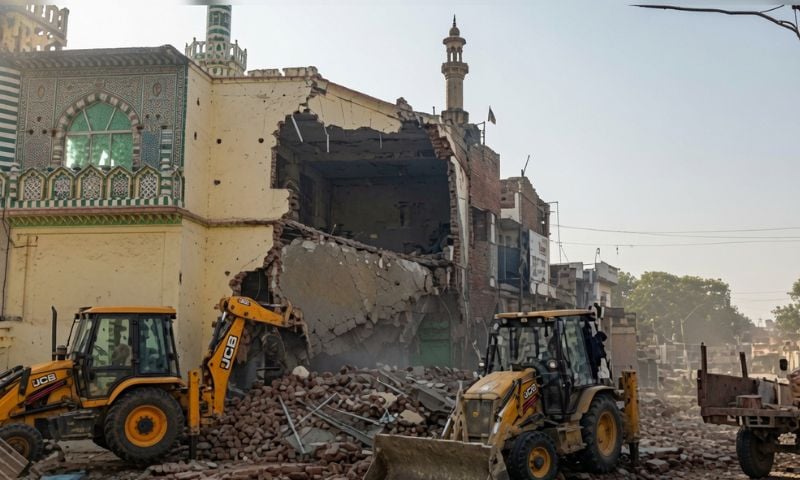
According to a BBC report, the Mustafa Qadri Mosque — the only mosque in Kaserwa village in Sambhal district — was demolished on June 6 on the orders of the local tehsildar. Shortly after the demolition, police claimed they recovered posters carrying the words “I Love Muhammad” along with a green flag from inside the mosque.
Based on the alleged recovery, police registered an FIR against seven people under provisions of the Indian Penal Code relating to statements or actions allegedly capable of promoting enmity between religious groups.
Among those named in the case is Muhammad Ali, who said the accused have been forced to remain away from their homes due to fear of arrest.
“We cannot even stay in our own homes. We are living elsewhere because of fear. We have suffered great injustice. We no longer have a mosque where we can offer prayers, and we are terrified of the police,” he said.
Faith becomes offence
The controversy surrounding the slogan dates back to 2025, when a banner reading “I Love Muhammad” appeared during an Eid Milad-un-Nabi procession in Kanpur’s Rawat area. Several Hindu organisations objected to the banner, after which the phrase spread widely on social media, with many users adopting it as their display picture in protest.
Uttar Pradesh Chief Minister Yogi Adityanath had criticised the campaign, accusing some groups of encouraging children to carry such placards instead of books and alleging that such activities disturbed public order. He warned that his government would not tolerate attempts to create unrest.
Victims become accused
However, villagers in Kaserwa say they struggle to understand why a criminal case was registered after the mosque itself had already been demolished.
“Our own mosque has been demolished, and now cases have been registered against us,” said an elderly local woman Afsari. “The Prophet is beloved to us. Naturally, we remember him. Now they are trying to implicate us with these allegations.”
Many other villagers declined to speak publicly, citing fears of police action.
The district administration maintains that the demolished structure had been built on land reserved for a graveyard and was therefore removed in accordance with an April 21 order issued by the tehsildar’s court.
Police Superintendent Krishna Kumar defended the registration of the FIR, saying every individual has the constitutional right to practice their religion provided it does not harm others.
“The investigation is still underway. We obtained legal opinion before registering the FIR. No accused has been arrested so far, and further action will depend on the findings of the investigation,” he said.
The demolition itself has also become the subject of legal controversy.
Following the tehsildar’s order, members of the local Muslim community challenged the decision before the district magistrate’s court. On June 5, the court upheld the demolition order, and authorities razed the mosque the following day.
Residents argue the dispute should never have been decided by revenue authorities.
Selective justice exposed
The legal dispute has also centred on whether the authorities followed the correct judicial process. Under Sections 83 and 85 of India’s Waqf Act, 1995, disputes involving properties recorded as waqf are required to be heard by a Waqf Tribunal rather than civil or revenue courts. A local resident, Qasim Jamal, argue that the Mustafa Qadri Mosque had been registered as waqf property since 1984, making the demolition order legally questionable.
“If the property was registered with the Waqf Board, then only the Waqf Tribunal had jurisdiction to hear the matter. That has always been our position,” he said, adding that the court failed to properly consider their arguments.
District Magistrate Ankit Khandelwal, howevers, argued that anyone claiming a property as waqf land must produce valid legal documentation, including land registration details and clearly defined boundaries. He said those requirements had not been fulfilled in this case.
Legal experts specialising in waqf law dispute that interpretation.
Supreme Court lawyer Fuzail Ayyubi said that once a property is claimed as waqf and supported by official notification, the dispute should be referred to the Waqf Tribunal for adjudication rather than decided by revenue authorities.
Although police have not arrested anyone in the case so far, several people associated with the mosque have reportedly left the village to stay with relatives, fearing possible detention.
The case has added to growing concerns among rights advocates over the condition of religious freedom in India, where Muslim organisations have repeatedly alleged that mosque demolitions, criminal investigations and administrative actions disproportionately target the country’s largest religious minority.