
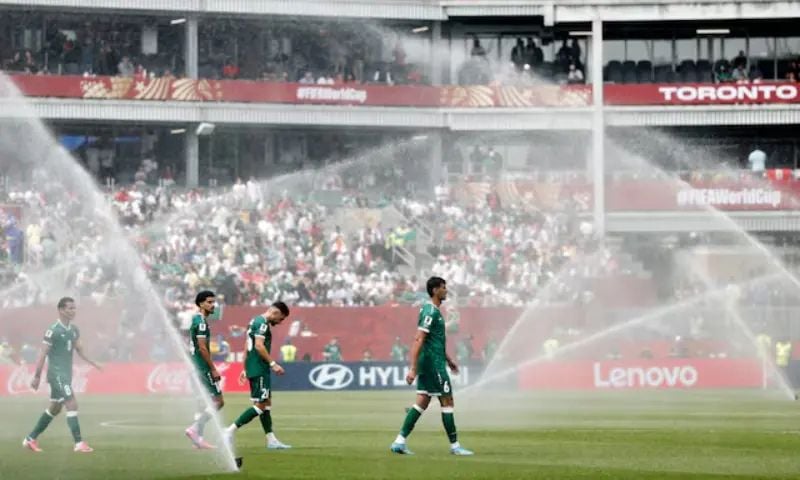
ISLAMABAD: Just as the FIFA World Cup enters its most thrilling phase, the high-stakes knockout rounds, Mother Nature has unleashed her own formidable opponent. A powerful “heat dome” has settled over large parts of the United States and Canada, bringing furnace-like conditions that threaten to overshadow the drama on the pitch.
With temperatures expected to exceed 43 degrees Celsius (110 degrees Fahrenheit) in several host cities, forecasters are warning about potential heat safety issues for players, officials, and the hundreds of thousands of fans flocking to stadiums across North America.
The tournament, already a cauldron of emotion and national pride, is now becoming a literal cauldron of heat. As the world’s best footballers battle for glory, they must also contend with an opponent that cannot be outrun, outpassed, or outscored, the relentless summer sun.
Which matches are at risk?
The knockout stage has arrived, and so has the scorching heat. Several high-profile matches are set to be played under extreme weather warnings, raising concerns about player performance and spectator safety:
- Thursday, Round of 32 – Toronto:Portugal faces Croatia at Toronto Stadium, where health authorities have issued urgent warnings. Environment Canada has declared a heat warning, with city medical officer Dr. Michelle Murti advising fans to stay hydrated and limit alcohol intake as temperatures could feel like 40°C (104°F) due to oppressive humidity.
- Friday, Round of 32 – Kansas City:Colombia takes on Ghana under an extreme heat warning, with “feels like” temperatures projected to reach a staggering 43°C (110°F). The open-air stadium offers little respite for the 69,000 fans expected to attend.
- Friday, Round of 32 – Miami:Argentina faces Cape Verde in a city experiencing moderate to major heat risk this weekend, with similar sweltering conditions forecast.
- Saturday, Round of 32 – Philadelphia:Paraguay meets France in conditions that could prove dangerous, with temperatures forecast to reach 39°C (102°F) and a heat index soaring to 43°C (110°F). FIFA has already taken the unprecedented step of shortening operating hours at its Fan Festival in the city due to the extreme heat.
Stadiums: A Tale of Two Worlds
Not all venues are created equal when it comes to beating the heat. Stadiums in Atlanta, Dallas, and Houston boast retractable roofs and air conditioning, offering players and fans a climate-controlled sanctuary once they step inside. But for millions of supporters in other host cities, the experience will be markedly different,and far more dangerous.
In Toronto, where stadium capacity was expanded for the World Cup with only limited roof cover, approximately 43,000 fans will be exposed to the blazing sun during Thursday’s Portugal-Croatia clash.
The situation is equally concerning in Philadelphia and Kansas City, where capacities of 68,000 and 69,000 respectively offer almost no built-in climate control. Spectators will rely entirely on whatever shade, misting stations, and cooling zones organizers provide, a gamble against nature’s fury.
The invisible danger: Walking to the stadium
Even when the match itself is indoors, the journey to the stadium poses its own risks. In Dallas, meteorologists warn that while air temperatures may hover around 32°C (90°F), the pavement outside the stadium could reach a blistering 50°C (122°F). Fans walking from car parks, train stations, and fan zones could experience temperatures far higher than forecast.
“Concrete can absorb some of that heat,” explained National Weather Service meteorologist Jennifer Dunn. “That will absorb and reflect it, and that can raise the temperature even more on those surfaces.” The warning highlights a hidden danger—one that could turn a celebratory walk to the stadium into a medical emergency.
How players are affected
When the body overheats during intense exercise, the risks become serious—even for elite athletes. Heat illness can cause dehydration, dizziness, cramping, headaches, and extreme fatigue. In the most severe cases, it can lead to exertional heat stroke, a medical emergency and the third-leading cause of death in athletes.
Beyond health risks, the heat fundamentally alters the game itself. Studies show that players often sprint less, cover less ground, and conserve energy in extreme conditions, changing the pace and intensity of matches. For fans expecting the high-octane drama of knockout football, the heat may deliver a slower, more cautious spectacle—a tactical battle against both the opponent and the thermostat.
FIFA’s response: Hydration breaks and controversy
To combat the extreme conditions, FIFA has implemented two mandatory three-minute hydration breaks per match, around the midway point of each half, regardless of weather or venue. The breaks have proven controversial, with many fans, coaches, and players arguing they disrupt the flow of the game and serve as a money-making opportunity for broadcasters to air additional commercials.
FIFA President Gianni Infantino has rejected that criticism, insisting “the main reason is the heat” and that the organization gains “absolutely nothing” from the breaks. In addition to hydration stoppages, teams can make up to five substitutions; there are at least three rest days between matches; and staff and substitutes at outdoor stadiums have access to climate-controlled benches.
In April, FIFA assured that the schedule was designed with heat in mind. “Outdoor matches during the hottest parts of the day have been strategically limited, kick-off times adjusted in certain markets and matches expected in warmer windows prioritised for covered stadiums where possible,” the organization stated.
These measures come after last year’s Club World Cup in the United States, when the global players’ union, FIFPRO, warned that extreme heat should be a “wake-up call” for football. That warning now rings louder than ever.
How fans can stay safe
Health experts are urging fans to take the heat seriously. Recommendations include:
- Drink water before you feel thirsty
- Take breaks in shade or air conditioning whenever possible
- Limit alcohol consumption
- Avoid long periods in direct sunlight
Medical teams will be stationed at FIFA Fan Festival sites and around stadiums to respond to heat-related illnesses. Some host cities have expanded access to shade, cooling areas, and free water for fans and workers.
Experts also emphasise knowing the warning signs: dizziness, confusion, severe fatigue, or a lack of sweating can all signal dangerous heat illness. If symptoms become severe, medical attention should be sought immediately.