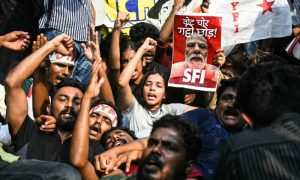
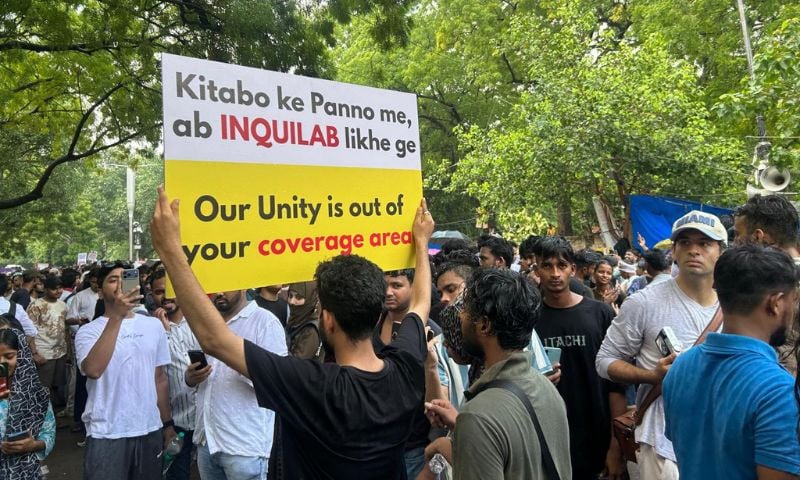
ISLAMABAD: The Cockroach Janata Party (CJP) protests at Jantar Mantar have laid bare a stark and uncomfortable truth about India’s media landscape: the chasm between organic public sentiment and curated mainstream coverage has never been wider.
On the ground, the movement has generated massive, unified support across diverse groups, students, farmers, and military veterans spending their own money to sit in 40-degree heat demanding educational accountability. Online, the movement exploded to millions of followers in days. Yet, mainstream television networks have largely ignored the protests, choosing instead to focus on polarising political theater.
The word ‘cockroach‘ has given Indian politics a new direction. That is the power of a single word. Thank you, CJI.
Godi media has collapsed. They are being ridiculed. Modi’s dominance on social media has been shattered. The fear of the RSS is fading.
For the first time,… pic.twitter.com/8mvex0s4Cn
— M V Nikesh Kumar (@mvnikeshkumar) July 25, 2026
The disconnect has ignited a fury that boiled over this week when a journalist was physically attacked by protesters, a shocking incident that has forced India to confront the uncomfortable question: has the country’s once-proud media become the government’s lapdog?
When Indian television reporter Dev Kotak went to cover the massive youth protest against Prime Minister Narendra Modi’s government this week, he planned to deliver a live broadcast, mill around and leave. Instead, amid chants of “godi media (lapdog media)”, he was beaten by dozens of protesters because his channel is seen as pro-government. Mobile phone cameras captured the assault, and the clip later went viral on social media.
A month of struggle,a lifetime of impact. Gen Z came, stood, and conquered.
Whole world stood🫡
Today isn’t just about a resignation-it’s proof that when Gen Z unites for justice, no power is too big to fall.All thanks to @Wangchuk66 Sir 🇮🇳 @Cockroachisback pic.twitter.com/POCiZmZg5Z
— Rutuparna Patro (@khush_muse18) July 25, 2026
“The mob might have actually killed me. There was a seething anger among them because they felt the media hadn’t reported their side of the story,” said Kotak, 36, who covers general news for the Times Now channel. “There were slaps, kicks, punches and water bottles being thrown. I was very scared and feared for my life; I just wanted to get out alive.”
Why the anger? A decade of declining media freedom
The hostility towards reporters reflects a broader debate over declining media freedom in the world’s most populous democracy since Modi took office in 2014 and started dominating Indian politics.
India’s ranking in the Reporters Without Borders’ World Press Freedom Index has deteriorated sharply over the past decade. The country ranked 122nd in 2010 but fell to 157th out of 180 countries in 2026.
The Paris-based media rights watchdog has attributed the decline to violence against journalists, concentration of media ownership in businesses aligned with the government, and growing political polarisation. The Editors Guild of India condemned the attack on Kotak but also acknowledged the underlying grievances.
“Flawed and biased reporting not only makes a bad situation worse, but has more serious and longer-lasting consequences which impact the fabric of our society and also weaken the media’s position as one of the key pillars of a functional democracy,” the Guild stated.
Read Also: How India’s ‘Cockroaches’ Expose Modi’s Hindutva Illusion
‘Godi media’: A term born from disillusionment
Prominent journalist Ravish Kumar, a winner of the Ramon Magsaysay Award, regarded as Asia’s equivalent of the Nobel Prize, is credited with coining the term “godi media,” which has spread widely because it also rhymes with Modi.
The term has come to include almost all TV channels and some national newspapers for what critics say is their lack of scrutiny of government, coverage of Modi that borders on the fawning, and ignoring or criticising any dissent.
“The godi-media is anti-democracy, anti-people, anti-opposition,” Kumar said. “They vilify any opposition, label critics as agents of foreign governments, and barely ever feature voices of political parties from opposition.”
@GaziOmer5 , a member of CJP Kashmir, has issued a statement on “Godi media” regarding the Jantar Mantar protest, condemning the Delhi Police’s actions against peaceful demonstrators.#cjp #jantarmantar #dharmendrapradhanresign pic.twitter.com/7hLjZ3OoqQ
— Cockroach Janta Party J&K (@cjp_JK29) July 25, 2026
The term has now been weaponised by the CJP protesters, who chant it at every news crew that approaches the Jantar Mantar site. The anger is palpable: protesters point out that while they have been occupying the protest site for over a month, risking police batons and tear gas, mainstream media has devoted more airtime to political mudslinging than to the grievances of millions of young Indians.
The protest that mainstream media ignored
The CJP protests began as a satirical response to Chief Justice Surya Kant’s comparison of unemployed youth to “cockroaches” and “parasites.” What started as an online joke quickly transformed into one of India’s largest youth-led movements, drawing thousands to Jantar Mantar and demonstrations across the country.
The movement’s demands are clear: accountability for the NEET-UG paper leak, compensation for families of students who died by suicide, and systemic reforms to India’s examination system. Yet, despite the massive public support, mainstream news channels have largely relegated the protests to the margins, choosing instead to focus on polarising political theater.
“Everyone is a gangster until the cockroach starts flying”
Supporters of India’s Cockroach Janta Party (CJP) celebrate after India’s Education Minister Dharmendra Pradhan resigned. REUTERS/Francis Mascarenhas pic.twitter.com/fERC0GBbN4
— Aditya Kalra (@adityakalra) July 25, 2026
Protesters correctly point out that mainstream media is largely ignoring the movement, choosing instead to focus on polarising political theater. This disconnect suggests that mainstream networks are prioritising the protection of the current administration over reporting on a massive, unified citizen grievance regarding systemic education failure.
Digital media: The new voice of dissent
The decline in trust of traditional news outlets has helped drive audiences toward independent online platforms. Digital commentator Akash Banerjee, a former Times Now journalist whose YouTube channel now attracts millions of followers, noted that the media’s failure to question the government had created a vacuum that digital media has filled.
“The fact that the media has stopped questioning the government has resulted in a rise of alternative digital media, which would not have happened otherwise,” said Banerjee.
The CJP movement itself is a testament to the power of digital platforms. Within days of its founding, the CJP’s Instagram account amassed over 22 million followers, more than double the BJP’s 9 million and far exceeding the Congress party’s 13 million.
The movement’s success in mobilising millions without any support from traditional media has exposed the irrelevance of mainstream news networks.
Breaking news: Sudhir Chaudhary is a sycophantic journalist.
This video is a mirror for the Godi media.
In the foreign media, there are reports of protests by the cockroach Janata Party, while in India, there are reports of the Tukde-Tukde gang. https://t.co/3TmfKwomSY pic.twitter.com/l9VzhJGqKV
— Gulab_Dharkar9711 (@Gulab_Dharkar97) July 23, 2026
The protesters’ perspective: A generation ignored
For the young protesters at Jantar Mantar, the media blackout is not a conspiracy theory, it is a lived reality. Many have been camping at the site for weeks, enduring scorching heat and police crackdowns, while national television covers political dramas and celebrity gossip.
“We have been here for days, and no one is covering us,” said one protester. “They call us anti-national, but we are just demanding our future. Why won’t they show the truth?”
A spokesperson for the CJP, Deepak Baliyan, said organisers had repeatedly urged demonstrators not to mistreat reporters. “We have urged and we keep urging protesters to not misbehave with godi-media. Let them do their job. We want to make sure that no one gets mistreated here,” he said.
However, the anger has taken on a life of its own. As Manisha Pande, editorial director of news website Newslaundry, warned: “The worrying part is that the anger has now taken on a life of its own. For many protesters, a reporter is no longer seen as an individual but as the face of a thick-skinned media establishment that is responsible for their pain.”
CNN is now analyzing the rise of the ‘Cockroach Janta Party,’ saying India’s Gen Z and young people are so fed up with the system that they’ve taken to the streets.”
International media is reporting the anger and frustration of India’s youth, while Godi Media has reduced itself… pic.twitter.com/j4EkqGrDGA
— Expose Propaganda (@EPropoganda1) July 20, 2026
A crisis of credibility for Indian media
The CJP protests have exposed a crisis of credibility for Indian mainstream media. For years, critics have accused television news of becoming a mouthpiece for the government, prioritising ratings over journalism, and abandoning its role as a watchdog of democracy.
The government’s response to the protests, police crackdowns, social media censorship, and labelling protesters as “anti-national” has only deepened the distrust. When the administration labelled the CJP a “national security threat,” mainstream media largely echoed the government’s framing rather than questioning it.
Godi Media, yaad rakhiye public sab janti hai bas time ka wait karti hai. pic.twitter.com/n7QfQhqjKh
— Cockroach Janta Party (@CJP_4_Bihar) July 21, 2026
The Editors Guild of India condemned the attack on Kotak but also issued a sharp critique of the media’s own failings. “Flawed and biased reporting not only makes a bad situation worse, but has more serious and longer-lasting consequences which impact the fabric of our society and also weaken the media’s position as one of the key pillars of a functional democracy,” the Guild stated.
Read Also: India’s Education Minister Resigns After Nationwide Protests
The Modi factor: A decade of media consolidation
Since Modi took office in 2014, India has witnessed a steady consolidation of media ownership in the hands of business tycoons aligned with the government. Advertisers, many of whom are government-linked, have significant influence over editorial content. Journalists who question the government often face harassment, legal threats, and social media trolling.
Read Also: Activist Sonam Wangchuk Announces Next Phase of India’s ‘Cockroach’ Movement
The result has been a media environment that is increasingly homogenous, where criticism of the government is muted, and dissent is delegitimised. The CJP protests have brought this crisis to the forefront, forcing a national conversation about the state of Indian journalism.
What the CJP protests mean for Indian democracy
The CJP protests are not just about education reform, they are about the future of Indian democracy. The movement represents a generation that has grown up in the Modi era, witnessing the erosion of democratic institutions, the suppression of dissent, and the co-opting of media for political ends.
Read Also: Cockroach Janta Party Ends 36-Day Protest After Modi Government Accepts Key Demands
The protests have also demonstrated the power of alternative media. Independent journalists, digital creators, and citizen journalists have filled the void left by mainstream media, ensuring that the voices of protesters reach the world.
The attack on Kotak was a troubling moment, reflecting the dangerous level of anger and frustration among protesters. But it also revealed the depth of the crisis: when protesters see journalists not as truth-seekers but as government agents, something has gone deeply wrong with India’s media apparatus.