ISLAMABAD: For over a decade, Indian Prime Minister Narendra Modi masterfully weaponised social media to construct the illusion of a “rising India”, but the Cockroach Janata Party (CJP) protests have punctured that carefully manufactured reality.
The very digital platforms that once served as Modi’s propaganda machinery are now broadcasting his government’s systemic failures, exposing the education sector’s collapse, the criminalisation of dissent, and the hollowing out of India’s demographic dividend. In a cruel irony for the BJP, the tools of narrative control have become instruments of its unmasking.
Historic. Another victory for democracy. The Government of India says it has agreed to all the students’ demands after taking a humanitarian view of the situation. Resignation, compensation, and reforms, all three demands have now been met. The CJP has urged its supporters to end…
— Sonam Mahajan (@AsYouNotWish) July 25, 2026
The Cockroach Janata Party (CJP)protests, born from a satirical jab at India’s Chief Justice and fueled by the systemic collapse of the education system, have exposed the deep chasm between Modi’s rhetoric and the lived reality of millions of unemployed graduates.
DEMOCRACY WINS! 🇮🇳🇮🇳🇮🇳 pic.twitter.com/HpCaqBkPxc
— Cockroach is Back (@Cockroachisback) July 25, 2026
With the resignation of Education Minister Dharmendra Pradhan on Saturday, the movement has secured its first victory, but more significantly, it has laid bare the authoritarian instincts, policy failures, and ideological contradictions that lie beneath the Modi government’s carefully curated image.
bro just leave jantar mantar now.
if cjp still refuses to leave jantar mantar after getting the resignation then the authorities should enforce the strict laws & clear the site. protests can’t become indefinite occupations once their stated demands have already been acted upon. https://t.co/aNM4YaAJb8
— 𝗿𝗮𝘀𝗺𝗮𝗹𝗮𝗶 (@cokee33cakee) July 25, 2026
The resignation that shook the establishment
Dharmendra Pradhan, in a post on X on Saturday (July 25, 2026), announced that he has tendered his resignation from the post of Union Education Minister.
In a letter posted to X, Mr. Pradhan stated that in order to avoid “anti-national forces” from exploiting the situation at Jantar Mantar and across the nation, and “so that the unity of the country remains intact, so that the future of no student in India gets tangled in legal complexities, and so that our children spend their time studying and focusing on building their careers,” he has decided to quit from his position.
Happy tears at Jantar Mantar after Dharmendra Pradhan’s resignation pic.twitter.com/G9brXAo7eo
— Cockroach is Back (@Cockroachisback) July 25, 2026
Prime Minister Narendra Modi is yet to provide any public comment on this development.
Loud cheers erupted at the Cockroach Janata Party (CJP) protest site at Jantar Mantar after its founder Abhijeet Dipke announced Pradhan’s resignation before the gathering, declaring that the movement had achieved its first breakthrough.
Dipke, however, made it clear that the agitation would continue. With Pradhan stepping down, Dipke described it as the movement’s “first victory” but reiterated that the remaining demands, compensation for the bereaved families and action against those responsible for the alleged paper leak, were yet to be fulfilled.
“Cockroaches won. Democracy won!” the CJP declared in a post on X.
A movement born from satire and despair
The CJP movement began as an online joke on May 16, 2026, when Dipke, a 30-year-old Boston University graduate, posted on X: “What if all cockroaches come together?”
The post was a direct response to India’s Chief Justice Surya Kant, who had reportedly compared unemployed youth to “cockroaches” and “parasites” during a court hearing. While Kant later clarified he was referring only to those with “fake and bogus degrees,” the damage was done.
What followed was unprecedented. Within days, the CJP’s Instagram account amassed over 22 million followers, more than double the BJP’s 9 million and far exceeding the Congress party’s 13 million. The movement’s logo, a cockroach on a mobile phone, became a symbol of defiance for a generation that felt invisible in mainstream political discourse.
The movement’s appeal is rooted in the harsh realities facing India’s youth. Government data shows that while the overall unemployment rate for those aged 15 and above was 3.1% in 2025, the rate for those aged 15 to 29 was a staggering 9.9%, climbing to 13.6% in urban areas. A Deloitte survey found that 54% of Indian Gen Zs have postponed major life decisions, like buying homes, due to economic worries. As one supporter put it: “I have an MBA degree, and I am overqualified for my job and also underpaid”.
The education crisis: A system in collapse
The immediate trigger for the Jantar Mantar protests was the cancellation of the National Eligibility cum Entrance Test (NEET), India’s medical entrance exam, after question papers were leaked.
The exam, taken by approximately 2.3 million aspirants competing for fewer than 150,000 seats, was declared void and rescheduled for June.
For many students, this wasn’t just an inconvenience, it was a life-altering catastrophe. Students who had spent years preparing, often with families going into debt to fund coaching classes, saw their hopes shattered. Reports emerged of at least a dozen students committing suicide in the wake of the leak and cancellation announcement.
At the Jantar Mantar protest site, 18-year-old Sachin Kumar, who had studied for a year for the exam, told journalists: “It broke my resolve. Students slip into depression, and no one cares”. He added: “I have no faith in the fairness of this exam anymore, or any other competitive exam for that matter. Everything in India has been compromised by the incompetent ministers who believe power is their inheritance”.
The NEET fiasco is just the latest in a long history of examination scandals. In 2024, both NEET and the UGC-NET exam for university teachers were compromised. The most notorious case remains the “Vyapam scam” in Madhya Pradesh, where a sprawling cheating network involved paid impersonators, seat-swapping, and even blank answer sheets later filled in by insiders. The systemic failures have eroded trust in the entire education infrastructure.
Read Also: India’s Education Minister Resigns After Nationwide Protests
Unity in dissent: Students from all faiths converge
What began as a student-led campaign against alleged exam paper leaks has become one of India’s biggest displays of public dissent in recent years, with thousands camping in Delhi and demonstrations spreading across the country.
The protests have drawn a remarkable cross-section of Indian society, uniting students from various religious and regional backgrounds. Hindus, Muslims, Sikhs, Christians, and others have stood shoulder to shoulder at Jantar Mantar, their common grievances transcending the religious fault lines that the BJP has historically exploited for electoral gain.
“This protest is different because it reflects a much broader cross-section of Indian society,” said Yamini Aiyar, an analyst and senior visiting fellow at Brown University. “They are expressing their frustration with a country whose long-atrophied education system has left them with very little hope of a better future.”
The CJP movement gained fresh momentum over the weekend after veteran reform activist Sonam Wangchuk, whose three-week hunger strike became a symbol of the protests, was forcibly taken to a hospital by police. Wangchuk ended his 26-day hunger strike on Friday after receiving a written assurance from the Union Government on the NEET examination issue and broader reforms to the country’s competitive examination system. “By risking his own life, Sonam sir has awakened an entire nation,” CJP founder Abhijeet Dipke announced from the main stage.
Sonam Wangchuk’s (@Wangchuk66) Gandhian satyagraha awakened an entire nation. Fasting for 26 days for the youth of this country was a pure and supreme sacrifice. It will go down in history as the moral force that united us all against impossible odds.
Words cannot fully express… pic.twitter.com/RZLetDQUSy
— Cockroach is Back (@Cockroachisback) July 25, 2026
Meme warfare: Gen Z’s digital arsenal
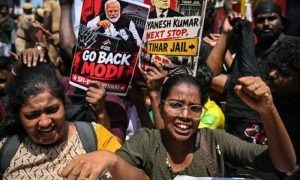
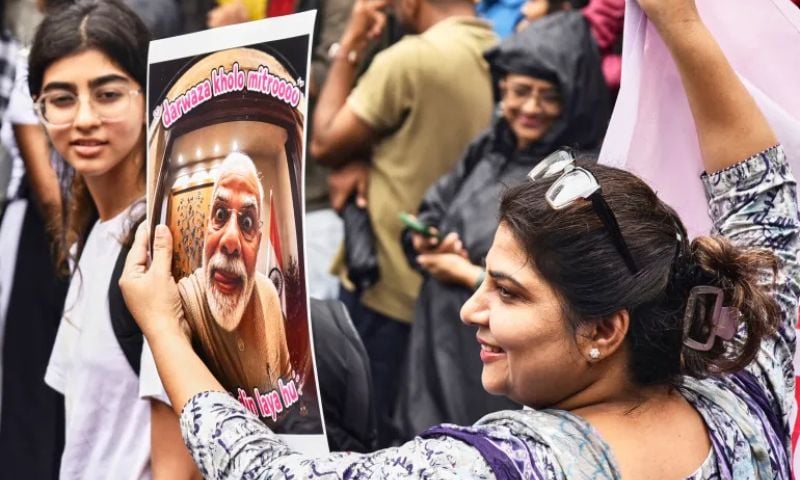
The protest site at Jantar Mantar looks like an Instagram feed come to life: posters, graffiti, and young people filming every moment on their phones. Protesters have turned humor into a form of resistance, creating memes, dressing up as Marvel superheroes, and even playing Uno while sitting on police barricades.
“This government is leaking any responsibility towards the youth of this country,” Ipshita Gulyari, a 20-year-old protester, told journalists. Modi, she said, had messed with the “wrong generation”. “There is a lot of arrogance in him, and, you know, teenagers do not tolerate that, bro.”
For many young protesters, the protest became a space where they documented every unexpected moment. From dance videos filmed during tense moments to “Get Ready With Me” clips before heading out, Gen Z protesters brought the language of social media into the streets. What traditionally would have been captured through news cameras was being recorded through front cameras, trending audios and quick-cut Instagram reels.
One particularly viral moment showed a woman from Mumbai standing in front of a police vehicle and placing her hand on it while asking for detained protesters to be released.
The result was a new kind of protest documentation: part activism, part personal storytelling, and part internet culture. Unlike earlier movements where participation often ended once people left the protest site, Gen Z protesters carried the experience back online. Every slogan, confrontation, joke, outfit choice and emotional moment became a potential reel.
The CJP demonstrations showed that for Gen Z, protests are no longer happening in only one place. They exist simultaneously on streets and screens, where every moment can become a story, a debate, or a viral video within minutes.
“Gen Z is taking it lightly, being funny about it, because humour is our coping mechanism,” said 18-year-old Yashvi Kumar, a friend of Gulyari at the protest. “In the middle of all chaos, somewhere we decided that to rebel, we need to find a way that unites us. The memes are uniting us.”
Today’s victory is a powerful testament to the extraordinary foresight of Dr. B.R. Ambedkar and the framers of our Constitution.
Decades ago, Babasaheb envisioned a nation where power flowed directly from the people, and he engineered the framework to make that possible. Jai… pic.twitter.com/AMC54ku05r
— Cockroach is Back (@Cockroachisback) July 25, 2026
Flipping the game: Social media as resistance
Twelve years ago, Modi was among the first world leaders to leverage social media to reach the masses. Today, Gen Z is flipping his Hindu majoritarian party’s dominance on social platforms, weaponising against it the very tools the Bharatiya Janata Party has long relied on.
Mainstream television news channels friendly to Modi have faced accusations of not covering the protests adequately. But young people increasingly rely on independent small publications, and, even more, on social media.
The most remarkable turnaround, according to analysts, has been the unmasking of critics at the protest, where demonstrators ridicule and mock Modi, erasing the fear. Cultural critic Anurag Minus Verma argued that the Modi government had crushed and criminalised protests by labelling them anti-nationals and breaking them into sections. “The Gen Z protesters already identify themselves ridiculously enough: they are cockroaches,” he said. “It becomes a single identity, and that becomes easier to penetrate the virality zone.”
Modi, in a tacit acknowledgement of the power of the social media wave that’s against his government, on Thursday morning offered his first comments on the student protests, on X. “Nothing is more important than the welfare and future of our youth!” he wrote, before mentioning that his government had set up fast-track courts to punish those behind the paper leaks. But the CJP’s leader Abhijeet Dipke was quick with his riposte on X. Playing on Modi’s own words, overlaid on a photo of Education Minister Pradhan, Dipke wrote: “Hi, my name is Nothing”.
Read Also: Why India’s Cockroach Party Worries Modi?
Exposing the cracks in Modi’s governance narrative
For 12 years, the Modi government has cultivated an image of a “rising India”, a nation of aspirational youth, economic growth, and strong governance. The CJP protests have peeled back this veneer, revealing deep contradictions between rhetoric and reality.
The education-priority paradox: A viral social media post during the protests highlighted that while the government scrapped the National Talent Search Examination (NTSE) scholarships, which cost less than INR 40 crore annually, it spent INR 62 crore over three years on “Pariksha Pe Charcha,” a PR event where PM Modi gives exam tips. Critics questioned why a government would prioritise personal branding over nurturing young talent. As one social media user put it: “Education empowers, PR campaigns distract”.
The authoritarian response to dissent: The CJP’s X account was blocked in India, and its website restricted. Government ministers accused the movement of being part of an “anti-India gang” and seeking followers from Pakistan. Dipke received death threats on WhatsApp, and his family’s safety became a concern.
When activist Sonam Wangchuk launched a hunger strike in support of the CJP’s demands, police forcibly removed him from the protest site after three weeks and hospitalised him, sparking further outrage. Critics argue that labeling a satirical youth movement as a “national security threat” only validated the protesters’ grievances about government overreach.
The failure of the demographic dividend promise: India has the world’s largest youth population, with an estimated 65% of its 1.42 billion people under 35. But as the Azim Premji University’s 2026 employment report showed, nearly 40% of university graduates aged 15-29 are unemployed.
Meanwhile, competition for government jobs has become absurd: between 2014 and 2022, 220 million people applied for federal government positions, but only 722,000 were hired, a selection rate of just 0.3%.
As political activist Yogendra Yadav observed: “If all was well with the country and the economy, 20 million young people would not rally around something like this. This is a critical moment that tells us something about the state of our polity: underlying all the claims of total dominance, there is a latent but widespread disquiet”.
ALWAYS REMEMBER! 🇮🇳💪🏻 pic.twitter.com/pnN1M7ot2Q
— Cockroach is Back (@Cockroachisback) July 25, 2026
The Hindutva ideology under scrutiny
The movement has also exposed the fault lines in the ruling establishment’s ideological positioning. For years, the Modi government has framed itself as the guardian of Hindu cultural nationalism, or Hindutva, while simultaneously projecting a pro-youth, aspirational image.
The CJP protests have peeled back this veneer, revealing the deep contradictions between the government’s rhetoric and its governance record.
The education system, once touted as a pillar of India’s global ambitions, now stands exposed as a crumbling edifice plagued by paper leaks, procedural failures, and systemic neglect. The government’s response, first dismissing the protests as the work of “anti-national forces,” then resorting to police brutality, and finally engaging in reluctant negotiations, has laid bare its authoritarian instincts.
The use of the term “cockroach” itself, first deployed by the Chief Justice of India to dismiss unemployed youth, was reclaimed by the protesters as a symbol of resilience and defiance. It became a powerful counter-narrative to the government’s attempts to delegitimise dissent. The Gen Z protesters, by identifying themselves as “cockroaches,” have rendered the government’s labels meaningless, turning the insult into a badge of honour.
Critics argue that the Modi government’s Hindutva agenda has always been about cultural symbolism rather than substantive welfare. While the government has invested heavily in building temples, renaming cities, and rewriting history textbooks, it has systematically underfunded education, healthcare, and employment generation.
The CJP protests have brought this contradiction into sharp focus: a government that claims to represent Hindu civilisation values has failed the very youth who are its future.
Read Also: Watch: India Crowds Swell as CJP Vows to Continue Protests Until Demands Met
The Congress factor and political realignments
The surge in protest numbers forced the government to engage with the movement after weeks of dismissing it. Alongside the police action, senior ministers opened talks with CJP leaders.
Home Minister Amit Shah met cabinet colleagues while Health Minister J P Nadda held discussions with representatives of the movement. The movement received a boost when leaders of India’s main opposition Congress party protested outside the prime minister’s residence. As during the farmers’ protests, leftist parties and student organisations have become visible on the ground, helping mobilize supporters and giving the movement organizational backing.
“After 50 years, youth have occupied the road to parliament,” political activist Yogendra Yadav told journalists. “This energy by the students shows that the path to parliament goes through the streets. It is remarkable.”
However, the CJP has maintained that its agitation will continue until all demands are met. “No point in talks if Dharmendra Pradhan doesn’t resign,” CJP spokesperson Ashutosh Ranka stated, reiterating that the resignation remains the group’s key demand. The party has rejected government invitations for talks at official residences, insisting that discussions should be held at Jantar Mantar. “The people’s court is here. Ministers should come among the people,” CJP chief spokesperson Saurav Das said.
Read Also: India Government, ‘Cockroach’ Protest Leaders to Resume Talks After Friday Deadlock
Police brutality and the backlash
The march to the Indian parliament on July 20 against serial examination paper leaks brought the nation’s capital to a standstill as tens of thousands of protesters occupied central roads leading to the country’s corridors of power. More than 100 students were injured in a crackdown by police, operating under the direct instructions of Prime Minister Narendra Modi’s government.
After the July 20 demonstrations, the police denied all the protesters’ allegations and media reports of excess force in the crackdown. But by then, social media was flooded with evidence, recorded by the protesting students. No sight escapes the cameras at the Jantar Mantar protest strip, where thousands of protesters keep recording round the clock. The visuals from July 20 have prompted protests across India, in cities like Mumbai, Bengaluru, Patna, Lucknow and Aizawl.
This week’s clashes have done little to quell the anger among India’s Gen Z. “Like many young people across India, I am angry about a lack of jobs and an education system that crushes my aspirations. Even though my family supports the BJP, I managed to get away,” Rukmini Singh, a student from Meerut, told journalists. “This was an attack against our children. I saw many young boys and girls hurt and bleeding. They will never forget it but the courage these people displayed gives me hope,” Vasundara Singh, a teacher from Bihar, told journalists.
— Cockroach is Back (@Cockroachisback) July 25, 2026
The road ahead: A long struggle
With Pradhan’s resignation, the CJP has won its first battle. But the war is far from over. The movement’s remaining demands, compensation for the families of students who died by suicide and action against those responsible for the paper leaks, remain unfulfilled.
As CJP chief spokesperson Saurav Das stated: “This is a long fight. We will have to engage in a very long struggle for this. Because you have to change an entire system, the nexus of that system is very deep-rooted”.
The protests at Jantar Mantar have also exposed deeper structural issues, the privatization of education, the commodification of aspirations, and the hollowing out of the state’s welfare obligations.
Read Also: Modi Faces Mounting Pressure as Student Protests Spread Across India
Critics argue that merely changing a minister will not solve the systemic crisis of an education system that breeds insecurity and despair. As Hotmail co-founder Sabeer Bhatia noted: “The Cockroach Party may have expressed the discontent of millions of unemployed youth, but can making a minister resign solve the unemployment problem? I don’t think so. True change must start from the root of the problem, not just finding a scapegoat”.
For now, the CJP has achieved something remarkable: it has transformed satire into sustained street mobilization, forced the government into talks, and ensured that the concerns of India’s young people remain firmly in the national spotlight.
Whether this movement can sustain its momentum, build a credible organisational structure, and translate online outrage into lasting political change remains to be seen. But as the cockroach, a resilient creature that survives against all odds, the Indian youth have made it clear that they will not be silenced.