NEW DELHI: Indian youth protests over examination paper leaks and irregularities continue to pile pressure on the Modi government, with demonstrators maintaining their demand for Education Minister Dharmendra Pradhan’s resignation despite activist Sonam Wangchuk ending his 26-day hunger strike on Friday.
The protesters have refused to end their campaign despite government outreach. The youth-led movement, organised under the banner of the self-styled Cockroach Janta Party (CJP), has emerged as one of the biggest challenges faced by Prime Minister Narendra Modi’s government since it came to power in 2014.
Meanwhile, leaders of the “cockroach” movement said on Friday that the government has asked for time until Saturday afternoon to respond to their demand for the education minister’s resignation, following talks between the two sides.
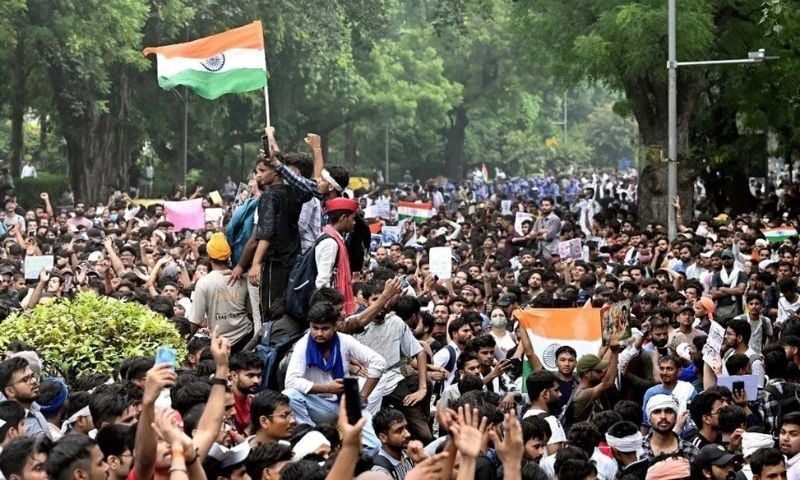
The talks came hours after activist Sonam Wangchuk ended his 26-day hunger strike, raising hopes that the two sides could reach a breakthrough after tens of thousands of angry youth converged in the capital Delhi, to demand the minister’s resignation over exam paper leaks.
Protesters accuse the government of failing to prevent leaks in competitive examinations, including medical entrance tests that affected millions of students and sparked widespread anger among young people seeking education and employment opportunities.
Wangchuk ended his hunger strike on Friday after appeals from lawmakers and discussions with government representatives. In a statement on social media platform X, the 59-year-old activist said he broke his fast in view of concerns over possible violence and after lengthy discussions on various conditions. However, CJP leaders said the end of Wangchuk’s fast would not bring an end to the protests.
Just now in the presence of Union Ministers Sh. JP Nadda, Dr. Jitendra Singh and the senior leaders of Apex Body of Leh Ladakh I finally broke my fast after 26 days. Earlier 65 members of parliament from different political parties had visited or signed letters urging me to break… pic.twitter.com/RFCet7Oksy
— Sonam Wangchuk (@Wangchuk66) July 23, 2026
CJP founder Abhijeet Dipke praised Wangchuk’s “courage and sacrifice” and said the demonstrations would continue until Education Minister Dharmendra Pradhan steps down. “We will not allow Sonam sir’s sacrifice to go in vain,” Dipke said in a video message.
Government offers reforms, protesters remain unconvinced
Prime Minister Narendra Modi has promised tougher action against those involved in examination fraud, including the creation of special courts to deal with paper leak cases.
Modi said the government was committed to protecting the future of young Indians and announced that stricter measures would be discussed at a cabinet meeting.
However, protesters rejected the proposal, arguing that punishment after leaks occur does not address the root causes behind repeated failures in the examination system.
CJP spokesperson Ashutosh Ranka questioned why paper leaks continue despite existing laws and enforcement mechanisms, saying students were demanding accountability and long-term reforms rather than temporary measures.
Protests spread across India
The movement has expanded beyond New Delhi, with demonstrations reported in cities including Ranchi, Pune, Thiruvananthapuram and Kolkata.
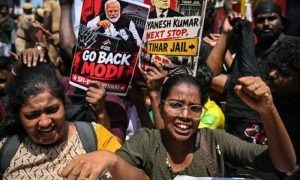
Thousands of protesters gathered at Delhi’s Jantar Mantar, carrying anti-government posters and raising slogans against failures in the education system.
The protests intensified after clashes between demonstrators and police during a march towards Parliament earlier in the week. Police used tear gas and batons to disperse crowds, while protesters accused authorities of excessive force.
Authorities later shut down 16 metro stations in central Delhi and restricted mobile internet services in protest-hit areas, affecting commuters, businesses and digital payments.
Opposition backs student movement
Opposition political parties have supported the protesters’ demands and criticised the Modi government’s handling of the crisis. The issue has also disrupted proceedings during Parliament’s monsoon session.
The protests have become a wider expression of frustration among almost all sections of India’s youth over examination pressures, limited job opportunities and concerns about institutional accountability.
Bollywood stars express support
Several leading Bollywood actors, including Salman Khan, Alia Bhatt and Kareena Kapoor, voiced support for the young protesters on social media, praising students for uniting over what they described as an important cause.
The CJP movement, which initially began as an online satire campaign involving a small number of young people, has rapidly grown into a nationwide youth protest movement.
With demonstrators refusing to withdraw their demands and the government attempting to open dialogue, the protests are becoming a significant political challenge for Modi’s administration and a major test of its response to growing youth dissatisfaction.
Growing challenge for Modi
The examination scandals have fuelled broader frustration among young Indians over unemployment and repeated allegations of examination paper leaks.
Analysts say the protests have also provided India’s fragmented opposition with a rare opportunity to challenge Modi’s BJP, which continues to rely heavily on support from younger voters despite losing its outright parliamentary majority in the 2024 general election.
“Student-led protests … risk spiralling into a larger political and social challenge for the Modi government, as it has touched a raw nerve among a young, growing workforce that is struggling to find jobs,” Shumita Deveshwar, chief India economist at consultancy TS Lombard, said.