

KEY POINTS
- Offline apps can relay messages between nearby smartphones without mobile data
- Bitchat drew attention during Cockroach protests in New Delhi in July
- Modi govt restrictions pose challenges for decentralised messaging tools
ISLAMABAD: Young protesters in India are turning to offline messaging applications and Bluetooth-based technology to communicate when authorities suspend mobile internet services, seeking ways to stay in touch without relying on conventional online platforms.
Bitchat, a peer-to-peer messaging application developed by Twitter co-founder Jack Dorsey, attracted attention during youth-led demonstrations at New Delhi’s Jantar Mantar in July 2026.
Protesters reportedly used the application to maintain contact amid connectivity disruptions, highlighting the potential of technology that does not depend on mobile data or centralised servers.
The issue resurfaced on October 2, when Prime Minister Narendra Modi’s government ordered a 12-hour suspension of mobile internet services within a 1.5-kilometre radius of Jantar Mantar, the popular protest site in New Delhi.
The restrictions coincided with demonstrations demanding the resignation of Chief Election Commissioner Gyanesh Kumar over irregularities in the revision of electoral rolls to benefit Modi’s ruling Bharatiya Janata Party (BJP).
The shutdown underscored a challenge for the youth protesters: how to coordinate meetings, exchange information, and remain connected when conventional digital communication channels are disrupted.

How offline messaging works
Unlike conventional messaging platforms that depend on internet connectivity, some applications allow smartphones to exchange messages directly over Bluetooth or Wi-Fi.
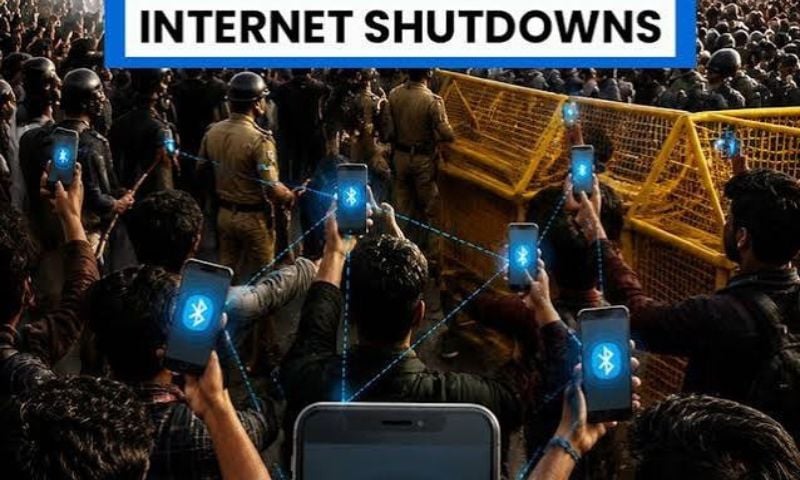
Bitchat uses Bluetooth Low Energy (BLE), a technology designed for short-range wireless communication. Compatible devices can connect with nearby phones, with messages relayed between participating devices to extend their reach beyond the sender’s immediate range.
This approach, known as mesh networking, can allow messages to travel across a chain of connected smartphones without requiring mobile data or a central server.
The more participating devices available within communication range, the greater the potential for messages to reach users farther away.
During the July demonstrations, protesters reportedly used Bitchat amid mobile internet disruptions.
Other applications, including Bridgefy and Briar, offer offline or decentralised communication features, although their technologies, operating requirements and security protections differ.
The technology has important limitations. Messages can travel only as far as the available network of participating devices allows, and communication may become unreliable when users are too far apart, or too few phones are available to relay messages.
Offline messaging also cannot restore access to websites, social media platforms or other online services that require an internet connection. Nor does it guarantee that every message will reach its intended recipient.

Sharing apps without internet access
Installing an offline messaging application can become difficult once an internet shutdown is in force, particularly for protesters who have not downloaded it beforehand.
In July, India Today reported on a Bitchat feature that enabled Android users to share the application directly between phones. Such phone-to-phone transfers can allow users to obtain compatible software without accessing an app store or downloading it over the internet.
However, successful installation depends on device compatibility, the software version and access to a legitimate copy. Obtaining applications outside official distribution channels can also expose users to malicious or modified software.
The technology has attracted government scrutiny. In July, Indian authorities directed GitHub to restrict access to repositories hosting Bitchat’s source code, according to media reports.
The restrictions raised questions about the availability of decentralised communication tools and official concerns about their potential misuse.
In October, Bitchat faced renewed scrutiny following reports that it had been removed from official app stores in India.
Dorsey said the Indian government had ordered its removal, drawing further attention to the challenges facing applications designed to operate outside conventional digital infrastructure.
Removing an application from an official store does not automatically disable copies already installed on smartphones. It can, however, make the software harder for new users to obtain, particularly if alternative distribution channels are also restricted.
What offline tools can and cannot do
Offline messaging can help protesters exchange local messages, share basic information and arrange meeting points when mobile internet access is unavailable.
Its usefulness, however, depends on the circumstances of a shutdown and the availability of alternative communication channels.
Suspending mobile internet services does not necessarily disable every form of communication. Voice calls, conventional text messages and Wi-Fi may be affected differently, depending on the restrictions imposed by authorities.
Security is another consideration. Users should not assume that all offline messaging applications provide equivalent encryption, anonymity or protection against surveillance. The security of a particular service depends on its design, implementation and configuration.
Mesh networks also face practical constraints in large or dispersed crowds. Physical distance, the number of participating devices, phone settings and network congestion can affect whether messages are delivered promptly.
Reports have documented interest in Bitchat during India’s July protests and subsequent restrictions affecting its distribution.
The growing interest in offline communication illustrates how protesters are adapting to internet restrictions.