Key Points
- Pakistan strive to replace costly borrowing without increasing its external debt stock
- The government cites stronger remittances, improved reserves and sustained primary budget surpluses
- Islamabad reaffirms its commitment to IMF-backed reforms and economic stability.
ISLAMABAD: Pakistan is pursuing cheaper international financing by diversifying funding sources and replacing costly borrowing without adding to its external debt stock.
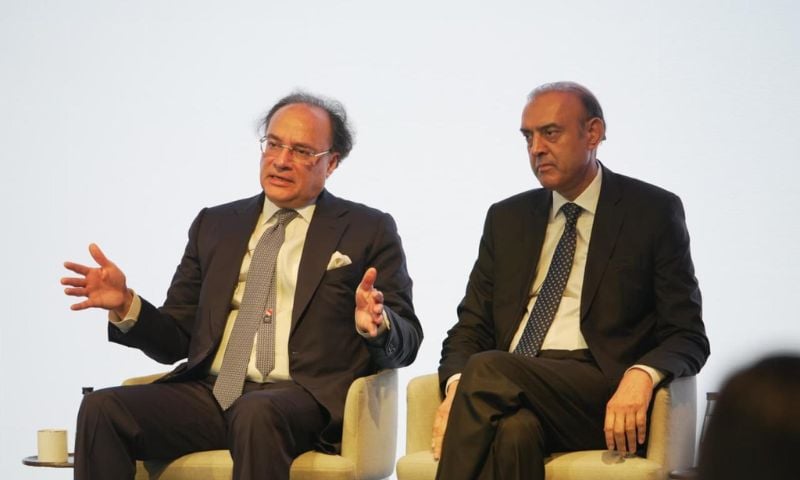
The country’s economy is graduating from stabilisation to export-led inclusive growth anchored in investment, Finance Minister Muhammad Aurangzeb said at a JP Morgan investment seminar in Bangkok on Wednesday.
Aurangzeb outlined the government’s strategy for sustaining macroeconomic stability, consolidating public finances and reducing financing pressures at the seminar, titled “Pakistan: The Road to Resilience in a Turbulent Global Economy Landscape.”
It was held on the sidelines of the World Bank Group–International Monetary Fund (IMF) Annual Meetings 2026.
He highlighted progress in revenue mobilisation, fiscal consolidation and primary budget surpluses. He also mentioned strong remittance inflows, improved foreign exchange reserves and a contained current account deficit.
He also referred to external debt repayments as part of the country’s financial position.
The finance minister reaffirmed Pakistan’s commitment to its IMF programme and continued structural reforms. He stressed the importance of prudent monetary policy to contain inflation and preserve the gains made in economic stabilisation.
Financing and fiscal reforms
Diversifying international financing is central to the government’s effort to manage borrowing costs and external payment obligations.
Replacing expensive financing with cheaper alternatives could reduce debt servicing, provided the new arrangements offer more favourable terms and do not add to the external debt stock.
READ ALSO: Pakistan Eyes Digital Finance Revolution, Seeks Global Investment at IMF-World Bank Meetings
Pakistan continues to face the challenge of meeting external financing requirements while maintaining adequate foreign exchange reserves.
Lower financing costs could ease pressure on public finances and the balance of payments, although the outcome will depend on the availability, terms and scale of alternative funding.
Aurangzeb also stressed the need for targeted support for vulnerable households, careful energy procurement and sustainable, export-led economic growth.
The emphasis on exports reflects the need to strengthen foreign exchange earnings and reduce reliance on external borrowing to meet the country’s import. Improved export performance could also help make economic growth more sustainable over the longer term.
Federal-provincial coordination
The seminar also covered fiscal coordination between the federal and provincial governments, as well as efforts to strengthen trade and investment partnerships.
Better coordination on public finances is important for improving revenue collection, managing expenditure and sustaining fiscal discipline.
Stronger trade and investment links could help attract capital, expand export opportunities and support private-sector activity.
The government’s strategy combines fiscal consolidation, structural reforms and prudent monetary management with measures to protect vulnerable households from the effects of economic adjustment.
Pakistan is striving to preserve recent stabilisation gains while reducing exposure to external shocks, including volatile energy prices and tighter global financing conditions.
The upfront challenge is to translate improved macroeconomic indicators into sustained investment, higher exports and durable economic growth.
Pakistan’s economy is showing signs of a gradual recovery after a prolonged period of macroeconomic instability.
Economic growth is now gaining momentum as inflation eases, fiscal discipline improves, and external pressures become more manageable.
Remittance inflows, improved foreign exchange reserves, greater confidence in financial stability, and continued efforts to attract investment have supported economic activity.
The government is also focusing on expanding exports, mobilising domestic revenue and advancing structural reforms under its International Monetary Fund programme.
However, sustaining the recovery will depend on higher private investment, industrial expansion, productivity gains and job creation.
A durable revival requires growth that generates exports, employment and rising household incomes.