
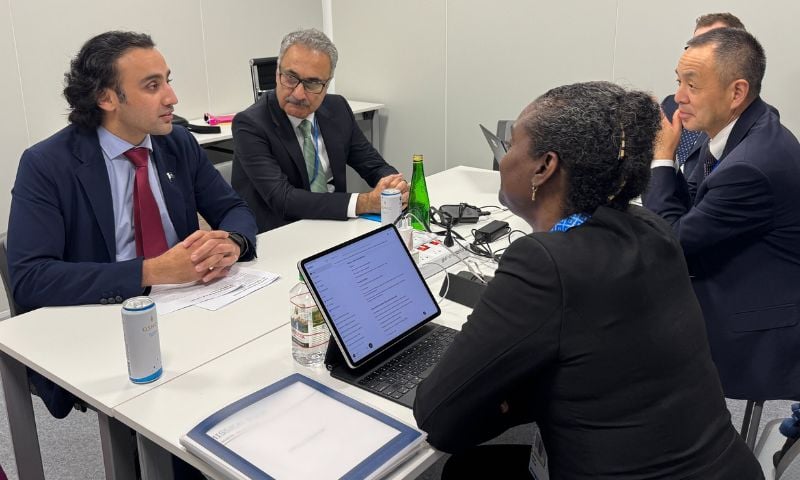
BANGKOK, Thailand: Pakistan has stepped up efforts to modernise its financial infrastructure and attract international investment, as Minister of State and Pakistan Virtual Assets Regulatory Authority (PVARA) Chairman Bilal Bin Saqib held high-level meetings with senior World Bank Group officials and international financial stakeholders on the sidelines of the 2026 IMF-World Bank Group Annual Meetings in Bangkok, Thailand.
Building stronger institutions for the future of digital finance.
In Bangkok, Minister of State and PVARA Chairman Bilal Bin Saqib met Zinga Venner, Vice President and World Bank Group Controller; Junxue Chu, Director, Trust Funds and Loan Operations; and Thomas Puschnik, Solutions and Transformation Manager, WBG Controllers.
Discussions explored blockchain-based financial transparency, AI-enabled supervision and strengthening Pakistan’s digital asset regulatory infrastructure.
@WorldBankGroup | @Bilalbinsaqib
— Pakistan Virtual Assets Regulatory Authority (@PakistanVARA) October 14, 2026
The discussions focused on emerging financial technologies, including digital capital markets, asset tokenisation, artificial intelligence (AI), cross-border payments and technology-driven regulatory oversight, with an emphasis on expanding financing opportunities for Pakistan’s public and private sectors.
During a meeting with Imad N. Fakhoury, Regional Vice President for the Middle East and Central Asia at the International Finance Corporation (IFC), the World Bank Group’s private-sector investment arm, the two sides discussed potential cooperation on tokenised bonds and sukuk, digital financial infrastructure, cross-border payments and the mobilisation of international private capital.
The engagement explored how emerging financial technologies could help Pakistan attract investment, deepen its capital markets and develop new financing channels for businesses and public-sector projects.
Talks focus on digital bonds, AI and regulatory capacity
Bilal Bin Saqib also met Jorge Familiar, Vice President and Treasurer of the World Bank Group, to explore potential cooperation on digital bond issuance, asset tokenisation and the application of AI to financial operations.
In a separate meeting, the PVARA chairman held discussions with Sangbu Kim, World Bank Group Vice President for Digital and AI, alongside Jonathan Gen Nagao, Director for Data and AI, and Ozan Sevimli, Acting Director of Strategy and Operations.
The discussions examined how artificial intelligence could strengthen financial regulation, improve supervisory capabilities and enhance institutional expertise in overseeing digital assets. Participants also explored asset tokenisation and opportunities to draw on international technical expertise to strengthen Pakistan’s regulatory infrastructure and accelerate the development of its digital economy.
Further discussions took place with Zinga Venner, World Bank Group Vice President and Controller, alongside Junxue Chu, Director of Trust Funds and Loan Operations, and Thomas Puschnik, Solutions and Transformation Manager.
The meeting focused on the potential of blockchain-based systems to improve financial transparency, AI-powered regulatory supervision and the technological and institutional foundations needed to support Pakistan’s emerging digital asset regulatory framework.
Read Also: Pakistan’s Parliament Passes Virtual Assets Act 2026
Pakistan seeks to mobilise international private capital
The engagements also included a roundtable with international investors to discuss Pakistan’s macroeconomic conditions, structural reforms, investment opportunities and renewed engagement with international capital markets.
The discussions reflected Pakistan’s ambition to move beyond establishing a regulatory framework for virtual assets and explore the financial infrastructure, institutional partnerships and technological capabilities needed to participate in the evolving global digital economy.
Read Also: Pakistan to Regulate Digital Assets for Growth in Digital Economy
Commenting on the engagements, Bilal Bin Saqib said Pakistan needed to move beyond adopting emerging financial technologies and focus on building institutions capable of shaping the future of finance.
He said the country aimed to unlock international investment, strengthen financial transparency and create economic opportunities through tokenised capital markets, more efficient cross-border payments and AI-powered regulation.
“The next chapter of Pakistan’s economic transformation must be driven by innovation, backed by credible institutions and anchored in financial stability,” he said.
Read Also: Pakistan Ranks Third In Global Crypto Market
PVARA is exploring how responsible financial innovation could support Pakistan’s economic development priorities through discussions on sovereign debt tokenisation, digital capital markets, AI-powered supervision and international private capital mobilisation.
The engagements also highlighted the importance of credible institutions, effective regulatory safeguards and investor confidence in ensuring that financial innovation contributes to stability and sustainable economic growth.
Pakistan’s emerging digital finance agenda aims to explore how new technologies can be used responsibly to attract investment, modernise financial markets and expand economic opportunities.