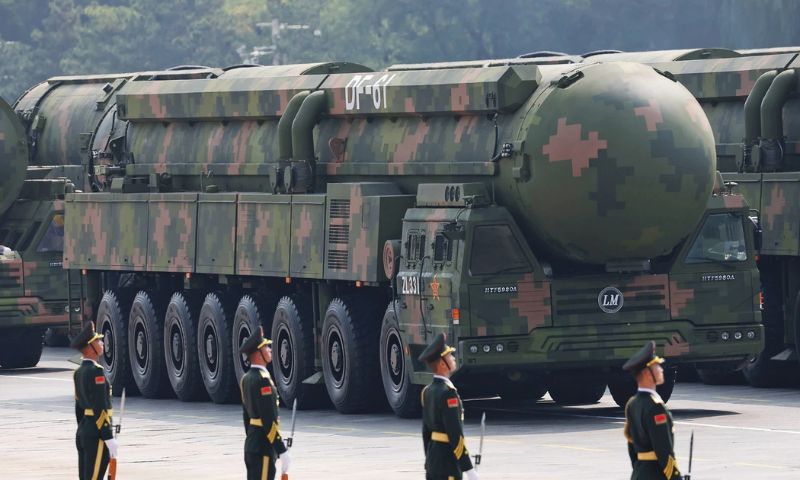
GENEVA: The United States on Monday accused China of rapidly expanding its nuclear arsenal and conducting low-yield nuclear tests, urging Beijing to participate in any future arms control agreements.
The warning came as the New START treaty between the US and Russia expired earlier this month, leaving no binding limits on the world’s largest nuclear arsenals.
Christopher Yeaw, US Assistant Secretary of State for Arms Control and Nonproliferation, addressed the Conference on Disarmament (CD) in Geneva, describing the expired treaty as “seriously flawed” for failing to account for China’s nuclear build-up.
“Perhaps its greatest flaw was that New START did not account for the unprecedented, deliberate, rapid and opaque nuclear weapons build-up by China,” Yeaw said.
“Despite its claims to the contrary, China has deliberately and without constraint, massively expanded its nuclear arsenal without transparency or any indication of intent or end point. We believe China may achieve parity within the next four or five years.”
New START treaty expiration
Signed nearly 16 years ago, New START limited the US and Russia to 1,550 deployed nuclear warheads each.
Both countries currently possess more than 5,000 nuclear weapons, according to the Nobel Peace Prize-winning campaign group ICAN.
Yeaw said the treaty’s numerical limits were “no longer relevant,” citing Russia’s alleged violations and its role in helping China expand its nuclear capacity.
He welcomed the expiration as a “fortuitous time” for the United States to pursue a “better agreement” that could include China.
“The treaty’s expiration and the absence of any nuclear arms control treaty right now does not mean the United States is walking away from or ignoring arms control. Quite the opposite is true,” Yeaw said.
“Our goal is a better agreement toward a world with fewer nuclear weapons.”
Accusations of China’s nuclear testing
The US official doubled down on claims that China conducted a low-yield nuclear test on June 22, 2020.
Data from a seismic monitoring station in Kazakhstan detected a 2.75-magnitude underground explosion near China’s Lop Nur test site at 0918 GMT, Yeaw claimed.
“It was a probable explosion. Based on comparisons between historic explosions and earthquakes, the seismic signals were indicative of a single fire explosion, not typical of mining explosions,” Yeaw said.
Yeaw estimated the yield of the blast at 10 tonnes of TNT equivalent, or five tonnes conventional equivalent, assuming ideal conditions for a fully coupled underground detonation.
However, in a recent report, the Center for Strategic and International Studies did not find conclusive evidence of an explosion, saying satellite imagery did not show unusual activity at Lop Nur, China’s historic testing site in the western region of Xinjiang.
China has denied the allegations, calling them “outright lies” and a pretext for the United States to resume nuclear testing. The US has not conducted a nuclear test since 1992.
Calls for multilateral arms control
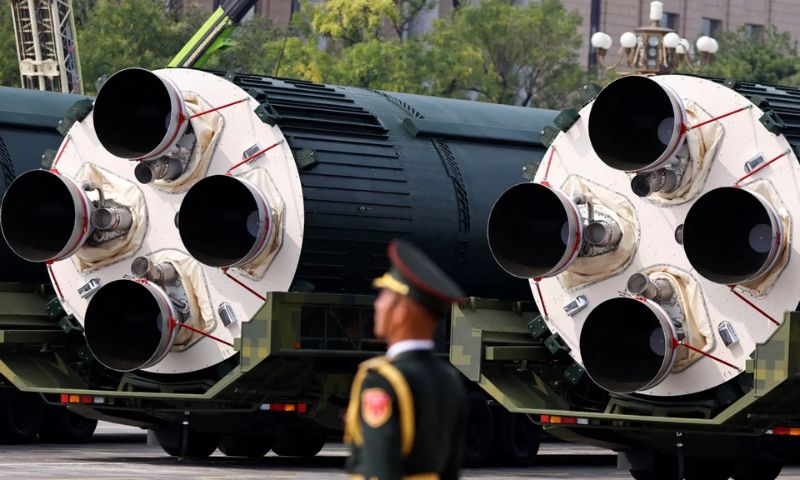
Yeaw emphasised the need to include China in future arms control discussions.
He noted that while past treaties focused on bilateral US-Russia limits, China’s rapid nuclear expansion requires a multilateral approach to prevent a renewed arms race.
“President Trump has made it clear that other countries have a responsibility to ensure strategic stability, none more so than China,” Yeaw said.
He urged other nuclear-armed states to engage in dialogue on strategic stability and arms control.
The US assistant secretary also criticised China’s alleged “lack of transparency” regarding its nuclear testing activities, citing delays in certifying seismic monitoring stations and restrictions on their placement near the Lop Nur site.
ALSO READ: Russia and China Conducted No Secret Nuclear Tests: Kremlin
Yeaw questioned the credibility of China’s no-first-use policy and its claims of maintaining a “minimum deterrent,” arguing that Beijing’s nuclear expansion undermines global strategic stability.
He noted that China had around 200 nuclear weapons at the time of New START’s signing but is projected to have sufficient fissile material for over 1,000 warheads by 2030.
He also raised concerns over Russian alleged assistance to China’s CFR-600 reactor programme, which could provide highly enriched uranium for nuclear weapons development.
Yeaw framed the US accusations as part of a broader push for “modernised, multilateral strategic stability and arms control discussions.”