


Key Points
- Pakistan raises concerns over unilateral and illegal treaty suspension
- Gilani calls for adherence to water-sharing framework
- Pakistan-United States relations and regional peace reviewed
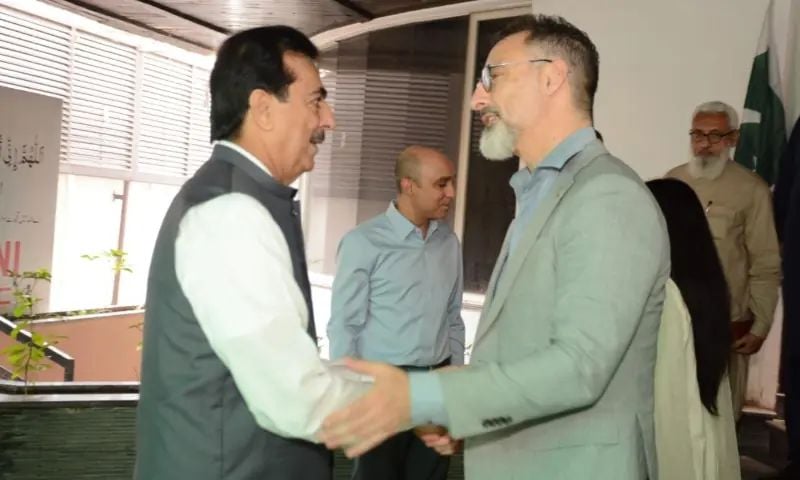
ISLAMABAD: Pakistan’s Senate Chairman Yousaf Raza Gilani has raised concerns over India’s illegal and unilateral breach of the Indus Waters Treaty during a meeting with US Consul General Stetson Sanders in Lahore.
He said the water-sharing formula under the treaty must be respected and urged adherence to international agreements governing transboundary rivers.
He warned that disruptions in established frameworks could affect regional stability and the livelihoods of millions dependent on the Indus basin system.
The Indus Waters Treaty, signed in 1960 with World Bank support, regulates the distribution of waters from the Indus River system between the two countries.
It assigns the eastern rivers primarily for use by India and the western rivers largely for Pakistan, and includes provisions for technical cooperation, data sharing, and dispute resolution.
Pakistan has in recent months stated that India’s unilateral and illegal holding “in abeyance ” of the treaty in 2025 has threatened the livelihood of millions dependent on the Indus waters.
Pakistan also declared water as its red line, saying tampering with river flows would be tantamount to an act of war. An international court of arbitration has also ruled in favour of Pakistan’s stance on the treaty.
Islamabad says India’s disregard for the treaty has affected established mechanisms of coordination and raised concerns over downstream flows and has sowed another seed of instability in the region.
Gilani said the international community should support full implementation of treaty obligations and uphold established international water governance principles.
During the meeting, discussions also covered Pakistan-United States relations, including trade, investment and regional security cooperation.
Gilani reaffirmed Pakistan’s commitment to strengthening ties with the United States, describing the relationship as an important part of its foreign policy.
He said Pakistan sought expanded cooperation in areas including information technology, energy, minerals, agriculture, health and education.
Gilani noted that the United States remained a key trading partner and major export destination for Pakistan.
Both sides also exchanged views on regional developments and stressed the importance of continued diplomatic engagement.
Gilani highlighted parliamentary exchanges and people-to-people contacts, including the role of the Pakistani diaspora and students in the United States in strengthening bilateral understanding.
He expressed confidence that Pakistan-United States relations would continue to grow through sustained engagement across multiple sectors.