CHAKWAL: Pakistan’s emerging olive oil industry is beginning to attract attention as the country looks for ways to reduce its heavy dependence on imported edible oil and position itself in a growing global market dominated by traditional Mediterranean producers.
Global demand for vegetable oils continues to rise, with the United States Department of Agriculture forecasting worldwide vegetable oil consumption at a record 238 million tonnes in 2026/27.
Market estimates also place the global edible oil industry at more than $250 billion, reflecting strong demand from households, food industries and health-conscious consumers.
For Pakistan, the issue is not only agricultural but also economic. The country remains one of the world’s major edible oil importers, relying heavily on palm oil, soybean oil and other vegetable oils to meet domestic demand.
Recent industry estimates suggest Pakistan’s edible oil imports reached around 3.4 to 3.5 million tonnes in 2025, while palm oil imports alone cost the country about $3.4 billion in FY25.
Climate-resilient agriculture
This dependence puts pressure on Pakistan’s foreign exchange reserves and widens the food import bill. Policymakers and private investors now see olive farming as one of several long-term options to reduce this burden, especially in areas where conventional crops are difficult to grow.
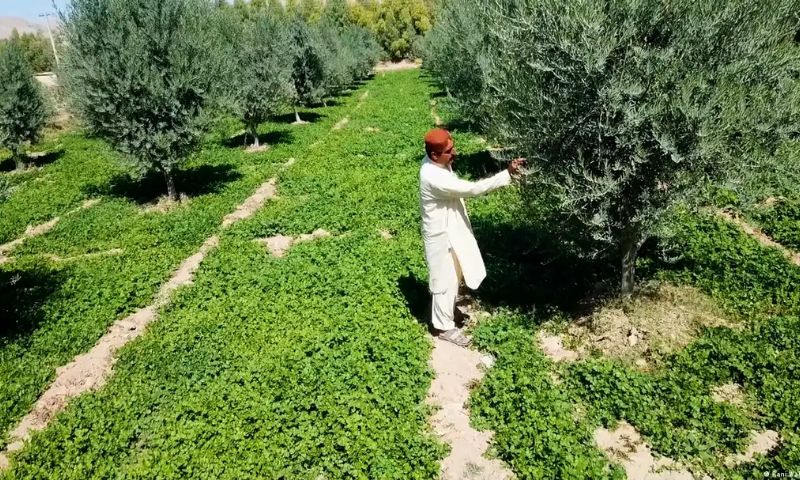
Located in the scenic Kallar Kahar region, Izhar Olive Farm reflects this changing agricultural ambition. Established in 2010 with olive saplings imported from Spain, the farm has grown into one of Asia’s largest olive plantations and has become a symbol of Pakistan’s potential in high-value, climate-resilient agriculture.
Olive trees are well suited to parts of Pakistan, particularly Potohar, Khyber Pakhtunkhwa and Balochistan, where climate and terrain support cultivation.
The Pakistan Business Council’s study on the sector notes that millions of hectares of underutilised land in the country could be suitable for olive farming.
The government has already supported olive cultivation through sapling distribution, technical training, processing facilities and drip irrigation support.
The long-term target of planting millions of olive trees on marginal lands is aimed at improving farmer incomes, creating rural jobs and reducing reliance on imported edible oils.
Made in Pakistan
At Izhar Olive Farm, harvesting is carried out through both handpicking and modern machines. The olives are collected, cleaned and processed through cold-press extraction systems.
After leaves are separated from the fruit, the olives are washed, crushed into pulp and processed through advanced machinery to produce extra virgin olive oil. The oil is then bottled and supplied across Pakistan under the “Made in Pakistan” label.
Experts say olive oil alone cannot immediately replace Pakistan’s mainstream cooking oils because local cuisine relies heavily on deep frying and high-temperature cooking.
Palm oil and other vegetable oils remain cheaper and more widely used. However, olive farming can still help Pakistan in three important ways.
Future export opportunities
First, it can replace a portion of imported premium olive oil currently consumed by restaurants, hotels and health-conscious urban consumers.
Second, it can support value-added products such as table olives, olive pickles, olive tea and cosmetic ingredients.
Third, it can create future export opportunities in markets where demand for natural and cold-pressed oils is rising.
The PBC report has also highlighted that Pakistan’s strategy must not focus only on planting more trees. It says the sector needs market research, quality certification, branding, private investment and export-focused processing if it wants to compete internationally.
Growing domestic awareness
Supporters of the industry believe Pakistan’s advantage lies in its large suitable land area, low-water crop potential and growing domestic awareness about healthier food choices. With proper planning, olive farming could become part of a wider solution to Pakistan’s edible oil challenge.
Spain, Italy and Greece may continue to dominate the global olive oil market, but Pakistan’s olive groves in Kallar Kahar, Potohar and Balochistan show that the country has entered the race.
The question now is whether Pakistan can turn this promising start into a sustainable, competitive and export-ready olive oil industry.