WASHINGTON: US President Donald Trump said on Thursday that Washington was not seeking talks with Iran and was instead focused on increasing economic pressure on Tehran, warning that countries doing business with the Islamic Republic could face penalties.
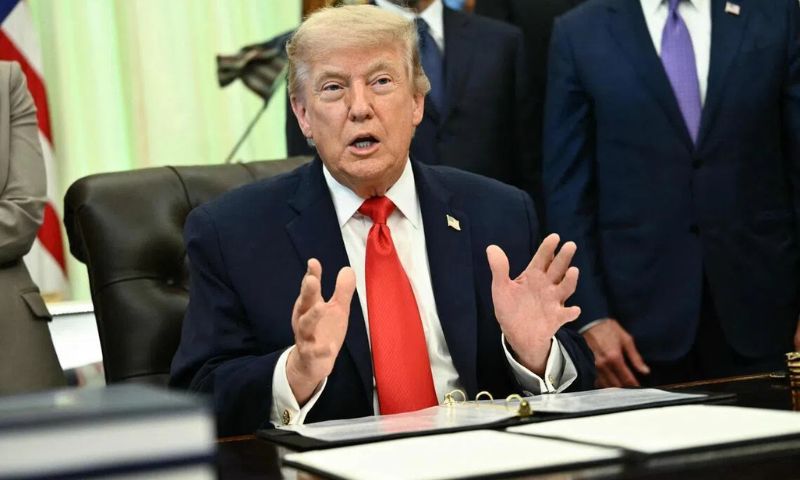
“We don’t want to speak to them. We’re not looking to meet or anything,” Trump told reporters in the Oval Office, as his administration stepped up its economic campaign against Iran.
White House Press Secretary Karoline Leavitt said earlier that no negotiations were currently taking place between Washington and Tehran and that the economic pressure campaign would continue until Iran was ready to negotiate meaningfully.
Economic pressure against Iran
“We have Operation Economic Outcast to destroy their economy,” Leavitt told Fox News programme “Fox & Friends”.
She said the United States had previously launched “Operation Epic Fury” against Iran’s military and was now pursuing economic measures against its economy.
“No negotiations are happening right now and this will continue until the president feels that maybe they come to the table in a meaningful way,” Leavitt said, adding that Trump “continues to retain all options on the table”.
The White House says the Iranian regime is already reeling, and President Trump is pulling “every economic lever” to increase the pressure.
Press Secretary Karoline Leavitt says inflation in Iran is above 100% and the regime is struggling to pay its police and military, while… pic.twitter.com/fPHmYI3MVK
— Fox News (@FoxNews) August 27, 2026
US Treasury Secretary Scott Bessent warned countries on Monday to cut their financial ties with Iran or face secondary sanctions under what the administration had called “Economic D-Day”. The Treasury Department, however, stopped short of imposing penalties at that stage.
Asked whether Russia would be punished for continuing to do business with Iran, Trump said it would depend on Moscow’s actions.
“So far, I think Russia’s behaved quite well, having to do with the Strait of Hormuz,” Trump said.
Trump:
So far, I think Russia has behaved quite well, having to do with the Strait of Hormuz.
For everything they do, we do also. pic.twitter.com/39ye0Igr6u
— Clash Report (@clashreport) August 27, 2026
The US President added that the United States also engaged in activities similar to those of other countries, including China.
Asked whether Chinese banks could face sanctions for doing business with Iran, Trump said he did not have to announce every action being considered by his administration.
Reporter: Why not sanction Chinese banks doing business with Iran?
Trump: Who said I’m not? You don’t know if I’m doing it. I don’t have to announce everything. pic.twitter.com/dxpp6krIqh
— Clash Report (@clashreport) August 27, 2026
Strait of Hormuz
Trump also addressed the Strait of Hormuz, a key global energy route that has become central to the dispute between Washington and Tehran.
Trump said the United States had cleared mines from the waterway and that the strait remained open. He also said vessels were moving through the waterway, while claiming that a US naval blockade meant that “nothing is going through it”.
The White House has described the United States as effectively controlling the strait and said it remains open because of US military action.
The waterway is a vital shipping route for global energy supplies, with about a fifth of the world’s oil historically passing through it.
Trump said Iran was under severe economic strain and repeated his claim that Tehran had limited capacity to pay its troops. “They’re in deep trouble, they have very little capacity,” he told reporters.
Qatar seeks diplomatic opening
Qatar’s prime minister visited Tehran on Thursday in an effort to revive diplomacy after Washington and Tehran exchanged accusations over the US campaign to increase economic pressure on Iran.
Iran and Qatar held talks on Thursday on efforts to de-escalate tensions and a proposed framework for reopening the Strait of Hormuz.
Qatar’s Prime Minister and Foreign Minister Sheikh Mohammed bin Abdulrahman Al Thani met Iranian Foreign Minister Abbas Araghchi in Tehran as part of intensified diplomatic efforts aimed at easing tensions and finding a way to reopen the vital waterway.
Also Read: Iran, Qatar Discuss Proposed Framework for Strait of Hormuz Reopening
Iranian state television confirmed the meeting between Al Thani and Araghchi but did not provide further details.
HE Prime Minister and Minister of Foreign Affairs Meets Iranian Consultative Assembly Speaker#QNA #Qatar ##Iran https://t.co/Ztrc0X0y70 pic.twitter.com/KroagHw9Hx
— Qatar News Agency (@QNAEnglish) August 27, 2026
Qatar’s Foreign Ministry said the two officials discussed de-escalation efforts and a proposed framework for the Strait of Hormuz being developed between Tehran and Muscat.
Al Thani stressed the importance of respecting the sovereignty of neighbouring states and ensuring freedom of navigation, while calling for continued dialogue, according to the ministry.
Qatar, alongside Pakistan, has played an important mediating role in previous efforts to ease tensions between Iran and the United States, helping secure an April ceasefire and a June agreement.
The Qatari PM’s visit comes after a week of diplomatic activity in Tehran, including separate meetings involving Oman’s top diplomat and Pakistan’s Chief of Defence Forces and Chief of Army Staff Field Marshal Syed Asim Munir and Interior Minister Mohsin Naqvi, as mediators seek to end the US-Iran conflict and restore freedom of navigation through the Strait of Hormuz.
Field Marshal Munir’s Iran visit
Earlier, Pakistan’s Foreign Office Spokesperson Tahir Andrabi, addressing a weekly press briefing in Islamabad, said that Chief of Defence Forces and Chief of Army Staff Field Marshal Syed Asim Munir’s recent visit to Tehran was part of Islamabad’s continuing diplomatic efforts to facilitate an end to the conflict and renewed efforts towards reopening the strategic Strait of Hormuz.
He said Pakistan remains engaged, alongside other brotherly states, in sincere efforts to resolve the crisis in the Gulf and the Middle East with respect to the standoff between Tehran and Washington.
Tahir Andarabi noted that the discussions held during CDF Munir’s visit to Tehran “focused on regional de-escalation, breaking the military stalemate and exploring a negotiated settlement to restore peace and stability”.
He said that the visit underscored Islamabad’s sincere and constructive role in bridging differences between Washington and Tehran. The Iranian leadership appreciated Pakistan’s efforts towards dialogue, de-escalation, and the peaceful resolution of the conflict.
Pakistan’s mediation efforts
Pakistan has been engaged with the leaderships of the US and Iran in efforts to broker peace between the two countries since their conflict broke out in February this year.
As a key mediator, Pakistan brokered the Islamabad memorandum of understanding between Tehran and Washington in June, aimed at ending hostilities and paving the way for further negotiations.
Also Read: UK Lauds Pakistan’s Role in Promoting Middle East Peace
After nearly six months of war since the US and Israel launched airstrikes against Iran on February 28, the sides are not firing at each other but also showing no sign of pursuing peace talks.
Oil shipments are at a virtual standstill in the Strait of Hormuz, with Tehran threatening to strike any unauthorised oil tankers that try to transit the vital waterway, and the country’s economy is already under immense pressure from sanctions.
Islamabad MoU framework for US-Iran talks
Tehran and Washington signed the Pakistan-brokered Islamabad MoU in June to halt fighting and start technical-level negotiations for a comprehensive agreement between the two countries.
Under the Islamabad MoU, the two countries committed to halt military operations, reopen the Strait of Hormuz to commercial shipping and negotiate a comprehensive agreement covering Iran’s nuclear programme, US sanctions and a permanent ceasefire within 60 days.
Since the war with the United States began on February 28, Tehran has maintained tight control over the Strait of Hormuz, a key global energy route, while Washington has imposed a naval counter-blockade on Iranian ports.
Iranian Vice President Mohammad Jafar Ghaempanah said on Wednesday that the blockade had prevented the country from importing enough petrol to make up for a shortfall in domestic production.
“Petrol production is insufficient, and because of the US naval blockade, we cannot import it,” he was quoted by the official IRNA news agency as saying.
As Washington intensifies economic pressure on Tehran, Iranian officials have dismissed the measures as ineffective and insisted they will not force the country to change its position.
“The country is in an all-out economic war,” Iran’s top negotiator Mohammad Bagher Ghalibaf said in a statement carried by local media.
“We will see that the government will defeat the enemy on this ground as well,” he added.