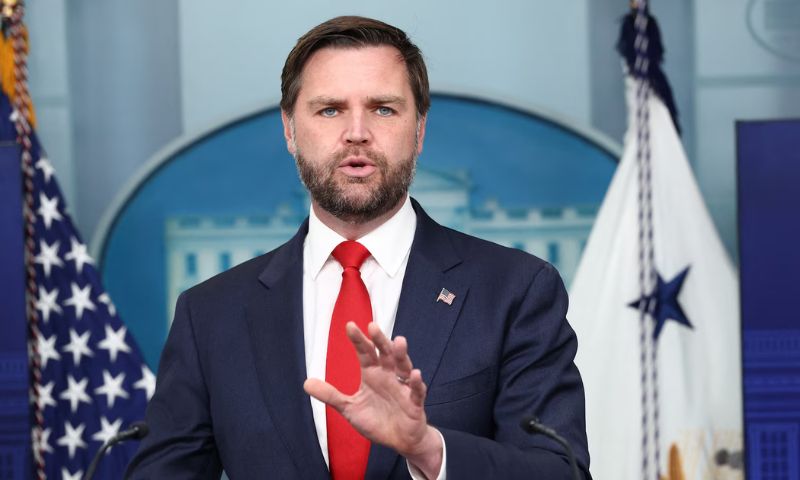
WASHINGTON: US Vice President JD Vance said on Wednesday that negotiations between the United States and Iran under the Pakistan-brokered Islamabad Memorandum of Understanding (MoU) were progressing “extremely well”, adding that Washington remained committed to reaching a negotiated agreement with Tehran.
Speaking after addressing US service members in Virginia, Vance said President Donald Trump’s instructions to the US negotiating team were clear. “The President’s instructions are clear: to press ahead to reach an agreement and to negotiate in good faith,” Vance said.
The US Vice President added that the United States saw “significant momentum amongst those within the Iranian regime who are seeking to turn a new page”.
In an interview with CNN, Vance said discussions in Doha were progressing positively and would soon move to Iran’s nuclear programme. “It’s still pretty early, but talks are going well,” he said.
“Right now, the technical negotiators are sitting down with the Iranians, with the Qataris, and with others in Doha, talking about some of the details here. We’re worried about the nuclear issue, and we’re going to start talking about that, so right now the talks are going well.”
Vance said that President Trump did not intend to restart military operations in Iran without a “clearly defined purpose”.
“What I can commit to is the president’s not going to send our military back in unless he has to,” Vance told reporters.
Iranian Deputy Foreign Minister Kazem Gharibabadi announced on Wednesday the conclusion of talks in Doha on implementing the Islamabad MoU between the US and Iran on ending the conflict, state-run IRNA news agency reported.
The participants agreed that “a communication channel would be established by tomorrow” to report and record violations of the Islamabad MoU, the IRNA state news agency quoted Gharibabadi as saying.
Meetings with Pakistani and Qatari mediators
Earlier, Iranian Deputy FM Gharibabadi said meetings in Doha were held in a trilateral format involving Iranian, Pakistani and Qatari delegations, Iran’s semi-official Mehr news agency reported.
Gharibabadi said the discussions focused on implementing the provisions of the Islamabad Memorandum of Understanding with the United States, particularly those relating to Lebanon and the release of Iran’s frozen assets.
Meanwhile, Iranian President Masoud Pezeshkian said that some financial and currency restrictions on the country had been eased, Iran’s semi-official Fars news agency reported.
Pezeshkian said continued oil exports, the easing of certain financial and foreign exchange restrictions, and new opportunities for economic cooperation were among the outcomes of Iran’s recent agreements.
Trump voices optimism
Earlier on Wednesday, President Donald Trump also expressed optimism about relations with Iran and the ongoing negotiations.
Speaking to reporters, Trump said Washington and Tehran were “getting along very well” and described the recent meetings in Qatar as productive.
“The denuclearisation of Iran is moving along well. They’ve had very good meetings, and we’ll see,” Trump said.
He added that Iran had “come a long way” in negotiations with Washington.
“We hit them very hard last week. I think they’re fine. It’s the denuclearisation of Iran. It’s very simple, and Iran can never have a nuclear weapon,” Trump said.
Technical talks continue in Doha
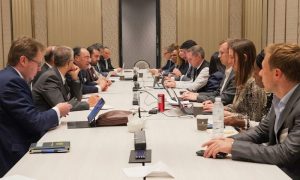
US and Iranian negotiators held indirect technical talks in Doha on Wednesday as they sought agreement on shipping through the Strait of Hormuz and a lasting ceasefire under the Islamabad MoU framework.
Qatari Amir Sheikh Tamim bin Hamad Al Thani on Wednesday met with US negotiators Steve Witkoff and Jared Kushner.
The trio discussed the “progress of the negotiations” between the US and Iran, according to a statement from the emir’s office, as well as the situation in Lebanon and the “importance of consolidating the ceasefire” there.
Qatar said on Tuesday that US Special Envoy Steve Witkoff and President Trump’s son-in-law Jared Kushner had arrived in Doha for consultations with mediators on regional issues.
However, Qatari officials said no direct meetings between US and Iranian officials had been scheduled in the coming days.
The latest developments followed Trump’s announcement on Monday that Washington and Tehran would hold talks in Doha under the Pakistan-brokered agreement.
“Iran has requested a meeting. It will take place tomorrow in Doha,” Trump wrote on his Truth Social platform.
Islamabad MoU framework
The latest diplomatic efforts follow the Islamabad MoU signed on June 18 by US President Donald Trump, Iranian President Masoud Pezeshkian and Pakistani Prime Minister Shehbaz Sharif after Pakistan brokered a ceasefire between Washington and Tehran.
The agreement committed both countries to halt military operations across all fronts, including Lebanon, reopen the Strait of Hormuz to commercial shipping and negotiate a final agreement covering Iran’s nuclear programme, US sanctions and a permanent ceasefire within 60 days.
Pakistan and Qatar also co-mediated the first round of high-level US-Iran negotiations in Lucerne, Switzerland, on June 21.
The talks were attended by US Vice President JD Vance and Iranian Parliament Speaker Mohammad Bagher Ghalibaf.
Following the meeting, Pakistani and Qatari mediators said encouraging progress had been made, while Washington announced the easing of sanctions on Tehran.
Pakistan’s diplomatic efforts
Pakistan is the main mediator between the US and Iran after it secured a ceasefire on April 08 and hosted the highest level of talks between the two nations on April 12 and 13 in Islamabad.
On June 18, Prime Minister Shehbaz Sharif, President Donald Trump and Iranian President Masoud Pezeshkian signed the Islamabad Memorandum of Understanding to end hostilities and launch further negotiations.
On June 21, Pakistan and Qatar mediated the high-level US-Iran talks in Switzerland.
The first round of Pakistan and Qatar mediated US-Iran talks, led by US Vice President JD Vance and Iran’s Parliament Speaker Mohammad Baqer Ghalibaf, was held in Switzerland a week ago, and Washington waived sanctions on Tehran.
After the talks, Pakistan and Qatar announced significant progress in diplomatic efforts between the US and Iran following the conclusion of the first round of high-level talks in Switzerland.