LONDON: The United Nations’ shipping agency said it opposes the imposition of transit fees on vessels passing through international straits after US President Donald Trump announced plans to charge cargo transiting the Strait of Hormuz.
A spokesperson for the International Maritime Organisation (IMO) said the agency was aware of Trump’s announcement and was awaiting further details, Reuters reported.
“We are aware of the post and awaiting more details,” the spokesperson said.
“We have always been consistent on our stance on fees. IMO stands firmly against charging fees for passage through straits used for international navigation. There is no legal basis through which to introduce mandatory tolls simply to transit through a strait,” the spokesperson added.
Trump announces transit charges
Trump said on Monday that the United States would reinstate a naval blockade of Iranian ports in the Strait of Hormuz, while allowing ships from other countries to continue using the strategic waterway.
“The Hormuz Strait is open, and will remain open, with or without Iran,” Trump wrote on his Truth Social platform.
“We are reinstating the Iranian blockade, so named because it is only stopping Iran’s ships or customers from entering or leaving. All other countries will have fair and open use of the Strait,” he said.
Trump also said the United States would become “the guardian of the Hormuz Strait” and should be reimbursed for providing security.
“As a matter of fairness, [the United States] will be reimbursed, at the rate of 20 percent on all cargo shipped, for any and all costs necessary to do the job of providing safety and security to this very volatile section of the world,” Trump wrote.
— Rapid Response 47 (@RapidResponse47) July 13, 2026
“The process and formation will begin immediately,” he added.
Iran rejects US move
Iran’s Islamic Revolutionary Guard Corps (IRGC) condemned the US proposal, accusing Washington of endangering global energy supplies through its actions in the Strait of Hormuz.
IRGC spokesperson Hossein Mohebi said the United States had “seriously endangered the security of the world’s oil and gas supply and must be held accountable”, according to his post on X.
He added that Iran “will continue to exercise sovereignty over and management of the Strait of Hormuz”.
Meanwhile, Iran’s Khatam al-Anbiya Central Headquarters rejected any US role in managing the waterway.
According to Iran’s state broadcaster Press TV, Khatam al-Anbiya spokesperson Ebrahim Zolfghari said Iran would not allow the United States to interfere in the management of the Strait of Hormuz.
“We will not allow the US to interfere in the management of the Strait of Hormuz under any circumstances,” Press TV quoted him as saying.
He added that “the US and the countries cooperating with its military bear full responsibility for all insecurity and the escalation of the war in the region”.
Trump floats broader US role
Earlier on Monday, Trump said in a phone interview with Fox News that the United States would probably take control of the Strait of Hormuz and should be paid for protecting the strategically important waterway.
“We’re going to keep the strait, and we’ll probably run it. We’ll become the guardian of the Strait. Maybe we’ll call it the guardian angel of the strait. And we should be reimbursed for that,” Trump said.
“We’re going to guard it. We’re going to get paid for guarding it – a lot of money,” he added.
“We’re going to be reimbursed, because the other nations are very wealthy. They’re on our side, and we can’t be expected to do that for nothing.”
Tanker traffic falls to lowest
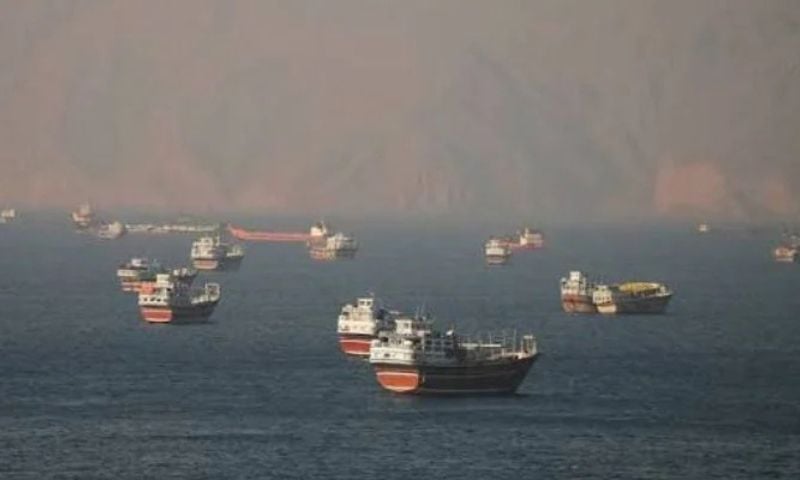
Meanwhile, tanker traffic through the Strait of Hormuz has fallen to its lowest level in nearly two months, according to shipping data.
Shipping industry sources told Reuters that an increasing number of vessels were switching off their Automatic Identification System (AIS) tracking transponders, making it more difficult to determine the actual volume of maritime traffic through the waterway.
Analysis by shipping intelligence firm Kpler showed that oil and gas tanker traffic had fallen to its lowest level since May 25.
Ship broker Gibson warned that any prolonged disruption to shipping through the Strait of Hormuz could have serious consequences for global energy markets.
“Should the renewed escalation in the strait lead to another prolonged closure of Hormuz, the world will find itself in a much tougher spot,” Gibson said in a report.
“With global inventories rapidly depleted in recent months, this is a recipe for much tighter supply, higher prices and significant downside risk for tanker markets.”