TOKYO: The United States’ long-standing strategy of helping India to become a regional economic, technological and military power has become a strategic miscalculation as Washington is now increasingly seeking to downgrade New Delhi’s role in its larger regional calculus rather than support New Delhi’s rise, according to The Japan Times.
The clearest indication of this shift came from US Deputy Secretary of State Christopher Thomas Landau, who recently said in New Delhi that Washington would “not repeat its China mistake” by allowing India to develop markets only to outcompete the United States commercially.
The US Deputy Secretary of State’s remarks reflect a broader change in American strategic thinking, with policymakers no longer viewing India’s rise as an unqualified geopolitical asset but through the lens of economic and technological competition, according to an opinion article published by The Japan Times.
Those remarks deserve far more attention than they received, according to The Japan Times. They amount to a candid acknowledgement that Washington no longer views India’s rise as an unqualified strategic asset. Instead, it increasingly sees India through the same prism that now shapes its approach toward China and must be carefully managed.
For nearly a quarter century, Washington believed that helping India become stronger — economically, technologically and militarily — served US interests by creating a durable counterweight to China, The Japan Times stated. However, Washington’s India consensus is now quietly unravelling.
Landau’s statement marks a structural shift in American strategy towards India. The shift is also visible in American strategic vocabulary. The Pentagon’s recent decision to drop the “Indo” from “Indo-Pacific” is far more than bureaucratic rebranding. Names in strategy reveal priorities, according to The Japan Times.
For nearly a decade, the Indo-Pacific concept placed India at the heart of America’s vision for countering China’s rise across two oceans.
Removing “Indo” sends a different signal. It suggests that Washington is narrowing its strategic horizon, placing greater emphasis on managing relations directly with Beijing while downgrading India’s role in its larger regional calculus.
The change also aligns with US President Donald Trump’s more conciliatory approach to Beijing since mid-2025 and his repeated references to a US-China “Group of Two,” a framework in which the world’s two largest powers bargain directly over global affairs rather than relying on broad coalitions of partners.
Successive US administrations in this century promoted India’s emergence through expanding defence cooperation, a civil nuclear deal, and growing technology partnerships. They believed India’s rise would strengthen, not challenge, American leadership. Today, that assumption is giving way to a different strategic calculation, according to The Japan Times.
The lesson many policymakers in Washington drew from China’s ascent is not simply that Beijing became militarily formidable. It is that the US aided the rise of an industrial and technological rival capable of dominating global manufacturing, critical supply chains and advanced technologies and challenging American primacy, The Japan Times stated.
Washington’s new objective is to avoid repeating that experience with India. Landau merely articulated publicly what American policy has begun to reflect.
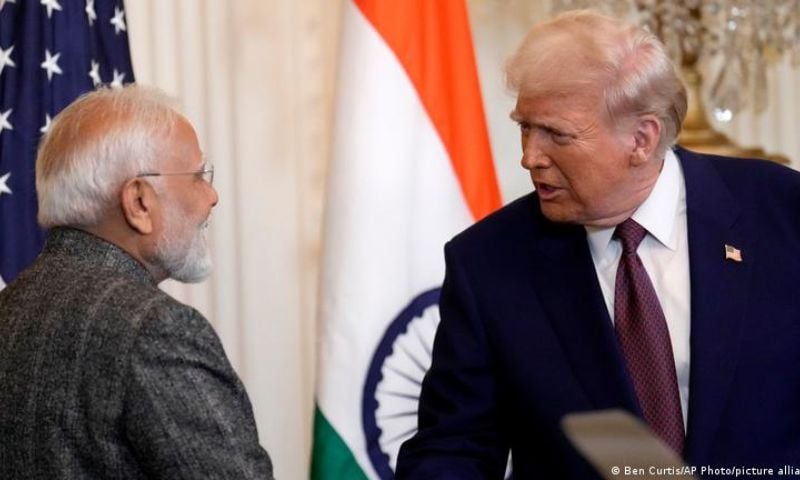
Trump’s 50 percent punitive tariffs on Indian exports were more than trade measures. They conveyed that “America First” applies as much to strategic partners as to competitors. His administration increasingly treats India less as a geopolitical pillar than as a market for American goods and investment. Indeed, Trump’s National Security Strategy frames the US-India relationship in transactional commercial terms rather than as a long-term geopolitical investment.
Even more revealing are the growing obstacles surrounding the transfer of advanced jet-engine technology.
The agreement between General Electric and India’s Hindustan Aeronautics was celebrated as a watershed because it promised unprecedented technology transfer for engines to power India’s three separate indigenous fighter programs: Tejas Mk1A, Tejas Mk2 and Advanced Medium Combat Aircraft. According to The Japan Times, the multibillion-dollar deal was never simply about supplying engines. It represented a potential breakthrough for India’s ambition to become an independent aerospace power.
Instead, implementation has become bogged down in unexpected roadblocks. Engine deliveries have stalled, delaying fighter production and leaving completed Indian-built aircraft stranded without propulsion systems.
The stalled deliveries, in turn, has placed the Indian Air Force under severe operational strain, with its active strength plummeting to approximately 29 operational squadrons, as against the required 42.5 combat squadrons to fight nuclear-armed allies China and Pakistan.
Whatever the official explanations, the broader strategic message is difficult to miss. Washington appears increasingly reluctant to facilitate technologies that could enable India eventually to compete at the highest end of advanced industrial manufacturing, according to The Japan Times.
The US shift extends to India’s own strategic backyard. If India is no longer viewed as the indispensable anchor of America’s Asian strategy, it becomes easier for Washington to pursue regional policies that diverge from New Delhi’s interests.
For much of the past decade, New Delhi assumed that growing strategic ties with Washington would naturally translate into greater American sensitivity toward India’s concerns in its immediate neighbourhood. According to The Japan Times, that assumption no longer holds.
America’s changing attitude toward India suggests that it is now being guided by a different strategic logic, according to The Japan Times. Washington is no longer asking whether its regional policies strengthen India’s position. Instead, it appears increasingly comfortable limiting India’s geopolitical room for manoeuvre while simultaneously restricting the technologies that would underpin its long-term industrial ascent.
The irony is striking. For two decades, Washington encouraged India’s rise because it believed New Delhi would reinforce American strategy in Asia. Today, many US policymakers appear to fear that helping India become successful economically could recreate the very mistake they believe Washington made with China.
The US now views India’s rise no longer as an inherently benign development, but as a phenomenon to be carefully managed, moderated and, where necessary, constrained.
The quiet demotion of India in America’s grand strategy represents the most significant shift in US policy since Washington embraced New Delhi as a strategic partner at the turn of the century.