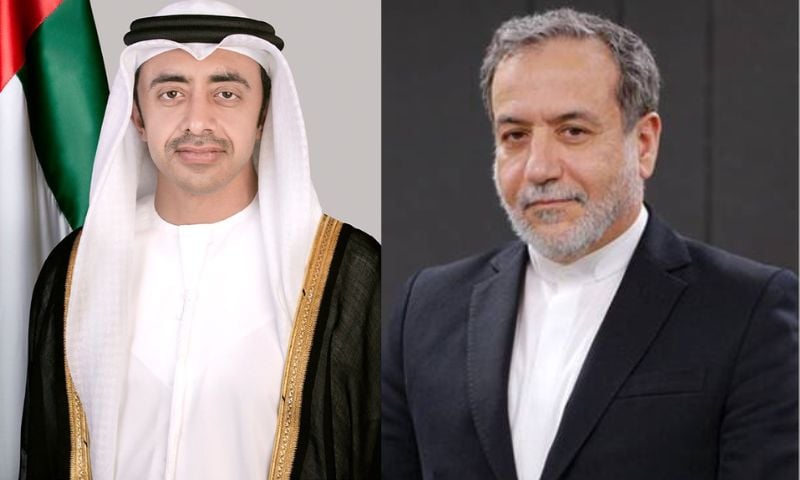



ABU DHABI: The Foreign Minister of the United Arab Emirates, Sheikh Abdullah bin Zayed Al Nahyan, held a phone conversation with Iran’s Foreign Minister Abbas Araghchi to discuss the latest developments in the region.
The call followed the signing of a memorandum of understanding between the United States and Iran, brokered by Pakistan.
The countries later agreed on a 60-day roadmap towards a final agreement following the conclusion of high-level talks in Switzerland mediated by Pakistan and Qatar.
Sheikh Abdullah underscored the importance of fully implementing the agreement to help achieve an immediate and comprehensive ceasefire, respect international law, safeguard state sovereignty and ensure the continued freedom of navigation, including through the Strait of Hormuz, a Foreign Ministry statement said on Friday.
Abdullah bin Zayed received a phone call from Abbas Aragchi, Foreign Minister of Iran, during which the latest regional developments were discussed, following the Memorandum of Understanding between the United States of America and Iran. His highness emphasized on the importance… pic.twitter.com/r8Kb8j540W
— OFM (@OFMUAE) June 26, 2026
He stressed that diplomacy and constructive dialogue remain the most effective means of addressing regional and international crises, expressing hope that ongoing talks would contribute to lasting security, stability, and peace across the region.
According to a joint statement, the US and Iran have agreed on a 60-day roadmap towards a final agreement following the conclusion of high-level talks in Switzerland mediated by Pakistan and Qatar.
The first session of negotiations under the framework of the Islamabad Memorandum of Understanding concluded at the Burgenstock resort, bringing together representatives of Iran, the United States, Pakistan and Qatar.
Earlier on Thursday, the Gulf foreign ministers said that addressing Iran’s missile programme and its regional network of allies would be essential to achieving lasting peace, adding that any future trade and investment ties with Tehran would remain reversible and dependent on Iran’s commitment to its agreement with the United States.
In a statement issued after the Ministerial Meeting between the United States and the Gulf Cooperation Council (GCC) in Manama, they stressed the need to maintain momentum and unity as negotiations proceed toward a more permanent end to hostilities and the shared objective of preventing Iran from ever developing or otherwise acquiring a nuclear weapon.
They also emphasised the importance of reopening the Strait of Hormuz, noting that free, unconditional, and unrestricted navigation, including the right of transit passage as guaranteed under international law, remains essential to regional and global security.