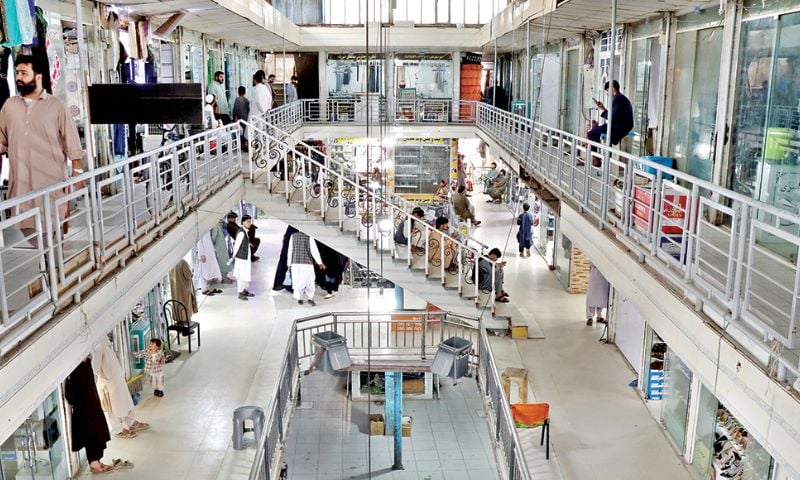



HERAT: Business owners in the western Afghan city of Herat say trade has fallen sharply after a renewed Taliban crackdown on women’s dress code prompted many female shoppers to stay away from markets.
According to local business owners, the stricter enforcement of clothing regulations by the Taliban’s morality police has severely affected commercial activity in one of Afghanistan’s busiest trading centres, where women traditionally account for the majority of retail customers.
The latest enforcement drive began in early June, when morality police detained dozens of women for allegedly failing to comply with the authorities’ prescribed dress code, including wearing a full-body chador or burqa.
The arrests triggered widespread concern among residents and were followed by a rare public protest, which the United Nations said was violently dispersed, leaving at least two people dead.
The renewed restrictions have had immediate economic consequences for local businesses.
According to AFP, Ramin Ghafoori, 26, who owns a tailoring shop in Herat, said customer numbers dropped dramatically after the detentions.
Residents of Kabul appear to be reaching a tipping point as frustration with the Afghan Taliban regime continues to grow. Following the reported crackdown on women and young people in Herat, signs of public discontent are becoming increasingly visible in the capital, with more… pic.twitter.com/pxtr5R7rBO
— The Strategic Insight (@Strategicprism0) July 12, 2026
“Since those incidents occurred, there have been almost no women in the markets,” he said. Shopkeepers say women are the driving force behind retail spending in the city, often purchasing not only for themselves but also for male family members.
Nazeer Ahmad Azimi, who runs a shoe shop, estimated that business turnover across Herat’s markets has fallen by around 50 per cent since the stricter enforcement began.
“Ninety per cent of our sales are to women. They even shop for the men in their families, who are often occupied with work,” he said.
A spokesperson for Herat’s city administration did not immediately respond to requests for comment on the reported impact of the restrictions.
Businesses in Afghanistan’s Herat have suffered from a downturn in female customers following a recent crackdown by morality police on women’s attire. pic.twitter.com/DW3wn708FK
— Pakistan TV Digital (@PakistanTVcom) July 12, 2026
Since regaining power in August 2021, the Taliban administration has steadily tightened restrictions on women’s participation in public life.
Women have been barred from education beyond primary school, excluded from many forms of employment, and prohibited from visiting public parks and several other recreational spaces.
Many women in Herat now say they avoid leaving their homes for fear of being stopped by morality police. A 28-year-old resident, who requested anonymity for security reasons, said she had abandoned outings with friends that once included shopping trips and visits to restaurants.
“I feel like a stranger,” she said, describing how the atmosphere in the city had changed.
Residents say the growing fear of enforcement has not only curtailed women’s freedom of movement but has also placed additional pressure on Herat’s already struggling local economy, where businesses remain heavily dependent on female consumers.