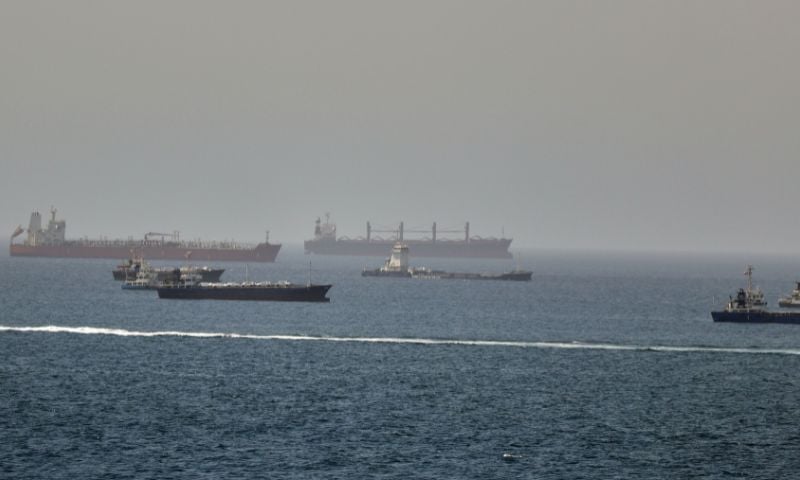
WASHINGTON: US President Donald Trump on Sunday said that the Strait of Hormuz is open to commercial traffic, though the US and Iran continue to trade attacks that have raised concerns over safety on one of the world’s most important oil shipping routes.
Speaking in an interview with NBC’s Meet the Press, Trump said the vital maritime corridor remained open to commercial traffic even as tensions between Washington and Tehran continued to escalate over attacks on international shipping in the Gulf.
Trump said the United States hit Iran hard in response to its latest attacks on shipping in the Strait of Hormuz. “We hit them very hard last night,” Trump told CNN by telephone in an interview.
Trump has said the United States and Iran had been close to “a deal” on Saturday. “They were giving up everything, and then all of a sudden two hours after that they hit a ship with a drone. These people, there is something wrong with them,” he has said.
The remarks came as the US military insisted that commercial traffic was continuing through the Strait of Hormuz despite Tehran’s assertions that it had shut the route.
“Iran does not control the strait. Traffic is flowing,” the US Central Command (CENTCOM), which oversees American military operations in the Middle East, said in a post on X.
🚫 CLAIM: The Iranian commander for the Islamic Revolutionary Guard Corps-Navy recently said on state-owned media that no foreign vessels may pass through the Strait of Hormuz without being identified, tracked, and monitored by Iranian forces.
✅ FACT: Iran does not control the… pic.twitter.com/8lRDNiOpXQ
— U.S. Central Command (@CENTCOM) July 12, 2026
In a separate statement, CENTCOM said the Strait of Hormuz was “open to all vessels seeking to lawfully transit the international waterway” and that US forces were “positioned and prepared” to ensure freedom of navigation despite what it described as “unwarranted Iranian aggression, harassment, threats, and arbitrary declarations.”
The Strait of Hormuz is open to all vessels seeking to lawfully transit the international waterway. U.S. forces are positioned and prepared to ensure that freedom of navigation remains available despite unwarranted Iranian aggression, harassment, threats, and arbitrary… pic.twitter.com/FS3TUBOZEj
— U.S. Central Command (@CENTCOM) July 12, 2026
Iran’s Revolutionary Guards said the waterway would remain closed until “the end of US interference in this region”.
The Strait of Hormuz carries around one-fifth of global oil supplies under normal conditions and is regarded as one of the world’s most strategically important maritime trade routes.
Iranian Foreign Minister Abbas Araghchi accused the United States of violating the ceasefire arrangement, saying any agreement could only succeed if both sides honoured their commitments.
Meanwhile, Iran’s senior negotiator Mohammad Baqer Qalibaf wrote on X that “the era of one-sided deals is over”, warning that future commitments must be observed by all parties.
Mediator Pakistan has consistently called for restraint and dialogue, maintaining that negotiated solutions remain essential for achieving lasting peace and stability in the region.
US launches third round of strikes
The latest developments came after the United States launched another round of military strikes against Iran, accusing the Islamic Revolutionary Guard Corps (IRGC) of attacking a commercial container ship transiting the Strait of Hormuz.
According to CENTCOM, the operation began at 7:15 p.m. Eastern Time on Saturday and marked the third round of US military action against Iran during the week.
At 7:15 p.m. ET today, U.S. Central Command forces began launching the third round of strikes this week against Iran after Islamic Revolutionary Guard Corps forces blatantly attacked M/V GFS Galaxy, a Cyprus-flagged container ship transiting the Strait of Hormuz. A civilian crew…
— U.S. Central Command (@CENTCOM) July 11, 2026
The US military alleged that Iranian forces attacked the Cyprus-flagged container vessel M/V GFS Galaxy while it was transiting the strategically important waterway.
CENTCOM said the attack caused a major fire onboard, severely damaged the vessel’s engine room and left one civilian crew member missing, rendering the ship incapable of continuing its voyage.
“The strikes are being carried out at the direction of the Commander in Chief,” CENTCOM said, referring to President Donald Trump.
The US military further accused Tehran of failing to honour previous commitments intended to safeguard commercial navigation in the Gulf.
“Iran was provided yet another opportunity to demonstrate adherence to the Memorandum of Understanding after being held accountable for earlier attacks on commercial vessels, but has again failed,” the statement said.
Washington said the military action was intended to further reduce Iran’s ability to threaten international shipping and civilian mariners operating in one of the world’s busiest maritime corridors.
“In response, the United States is imposing a heavy cost by continuing to degrade Iran’s ability to attack civilian mariners and commercial ships freely transiting the strait,” CENTCOM added.
More than 300 Iranian targets struck
Later, CENTCOM said US forces had completed the latest round of strikes against Iran, targeting approximately 140 military sites using precision-guided munitions launched from land- and sea-based fighter aircraft, drones and naval vessels.
The targets included missile and drone launch sites, naval capabilities, ammunition storage facilities, communications networks and coastal surveillance positions, according to the command.
CENTCOM said that during three nights of military operations this week, US forces had struck more than 300 targets at the direction of the Commander in Chief to reduce Iran’s capability to attack civilian mariners and commercial vessels transiting the Strait of Hormuz.
The command added that commercial shipping continued through the waterway and said US forces had facilitated the safe transit of more than 800 commercial vessels carrying around 400 million barrels of crude oil since early May.
Oman rescues crew after vessel attack
Meanwhile, Oman’s Maritime Security Centre said it had rescued 23 crew members from a commercial vessel after it was struck off the country’s eastern coast, while search operations continued for one missing crew member.
The agency said it received a distress call from the Cyprus-flagged GFS Galaxy, located about 4.4 nautical miles off Musandam Governorate.
According to CENTCOM, the vessel had been disabled by fire and extensive engine-room damage following what it described as an Iranian attack.
Separately, Oman’s Foreign Ministry said it had summoned the Iranian ambassador to protest drone strikes targeting Musandam and Al Batinah.
قام سعادة الشيخ خالد بن هاشل المصلحي @muslahi وكيل الوزارة للشؤون الإدارية والمالية، باستدعاء سعادة موسى فرهنك، سفير الجمهورية الإسلامية الإيرانية المعتمد لدى سلطنة عُمان، وذلك لتسليمه مذكرة احتجاج على خلفية تعرّض مواقع في محافظتي مسندم والوسطى لاستهدافات بواسطة طائرات مسيّرة.…
— وزارة الخارجية (@FMofOman) July 12, 2026
The ministry said Undersecretary for Administrative and Financial Affairs Sheikh Khalid bin Hashel Al Muslahi expressed Oman’s “dismay at these irresponsible acts”, calling for respect for state sovereignty, good neighbourly relations and non-interference in internal affairs.
The United Arab Emirates also condemned renewed Iranian attacks across the region.
The UAE Foreign Ministry said the strikes constituted “a blatant violation of the sovereignty” of neighbouring countries and reaffirmed its solidarity with Jordan, Qatar, Bahrain and Kuwait, which had also come under attack.
Pakistan urges diplomacy
Meanwhile, Pakistan’s Deputy Prime Minister and Foreign Minister Ishaq Dar reaffirmed Pakistan’s commitment to diplomacy as the primary means of resolving regional disputes, telling his Iranian counterpart Abbas Araghchi that dialogue remains the only viable route to lasting peace and stability.
Deputy Prime Minister/Foreign Minister Senator Mohammad Ishaq Dar @MIshaqDar50 held a telephone conversation today with His Excellency Seyyed Abbas Araghchi, Foreign Minister of the Islamic Republic of Iran. @araghchi
Both leaders exchanged views on the evolving regional… pic.twitter.com/WuRxnROwwp
— Ministry of Foreign Affairs – Pakistan (@ForeignOfficePk) July 12, 2026
According to a statement issued by the Foreign Office on Sunday, Dar held a telephone conversation with the Iranian foreign minister to discuss the rapidly evolving security situation in the region amid escalating tensions involving Iran, the United States and Israel.
During the exchange, the two leaders reviewed recent developments and emphasised the importance of preventing further escalation. Dar urged all parties to exercise maximum restraint and pursue de-escalation in accordance with the Islamabad Memorandum of Understanding (MoU) reached in June.
The deputy prime minister stressed that peaceful engagement and diplomatic efforts offered the only sustainable solution to regional disputes. He also reiterated Pakistan’s readiness to continue playing a constructive role in supporting initiatives aimed at promoting regional peace and long-term stability.
The Foreign Office said both ministers agreed to remain in close contact as the situation continues to develop.
Pakistan has consistently called for restraint, dialogue and diplomatic engagement, maintaining that negotiated solutions remain essential for ensuring peace and stability across the region.