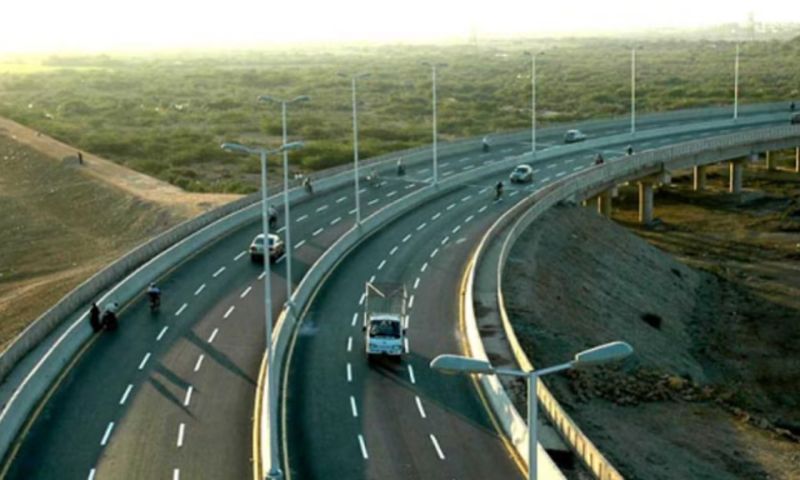
ISLAMABAD: In a major boost to Pakistan’s transport infrastructure, the Special Investment Facilitation Council (SIFC) has broken the logjam on the country’s long-stalled Eastern Motorway Corridor, catapulting the strategically vital M-13 Motorway into the fast lane of execution.
Through a decisive blend of policy coordination and institutional intervention, the SIFC has effectively resurrected a project that had languished for years, transforming what was once a provincial dream into a national priority poised to redefine freight logistics and regional connectivity.
M-13 Motorway: 100 km Shorter. 1 Hour Faster. A New Era of Strategic Connectivity. 🇵🇰
The M-13 Kharian–Rawalpindi Motorway is moving forward through sustained institutional coordination led by SIFC. Through SIFC’s efforts, the project underwent a comprehensive transformation and… pic.twitter.com/A9y9hhj8S7
— SIFC | Special Investment Facilitation Council🇵🇰 (@sifcpakistan) June 25, 2026
Breaking the deadlock: A new era for the eastern corridor
The Eastern Motorway Corridor, comprising the M-11 (Lahore-Sialkot), M-12 (Sialkot-Kharian), and the pivotal M-13 (Kharian-Rawalpindi), has long been recognized as a critical artery for Pakistan’s economy.
Originating in 2007 as a Punjab initiative to link Lahore with the export hub of Sialkot, the project was later expanded by the National Highway Authority (NHA) into a national transport spine stretching to the federal capital.
While the 103-kilometer M-11 was successfully completed by the Frontier Works Organization (FWO) in 2020, and the 69-kilometer M-12 broke ground in 2022, progress on the entire corridor was hamstrung by persistent procedural delays and financial headwinds. The 117.2-kilometer M-13, the corridor’s most critical segment, remained particularly elusive, until SIFC stepped in.
M-13 Motorway: 100 km Shorter. 1 Hour Faster. A New Era of Strategic Connectivity. 🇵🇰
The M-13 Kharian–Rawalpindi Motorway is moving forward through sustained institutional coordination led by SIFC. Through SIFC’s efforts, the project underwent a comprehensive transformation and… pic.twitter.com/8a2OUKoqL3
— Khawaja M. Asif (@KhawajaMAsif) June 25, 2026
Policy overhaul: From four lanes to six
The project’s revival gained tangible momentum in March 2025 when the SIFC Executive Committee issued a game-changing directive. Ordering the NHA to redesign the M-13 from a four-lane to a six-lane motorway, the committee simultaneously mandated a comprehensive revision of its financial structure to insulate it against inflation, rising financing costs, and currency depreciation.
Crucially, SIFC accelerated the entire approval process by directing the parallel processing of technical and financial clearances. This strategic move slashed bureaucratic red tape, leading to swift subsequent approvals from the Executive Committee of the National Economic Council (ECNEC) and the Public-Private Partnership Authority (P3A).
Strategic impact: Connectivity, trade, and growth
Once completed, the Eastern Motorway Corridor will provide a seamless, high-speed alternative route between Lahore and Rawalpindi, alleviating pressure on the existing M-2 Motorway.
More importantly, it will create a modern transport spine linking Pakistan’s industrial heartland, home to export-oriented textiles, sports goods, and surgical instruments, directly with the federal capital and the broader motorway network, including the M-1 and the Rawalpindi Ring Road.
This integration is expected to drastically reduce freight transit times, lower logistics costs, and unlock new efficiencies for exporters, positioning the corridor as a catalyst for sustained economic growth and enhanced regional trade.
M-13 Motorway!
A New Era of Strategic Connectivity#SIFC #Connectivity #RisingPakistan #motorways #infrastructure #Connectivity pic.twitter.com/DiKD75D3zq— SIFC | Special Investment Facilitation Council🇵🇰 (@sifcpakistan) June 25, 2026
SIFC’s growing role in national infrastructure
The project’s rapid advancement underscores the SIFC’s emerging role as a powerhouse for strategic infrastructure development. By fostering inter-agency coordination and prioritizing investment facilitation, the Council is demonstrating its capacity to navigate complex financial and administrative challenges.
As the M-13 moves from blueprint to reality, it stands as a testament to what coordinated policy action can achieve, laying the foundation for a more connected, competitive, and resilient Pakistani economy.