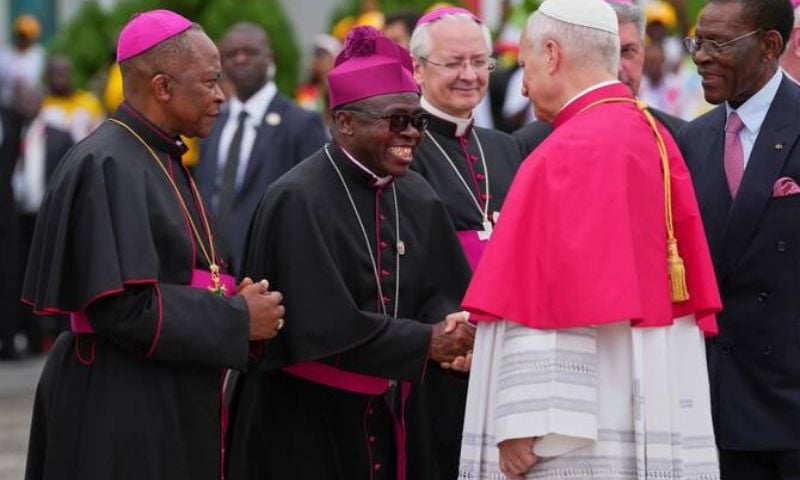
BATA/MALABO: Pope Leo XIV’s visit on Wednesday to a prison in Equatorial Guinea has placed the West African nation’s human rights record under renewed international attention, particularly following reports that migrants deported from the United States have been sent to the country under controversial arrangements.
The pontiff’s stop at the facility in Bata, a major port city, continues a long-established tradition of papal prison visits, previously emphasised by Pope Francis, who regularly prioritised outreach to inmates as part of his ministry.
Francis had framed such visits as an effort to offer hope to prisoners while drawing global attention to issues such as overcrowding, judicial abuse, and systemic injustice.
Leo’s visit forms part of the concluding stage of an extensive 11-day, four-nation African tour that has taken him from Algeria in the north of the continent to Angola in the south, with Cameroon also included in the itinerary, according to AP.
Earlier in the day, he was scheduled to celebrate Mass in Mongomo in the country’s east before travelling to Bata, Equatorial Guinea’s most populous coastal city.
His programme also included a prayer at a memorial dedicated to victims of a 2021 military barracks explosion in Bata, which authorities attributed to negligence.
Long-standing human rights concerns
Equatorial Guinea’s justice system and prison conditions have repeatedly come under criticism from international bodies.
While the United Nations human rights office welcomed the abolition of the death penalty in 2022, it and multiple advocacy organisations have continued to highlight systemic abuses within the country’s legal framework.
A 2023 report by the United States government documented allegations including arbitrary arrests and killings, political detentions, torture, severe prison conditions, and a lack of judicial independence, which it described as a “serious concern”.
Human rights groups say such abuses remain widespread. Amnesty International’s West and Central Africa office has reiterated concerns over torture used for extracting confessions and punishing detainees, as well as the harassment of human rights defenders and compromised fair trial standards.
Equatorial Guinea has been governed by President Teodoro Obiang Nguema Mbasogo since 1979. His long rule has been frequently criticised by international observers, who accuse his administration of authoritarian practices and entrenched corruption.
Deportation controversy involving US migrants
The country has also recently emerged in international debate due to its involvement in migration agreements with the United States. Reports indicate that several African states, including Equatorial Guinea, have received funding under arrangements linked to the deportation of migrants from the US who are sent to third countries.
According to reporting by the Associated Press, at least 29 migrants with no connection to Equatorial Guinea have been deported there under such arrangements.
While these individuals were not transferred to the Bata prison, some are reportedly being held in detention facilities in the capital, Malabo, with restricted access to legal assistance and medical care. Others are said to have been repatriated to countries where they may face persecution.
The Equatorial Guinean government has denied allegations of human rights violations and has not publicly addressed concerns relating to the deportation arrangements.
Pope Leo XIV, the first US-born pontiff, has previously criticised the broader migration policies of the Trump administration, describing them as “extremely disrespectful”.
Calls for papal intervention
Ahead of the visit, around 70 human rights organisations issued an open letter urging the Pope to address the issue of deportations during his trip and to call on African governments not to cooperate in practices they say violate international law.
The groups argued that such deportations bypass humanitarian protections and expose vulnerable individuals to detention, coercion, and possible refoulement — the forced return of people to countries where they may face danger, which is prohibited under international law. They also warned that the conditions surrounding these transfers demonstrate a disregard for human safety and dignity.
Among the signatories was EG Justice, an organisation that has long documented political imprisonment in Equatorial Guinea. Its executive director, Tutu Alicante, urged the Pope to use his moral authority to highlight ongoing concerns.
He said that political detainees and prisoners of conscience continue to face serious violations of due process, adding that meaningful judicial reform and case reviews could signal a genuine shift towards accountability and reconciliation.
Alicante also noted that while the government had made what he described as “cosmetic improvements” to certain detention facilities ahead of the papal visit, these measures were likely temporary.
He stressed that the real measure of progress would be whether humane conditions, access to healthcare, and basic legal rights are sustained beyond the Pope’s departure.