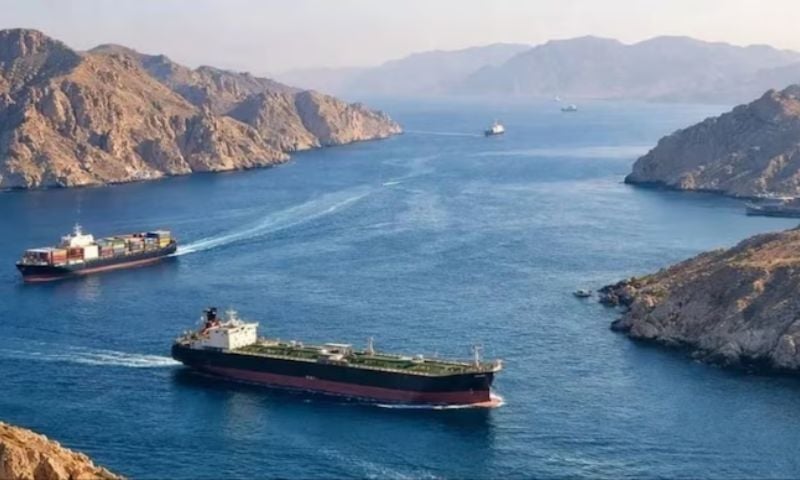



LONDON: The number of vessels transiting the Strait of Hormuz fell to a five-week low on Sunday as renewed hostilities between the United States and Iran and attacks on commercial shipping heightened security concerns in one of the world’s most important energy corridors.
Ship-tracking data from Kpler showed that only six vessels passed through the strategic waterway on Sunday, reflecting growing caution among shipping operators.
Tanker Traffic Slows
Among the vessels leaving the Strait of Hormuz were the Very Large Crude Carrier Humanity, carrying around two million barrels of Iranian crude oil, and the tanker Capetan Andreas, transporting approximately 500,000 barrels of Kuwaiti oil products.
Three empty tankers entered the Gulf to load crude cargoes, while most vessels switched off their transponders while passing through the strait, according to the tracking data.
No liquefied natural gas (LNG) tankers were observed entering the Strait of Hormuz over the weekend.
Kpler data also showed that only one tanker operated by Abu Dhabi National Oil Co. exited the strait between July 10 and July 12. The vessel is bound for Dahej port in India.
Security Concerns Intensify
Shipping activity has slowed following renewed military exchanges between Washington and Tehran.
US Central Command (CENTCOM) said on Sunday that American forces carried out another wave of strikes against Iran, targeting dozens of military sites with precision-guided munitions.
US President Donald Trump said the Strait of Hormuz remained open to commercial shipping despite the latest escalation.
Iran, however, earlier declared the strategic waterway closed, claiming a vessel travelling along what it described as an unauthorised route had been struck.
Iran Claims Ships Stopped
Iran’s Revolutionary Guards said on Monday that their naval forces had stopped two ships in the Strait of Hormuz overnight after disabling their onboard systems.
The Guards did not identify the vessels or provide further details.
The Strait of Hormuz, through which roughly one-fifth of the world’s oil supplies pass, remains under close international scrutiny as concerns grow that continued military escalation could disrupt global energy markets and commercial shipping.