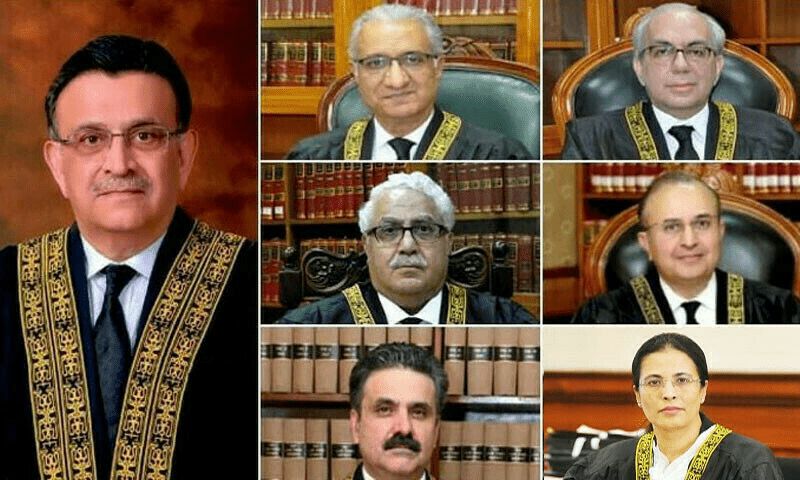
ISLAMABAD: A seven-member bench of the Supreme Court of Pakistan, headed by Chief Justice of Pakistan (CJP) Umar Ata Bandial, heard petitions challenging the trial of civilians in military courts. The court has canceled the cause list of other benches as three regular benches were scheduled to hear cases.
The hearing of the case has been adjourned till Monday, 26 June, at 9:30 am. Chief Justice Umar Ata Bandial expressed the court’s intention to announce the verdict in the “civilians trial in military courts” case before the Eid holidays.
During the proceedings, the Attorney General of Pakistan (AGP) informed the court that no journalists, minors, women, or lawyers were in the custody of Pakistan Armed Forces. He also clarified that no person was under custody of Islamabad Capital Territory (ICT) Police. The AGP provided details on the number of arrests made under various acts in different regions of Pakistan.
Prominent lawyer Aitzaz Ahsan, along with his counsel Sardar Latif Khosa, and civil society lawyer Faisal Siddiqui were present in the Supreme Court during the hearing. Faisal Siddiqui began presenting his arguments, stating that some defendants were treated differently in this case, with only a fraction of the accused being handed over to military courts.
Faisal Siddiqui emphasized the importance of a fair trial and referred to specific cases to support his argument. The judges of the Supreme Court raised questions regarding the circumstances under which trials in military courts are conducted, the applicability of the Official Secrets Act, and the process of accusation in military courts.
Advocate General Punjab submitted a report to the court, providing data on the detainees and arrests made after the incidents on May 9. The court adjourned the hearing for a short period and later resumed.
The proceedings continued with arguments presented by Faisal Siddiqui, who highlighted the need for a strict inquiry before charging individuals. He pointed out that civilian trials in military courts had not been conducted in history, except in 1998. Siddiqui also discussed the impact on fundamental rights and emphasized the importance of fair trials for everyone.
Another lawyer, Ahmed Hussain, representing Justice Jawad S. Khawaja, questioned the trial of civilians in military courts and expressed concerns about the scope of civilian court-martial in the Army Act. He stated that fundamental rights, as enshrined in the Constitution, would be affected by such trials.
The Supreme Court also issued notices to Prime Minister Shehbaz Sharif, the federal government, the four provinces, the Attorney General, the Ministry of Interior, the Ministry of Defense, and Pakistan Tehreek-e-Insaf (PTI) chairman Imran Khan. The court also requested details of all the people arrested after the arson attacks on state institutions that took place on May 9.
The case hearing will continue, and the Supreme Court is expected to deliver its verdict on the matter before the Eid holidays.