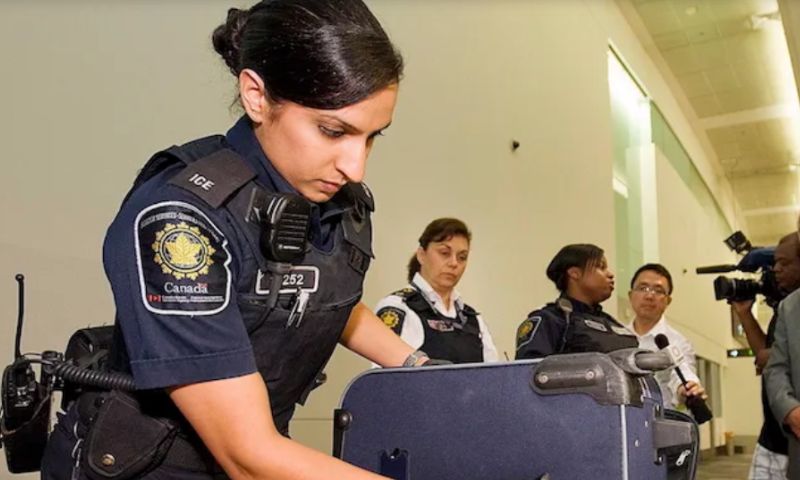
TORONTO, Canada: In a major crackdown on organised crime, Canada has deported more than 80 individuals, overwhelmingly Indian nationals, for their alleged involvement in extortion-related crimes, with nearly 140 others facing removal proceedings, the Canada Border Services Agency (CBSA) has revealed.
The sweeping enforcement action, which began in August last year, underscores Ottawa’s growing resolve to root out criminal networks that have spread terror across major metropolitan regions, particularly in British Columbia, Alberta and Ontario, with the Indian diaspora finding itself at the epicentre of this crackdown.
Canada Deports 81 Over Alleged Extortion-Linked Crime; Around 2 Dozen Indians Among Those Identified#Canada #CBSA #Deportation #Extortion #IndianNationals #Immigration #Crime #Calgary #Surrey #News @_deeksha_pandey https://t.co/B2c6BZbvln
— Free Press Journal (@fpjindia) June 27, 2026
Sweeping crackdown across major Canadian cities
According to data released by the CBSA this week, as of June 18, 2026, the agency has opened 484 immigration investigations nationwide, issued 139 removal orders on various inadmissibility grounds, and removed 81 individuals from Canada. While the CBSA did not provide an official breakdown by nationality, all of those publicly named as having been removed, approximately two dozen, are from India.
The enforcement action has been particularly intense in regions where extortion-related violence had become a crisis. In the Pacific Region, encompassing Metro Vancouver and the town of Surrey in British Columbia, home to a large Indo-Canadian population, 150 immigration investigations have been opened, 69 removal orders issued, and 46 individuals removed from Canada.
In the Greater Toronto Area, 196 investigations have been launched, with 33 removal orders and 17 individuals deported. The Prairie Region, including Edmonton and Calgary in Alberta, has seen 138 investigations, 37 removal orders, and 18 persons removed from Canada.
💥 INDIANS CHARGED IN EXTORTIONS
CHARGED: Ravjot Toor, Germanjeet Singh, Jaskaran Singh, Karanbir Singh, Amandeep Singh, Anurag Sidhu, Anurag Singh, Amandeep Mallhi, Sandeep Singh, Daksh Gautam, Akashdeep Singh, Gagandeep Singh, Pardeep Singh, Taranveer Singh, Gurkaran Dhaliwal. pic.twitter.com/Y5TaU7eMZM
— The Deport Report (@TheDeportReport) June 26, 2026
Police continue to act against criminal networks
Calgary Police Service has charged 16 individuals with 56 offences as part of its extortion-related investigations. All 16 are of Indian origin. “Despite laying charges in a number of cases, we want to emphasize that these investigations remain active and ongoing,” said Superintendent Jeff Bell of the CPS Criminal Operations & Intelligence Division. “We will not stop until everyone involved in these crimes has been identified and held accountable.”
Meanwhile, Surrey Police Service arrested four individuals in connection with a shooting incident on June 11, with two formally charged. Those charged were identified as Arman Singh, 21, and Simarjeet Singh, 22, who face charges of reckless discharge of a firearm. Both are foreign nationals, and the CBSA has been engaged regarding their status. The other two men arrested remain in CBSA custody without criminal charges at this time.
Government vows to hold criminals accountable
“We continue to take strong action by strengthening enforcement, investing in our partners, and ensuring that those who exploit or endanger others are held accountable,” said Canada’s Minister of Public Safety Gary Anandasangaree. “This includes removing criminals and individuals who have no legal right to remain here.”
The crackdown represents a significant escalation in Canada’s response to what had become a crisis of extortion-related violence in several municipalities. Under Anandasangaree’s watch, the enforcement action has expanded across major regions where criminal networks had been operating with increasing impunity.
Calgary Police have released photos of 15 suspects—all foreign nationals of Indian origin—tied to a massive extortion racket targeting Canada’s South Asian community. 16 individuals face 56 charges. Police are tracking links to the Bishnoi gang. 👇 #CanadaNews@NewsArenaIndia pic.twitter.com/w2fmyrF79B
— Gummalla Lakshmana (@GUMMALLALAKSHM3) June 27, 2026
CBSA committed to disrupting criminal networks
CBSA president Erin O’Gorman emphasised the collaborative nature of the enforcement effort, stating that his agency was “working side by side with other law enforcement partners to counter extortion, disrupt criminal networks” and was “committed to ensuring that individuals involved in these activities cannot find safe haven in Canada.”
The revelations come as Canadian authorities continue to grapple with transnational criminal networks that have exploited immigration systems and targeted vulnerable communities.
The enforcement action sends a clear message that Canada will not tolerate criminal activity by foreign nationals within its borders, while raising questions about the screening processes that allowed individuals involved in organized crime to enter the country in the first place.