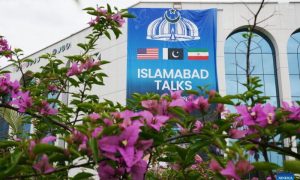
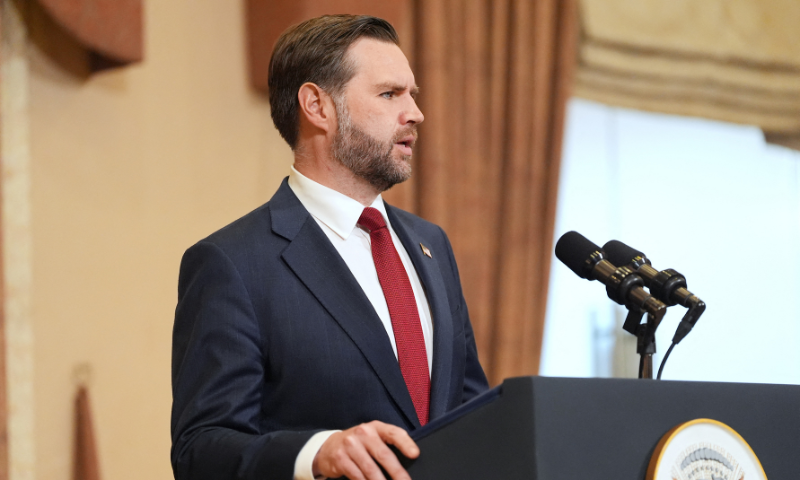



ISLAMABAD: US Vice President JD Vance said on Sunday that Washington and Tehran were unable to reach an agreement after 21 hours of “substantive discussions” held under the Pakistan-mediated “Islamabad Talks”, while praising Islamabad’s role in facilitating the high-stakes dialogue.
Addressing a press conference in Islamabad after negotiations stretched into a second day, Vance described the engagement as serious and detailed, even as key differences remained unresolved.
.@VP in Islamabad, Pakistan: “We’ve had a number of substantive discussions with the Iranians. That’s the good news. The bad news is that we have not reached an agreement — and I think that’s bad news for Iran much more than it’s bad news for the United States of America.” pic.twitter.com/RLIQ30btO5
— Rapid Response 47 (@RapidResponse47) April 12, 2026
Vance signalled that he was still giving time to Iran to consider the offer from the United States, which on Tuesday said it would pause attacks with Israel for two weeks pending negotiations.
“We leave here with a very simple proposal, a method of understanding that is our final and best offer. We’ll see if the Iranians accept it,” Vance told reporters after 21 hours of talks in the Pakistani capital, Islamabad.
Vance said that the core dispute was on nuclear weapons. Iran insists it is not pursuing an atomic bomb, and the United States and Israel bombed sensitive Iranian sites both in the war launched on February 28 as well as last year.
Vice President JD Vance gives an update in Pakistan:
“The simple fact is that we need to see an affirmative commitment that they will not seek a nuclear weapon, and they will not seek the tools that would enable them to quickly achieve a nuclear weapon.” pic.twitter.com/il4THN5DwV
— The White House (@WhiteHouse) April 12, 2026
“The simple fact is that we need to see an affirmative commitment that they will not seek a nuclear weapon and they will not seek the tools that would enable them to quickly achieve a nuclear weapon,” Vance said.
“The simple question is, do we see a fundamental commitment of will for the Iranians not to develop a nuclear weapon — not just now, not just two years from now, but for the long term?
“We haven’t seen that yet. We hope that we will.”
Iran’s foreign ministry said no one had held any expectation that talks with the United States could have reached an agreement within one session after the negotiations in Islamabad stalled on Sunday.
“Naturally, from the beginning, we should not have expected to reach an agreement in a single session. No one had such an expectation,” ministry spokesperson Esmaeil Baqaei said, according to state broadcaster IRIB.
Iran FM Spox.: These negotiations took place after 40 days of imposed war and were conducted in an atmosphere of mistrust and suspicion; it is natural that, from the beginning, we should not have expected to reach an agreement within a single session. No one had such an…
— Mehr News Agency (@MehrnewsCom) April 12, 2026
He said Tehran was “confident that contacts between us and Pakistan, as well as our other friends in the region, will continue”.
Vance, in brief remarks at a luxury hotel in Islamabad where the two sides have been meeting, did not highlight disagreement on another key issue, the reopening of the Strait of Hormuz, the narrow passageway through which one-fifth of the world’s oil transits.
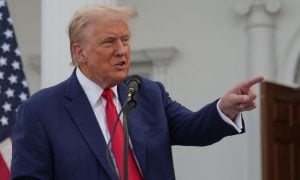
He insisted that President Donald Trump — who on Saturday in Washington said he did not care if the two sides sealed a deal — had been accommodating in the talks.
“I think that we were quite flexible. We were quite accommodating. The president told us, You need to come here in good faith and make your best effort to get a deal.
“We did that and, unfortunately, we weren’t able to make headway.”
“We have been at it now for 21 hours, and we have had a number of substantive discussions; that’s the good news,” said Vance. “The bad news is that we have not reached an agreement.”
He emphasised that the United States had clearly outlined its position during the talks.
“We have made very clear what our red lines are, what things we are willing to accommodate them on and what things we are not willing to accommodate them on,” he said, adding that the Iranian delegation had “chosen not to accept our terms”.
Despite the lack of a breakthrough, Vance strongly appreciated Pakistan’s role, commending its leadership and hospitality.
On the Iranian side, Foreign Ministry spokesperson Esmaeil Baqaei described the talks as intensive and wide-ranging, noting that multiple exchanges took place between the two delegations.
دیپلماسی برای ما ادامه جهاد مقدس مدافعان ایران زمین است. تجربه بدعهدیها و بدسگالیهای آمریکا را فراموش نکرده و نمیکنیم. همانطور که جنایات شنیع ارتکابی آنها و رژیم صهیونیستی در جریان جنگهای تحمیلی دوم و سوم را نخواهیم بخشید.
امروز روز پر کار و طولانی برای هیات نمایندگی جمهوری…
— Esmaeil Baqaei (@IRIMFA_SPOX) April 12, 2026
“In the past 24 hours, discussions were held on various dimensions of the main negotiation topics, including the Strait of Hormuz, the nuclear issue, war reparations, lifting of sanctions, and the complete end to the war against Iran and in the region,” he wrote on X.
He reiterated Tehran’s position that progress depends on “seriousness and good faith”, urging the opposing side to avoid “excessive demands and unlawful requests” while recognising Iran’s “legitimate rights and interests”.
“The success of this diplomatic process depends on the seriousness and good faith of the opposing side, refraining from excessive demands and unlawful requests, and the acceptance of Iran’s legitimate rights and interests,” he said.
Baqaei also expressed appreciation for Pakistan’s role in hosting the negotiations.
He thanked the “government and the warm-hearted and noble people of the Islamic Republic of Pakistan for hosting the negotiations and their benevolent efforts in advancing this process”.
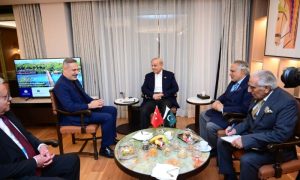
At the conclusion of talks, Pakistan called on the United States and Iran to maintain a “positive spirit” and uphold the ceasefire, as Foreign Minister and Deputy Prime Minister Ishaq Dar stressed Islamabad’s continued commitment to facilitating dialogue following the conclusion of talks in the capital.
Addressing a press conference after the Pakistan-hosted negotiations ended without an agreement, Dar emphasised that diplomacy must continue despite the absence of a breakthrough.
Official statement of Deputy Prime Minsiter Ishaq Dar on US-Iran negotiations. Pakistan expresses gratitude to US, Iran for appreciating Pakistan’s efforts to help achieve the ceasefire.@MIshaqDar50@ForeignOfficePk#IslamabadTalks #Ceasefire… pic.twitter.com/YTu7ThRWro
— Pakistan TV (@PakTVGlobal) April 12, 2026
“We hope that the two sides continue with the positive spirit to achieve durable peace and prosperity for the entire region and beyond,” he said.
Highlighting the importance of maintaining stability, Dar underscored that adherence to the ceasefire remains critical.
“It is imperative that the parties continue to uphold their commitment to ceasefire,” he added.
Reaffirming Pakistan’s diplomatic role, the foreign minister said Islamabad would remain actively engaged in supporting future negotiations between Washington and Tehran.
“Pakistan has been and will continue to play its role to facilitate engagement and dialogue between the Islamic Republic of Iran and the United States of America in the days to come.”
Dar also expressed appreciation to both countries for responding to Prime Minister Shehbaz Sharif’s call for a ceasefire and for accepting Pakistan’s invitation to hold talks in Islamabad.
Iranian state broadcaster IRIB said on Sunday that “unreasonable demands” by the United States had scuppered talks in Islamabad aimed at ending the war in the Middle East.
“The Iranian delegation negotiated continuously and intensively for 21 hours in order to protect the national interests of the Iranian people; despite various initiatives from the Iranian delegation, the unreasonable demands of the American side prevented the progress of the negotiations. Thus, the negotiations ended,” IRIB said on Telegram.
Although the marathon talks concluded without an agreement, both sides remained engaged throughout, highlighting Pakistan’s growing role as a credible mediator at a critical moment for regional diplomacy.
The talks took place during a two-week ceasefire in the US–Israeli war against Iran, which began with attacks on February 28.
The conflict, which spread across the Middle East and sent shockwaves through global economies, was paused after Pakistan brokered a temporary ceasefire on April 8.
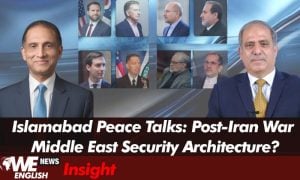
Delegations from both countries arrived in Islamabad to participate in the negotiations.
The US delegation was led by Vice President JD Vance and included Jared Kushner, son-in-law of President Donald Trump, as well as Middle East envoy Steve Witkoff.
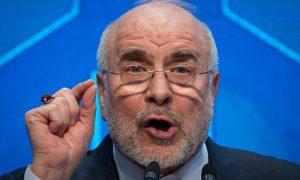
The Iranian delegation was headed by Parliament Speaker Mohammad Bagher Ghalibaf and included Foreign Minister Abbas Araghchi, along with other senior officials.