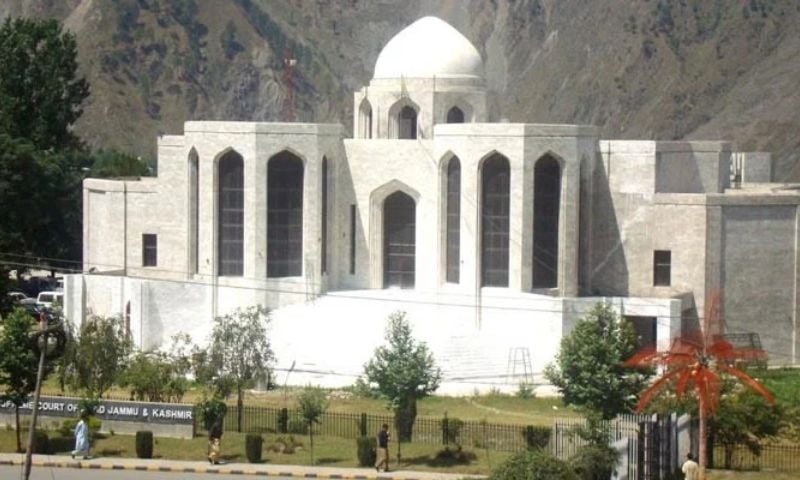
Key Points
- Court traces refugee seats back to electoral arrangements beginning in 1960 and later constitutional reforms
- Describes refugee representation as a “continuously affirmed constitutional principle” reflecting post-1947 displacement
- Rules that road blockades and forced shutdowns are not protected under the right to peaceful protest
- Says coercive protest methods cannot be used to force constitutional change and are legally unenforceable
- Clarifies the advisory opinion is non-binding and meant to assist constitutional interpretation, not settle disputes
- Notes refugee seats have remained intact through successive constitutional frameworks, including the 13th Amendment
MUZAFFARABAD, Pakistan: The Azad Jammu and Kashmir (AJK) Supreme Court on Sunday held that the 12 seats reserved for refugees in the Legislative Assembly are constitutionally safeguarded and cannot be altered through administrative decisions, political understandings or public pressure, according to a detailed advisory opinion issued on a presidential reference.
The opinion delivered by the AJK Supreme Court reaffirmed that any change to the structure of the Assembly must strictly follow the constitutional amendment procedure laid down in Article 33 of the AJK Constitution. It ruled that no executive authority, political agreement or extra-constitutional mechanism can lawfully amend or bypass these provisions.
The 53-member Azad Jammu and Kashmir Legislative Assembly includes 12 reserved seats for Kashmiri refugees who migrated from Indian Illegally Occupied Jammu and Kashmir (IIOJK) following the conflicts of 1947 and 1965, and are presently settled in various parts of Pakistan.
Of these, six seats represent refugees from the Jammu division, estimated at around 434,000 individuals, while the remaining six represent refugees from the Kashmir Valley, with an estimated population of nearly 30,000. The arrangement has long been a subject of political debate and demands for reform.
The issue of refugee representation has also remained central to the agenda of the now-banned Joint Awami Action Committee (JAAC), which organised widespread protests last year that turned violent and resulted in multiple fatalities.
In its opinion, the court traced the constitutional and historical evolution of refugee representation, stating that the arrangement originates from electoral frameworks introduced in 1960 and was subsequently reinforced through legal and constitutional developments in 1964 and 1970, before being explicitly incorporated into the Constitution through the 13th Amendment.
Describing the arrangement as a “constitutional expression of a profound historical and juridical truth”, the court observed that refugee representation reflects the displacement of Kashmiris following Partition and subsequent conflict, and has been consistently preserved through successive legal instruments.
It further emphasised that constitutional change must follow the prescribed procedure under Article 33, describing the amendment mechanism as “exhaustive and exclusive”. The court made clear that no authority other than the legislature acting within constitutional limits can alter the composition of the Assembly.
The opinion categorically rejected the validity of executive orders, political settlements or protest-driven demands aimed at altering constitutional provisions. It stressed that constitutional change must arise through “public mandate, parliamentary deliberation and due legal procedure”.
A substantial portion of the ruling addressed the use of protests and civil agitation. While reaffirming the constitutional right to peaceful assembly, the court noted that such rights are not absolute and must be exercised within the limits of public order and respect for the rights of others.
It warned that road blockades, forced shutdowns and disruption of supply chains fall outside constitutional protection. The court observed that “the exercise of one fundamental right cannot be permitted in a manner that substantially impairs or destroys the rights of others”.
It further held that coercive methods to secure constitutional change are legally unenforceable and incompatible with the rule of law, adding that while peaceful dissent is protected, actions undermining public order are not.
The court also highlighted the constitutional obligation to hold timely elections under Article 22(4), stating that general elections must be conducted within the prescribed timeframe without exception or delay.
It directed the Election Commission and relevant authorities to ensure that free, fair and transparent elections are held on schedule, with all necessary arrangements in place to maintain orderly polling conditions.
The court also noted that refugee seats have existed in various forms since 1960 and have remained intact through successive constitutional arrangements. It described this continuity as evidence of a “deep-rooted constitutional commitment” rather than a temporary administrative provision.
The opinion clarified that it is advisory in nature and does not create enforceable rights between parties, emphasising that the reference was intended to assist constitutional authorities in interpretation rather than resolve a formal dispute.
The ruling comes just days after the AJK government declared the Joint Awami Action Committee a banned group, accusing it of involvement in terrorism, incitement of hatred and attempts to create anarchy ahead of its planned protest on June 9.
The decision also coincided with the announcement by the AJK Election Commission that general elections will be held on July 27. Preparations, it said, are underway to ensure transparent and impartial polling under judicial oversight.
Political tensions surrounding refugee seats have persisted for years, intensifying during the protest movement led by JAAC last year, which demanded sweeping governance reforms, abolition of privileges for elites, removal of refugee-reserved seats and scrapping of the quota system.
Violent unrest during the protests resulted in at least nine deaths, including police personnel, during one of the region’s most turbulent periods in October 2025.
Following the unrest, the government and JAAC reached an agreement covering multiple points and agreed to form a high-level committee to examine the refugee seat issue. However, differences persisted over implementation.
The political crisis also led to a no-confidence motion against the then prime minister, Chaudhry Anwarul Haq, supported by opposition parties including the Pakistan Muslim League-Nawaz. He ultimately lost office after a subsequent vote in the Assembly. Raja Faisal Mumtaz Rathore later emerged as prime minister following the legislative process.
With elections approaching, the government convened an All Parties Conference in Muzaffarabad to build consensus on key issues, including refugee representation. Most major parties attended, except Pakistan Tehreek-e-Insaf (PTI) and JAAC, both of whom boycotted the meeting.
JAAC maintained that the government had already dismissed its written proposals submitted on May 30, rendering participation meaningless. It had proposed either retaining symbolic representation for refugees until the Kashmir dispute is resolved or replacing the 12 seats with four seats in the AJK Council, chaired by the prime minister, arguing that it would better reflect the political dimensions of the Kashmir issue.
However, the All Parties Conference rejected any changes outside the constitutional framework, stating that only the elected Assembly had the authority to amend refugee seat provisions. JAAC criticised the outcome accusing participants of prioritising political interests over public concerns.