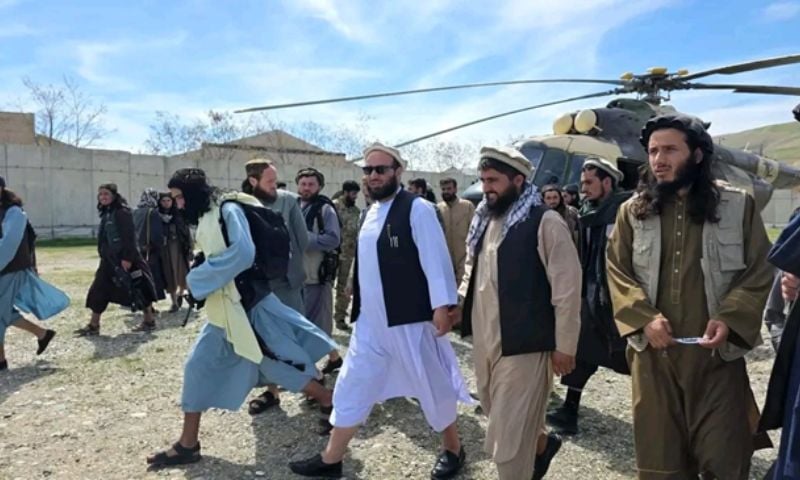
KABUL, Afghanistan: The Afghan Taliban regime has arrested a local commander in Afghanistan’s northeastern Badakhshan province and transferred him to Kabul, Afghan media reported, citing local sources, in the latest sign of growing internal divisions within the group’s ranks.
At least three local sources, cited by Afghanistan International, said that Commander Juma Khan Fateh, a Tajik Taliban commander, was arrested in Kuran wa Munjan district on Saturday. The sources said he had previously served in the Taliban regime’s armed forces but had been removed from his post several months ago.
According to the sources, no information has been released about Juma’s condition or whereabouts.
The arrest comes amid increasing division between several local Taliban commanders and the group’s leadership over appointments, control of resources and mining sites and security measures in Badakhshan.
Meanwhile, Afghanistan International reported, citing sources in northeastern Afghanistan, that Juma Khan Fateh, after disagreements with the Taliban regime’s leadership, has increased military activity in the Darwaz area of Badakhshan.
According to informed sources, Fateh has organised his forces in recent days and held extensive meetings with residents in the Nusay district.
The sources said he has strengthened the deployment of fighters under his command and increased his presence in the field.
Sources close to Fateh told Afghanistan International that Taliban officials had attempted to persuade him to return to the movement by offering him a new position, but that he rejected the proposal.
Two sources who recently met him quoted Juma Khan Fateh as saying: “I am in my own home. I do not want a position. I will stay here. I will not fire the first shot.”
The same sources said Juma Khan Fateh had nevertheless kept his forces on high alert and remained prepared both militarily and logistically.
They added that he believed the mountainous terrain of Badakhshan would make it difficult for Taliban forces from Kabul to conduct a successful military operation against his positions.
According to Afghanistan International, the Taliban regime leadership has recently sought to contain growing discontent in the province by establishing a special commission to examine internal disputes.
Earlier reports also indicated that several local Taliban commanders and the group members in Badakhshan had been dismissed, arrested or sidelined amid disagreements over appointments, mining resources and the leadership’s policies, according to Afghanistan International.
Meanwhile, local sources, cited by Hasht-e Subh Daily, said that a Taliban regime leadership delegation visited Badakhshan and met local commanders in the Darwaz area of Shighnan district to discuss the recent unrest.
According to the sources, the meeting focused on maintaining security in the district, preventing armed individuals—most of whom were described as members of Juma Fateh—from moving freely, and continuing the destruction of poppy fields.
Hasht-e Subh Daily reported that the delegation was led by the Taliban regime’s Director General of Intelligence Abdul Haq Wasiq. It also included the Taliban regime’s Army Chief of Staff Fasihuddin Fitrat, interim Economy Minister Din Mohammad, Director General of the Supreme Directorate for Monitoring and Follow-up of Decrees and Orders Shamsuddin Shariati, and Helmand Governor Amanuddin Mansouri.
The meeting took place after tensions escalated in Badakhshan. According to media reports, Taliban fighters had also begun collecting weapons from residents and mine workers in the village of Abkandah in the province.
According to Afghanistan International, Juma Khan Fateh is regarded by his supporters as one of the Taliban regime’s most influential commanders in northeastern Afghanistan and is known as the “Conqueror of Darwaz”.
The outlet reported that he was recently removed from his post as deputy governor of Zabul following a dispute with the Taliban regime leadership in Kandahar over the management of local resources and gold mines.
Observers cited by Afghanistan International believe his dismissal without another appointment reflects a broader effort by the Taliban leadership to sideline non-Pashtun commanders within the group.
Afghanistan International reported that Fateh’s military preparations and his refusal to accept a new position have intensified attention on the possibility of a confrontation between the dissident commander and the Taliban leadership.