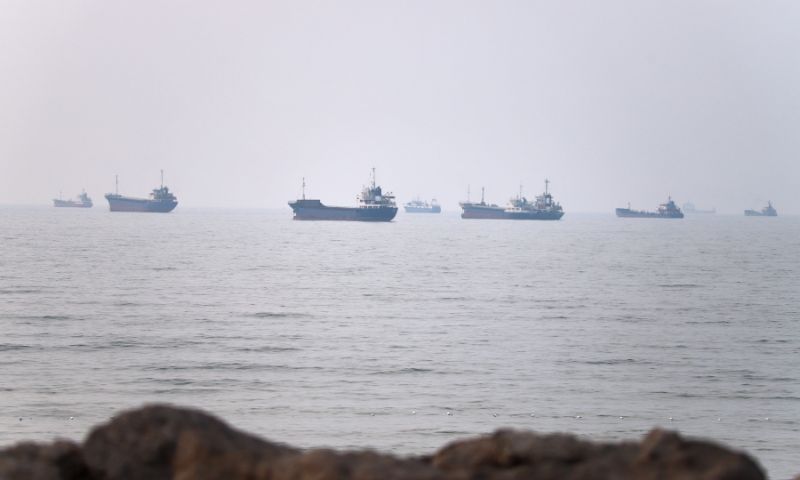



DUBAI: Three commercial tankers, including a Qatari liquefied natural gas (LNG) carrier, were struck by projectiles in the Strait of Hormuz within hours on Tuesday, the United Kingdom Maritime Trade Operations (UKMTO) centre said.
The maritime monitor added that the latest tanker to be hit is said to be travelling off the coast of Oman and caught fire.
UKMTO WARNING 082-26
Click here to view UKMTO Products⤵️https://t.co/WONv2QkMJu#MaritimeSecurity #MarSec pic.twitter.com/mJIxl6Y93G
— UKMTO Operations Centre (@UK_MTO) July 7, 2026
Meanwhile, Iranian state television said the LNG tanker came under attack after ignoring warnings.
Earlier, two tankers were also hit, including one that was struck by a drone. Both of those ships sustained some damage, but no injuries have been reported by the UKMTO.
UKMTO WARNING 081-26
Click here to view UKMTO Products⤵️https://t.co/sSgZDMWUc1#MaritimeSecurity #MarSec pic.twitter.com/tUpBCML5PZ
— UKMTO Operations Centre (@UK_MTO) July 7, 2026
An “unknown projectile” hit a tanker overnight, causing a fire, before two more were hit, at least one by a drone, UKMTO said earlier.
UKMTO WARNING 080-26 – ATTACK
Click here to view UKMTO Products⤵️ https://t.co/Oc7hGsk3Do#MaritimeSecurity #MarSec pic.twitter.com/uK8cm9a76M
— UKMTO Operations Centre (@UK_MTO) July 6, 2026
The string of attacks after more than a week of respite revived concerns about freedom of navigation after Iran lifted its blockade of the vital waterway following a ceasefire with the United States.
All three vessels were struck close to Oman. Oman had proposed a temporary transit corridor hugging its coastline.
Qatar blamed Iran for the attack on its tanker and urged Tehran to “cease all practices that undermine regional security or threaten the safety of international maritime navigation”.
“The targeting of the Qatari vessel ‘Al-Rekayyat’ while transiting near the Strait of Hormuz constitutes an unacceptable attack on the security and safety of international maritime navigation,” Qatar’s foreign ministry spokesman Majed Al Ansari wrote on X.
The targeting of the Qatari vessel "Al-Rekayyat" while transiting near the Strait of Hormuz constitutes an unacceptable attack on the security & safety of international maritime navigation, the security of global energy supplies, & a grave & explicit violation of international…
— د. ماجد محمد الأنصاري Dr. Majed Al Ansari (@majedalansari) July 7, 2026
“We hold Iran fully legally responsible for this attack and for any resulting damages or repercussions,” he added.
The future of Hormuz, the main route for energy exports, has been a sticking point during talks between Tehran and Washington to permanently end the conflict.
Qatar summons Iran’s envoy
Later on Tuesday, Qatar summoned Iran’s deputy ambassador and lodged a formal protest over the targeting of a Qatari-owned liquefied natural gas (LNG) carrier in the Strait of Hormuz.
Qatar’s Foreign Ministry, in a statement posted on X, said the incident constituted a “serious violation of international navigation safety”, a “direct threat to the security of global energy supplies” and a “clear and explicit breach of the rules of international law”.
الخارجية تستدعي نائب السفير الإيراني وتسلّمه مذكرة احتجاج على استهداف الناقلة القطرية "الركيات"
الدوحة | 7 يوليو 2026
أعربت دولة قطر عن إدانتها واستنكارها الشديدين لاستهداف الناقلة القطرية "الركيات" أثناء عبورها قرب مضيق هرمز، مؤكدة أن هذا الاعتداء يمثل انتهاكًا خطيرًا لسلامة… pic.twitter.com/aMHmBs3i5Q
— الخارجية القطرية (@MofaQatar_AR) July 7, 2026
The ministry called on Tehran to immediately halt all actions that threaten regional security and jeopardise the safety of international shipping lanes and global energy supplies.
In addition, it called on Iran to provide urgent clarifications regarding this targeting, take immediate measures to prevent its recurrence, and fully comply with the relevant rules of international law.
Qatar stressed its right to take whatever measures it deems appropriate in accordance with international law to protect its interests and capabilities.
Maritime traffic had tentatively resumed after Washington and Tehran signed the Islamabad memorandum of understanding last month aimed at ending the conflict and reopening the strategic route.
Under the 14-point US-Iran Islamabad MoU, Iran and Oman, which border Hormuz, must hold talks “to define the future administration and maritime services” in the key waterway with other Gulf states.