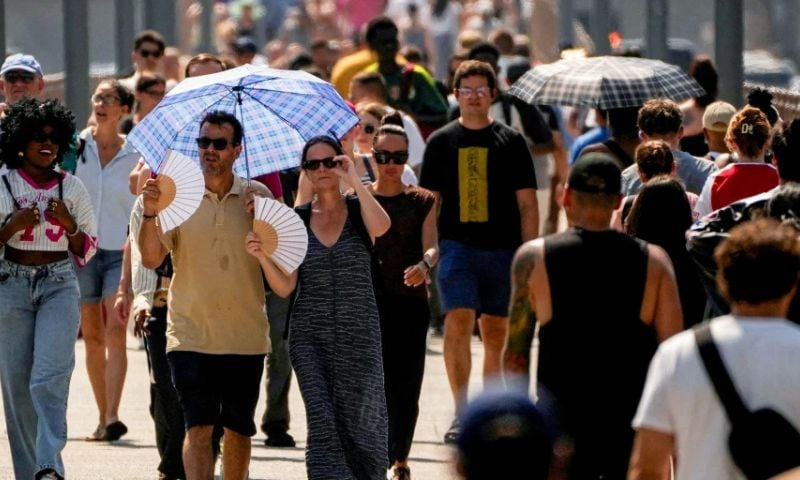
WASHINGTON: Record-breaking heat spread across the eastern United States on Wednesday, placing tens of millions of people under heat warnings as forecasters warned of dangerous conditions through the Independence Day holiday weekend while the country co-hosts the FIFA World Cup 2026.
A “heat dome” – a high-pressure weather system that traps hot air over a region – has persisted over parts of the Midwest and the South and is now moving eastwards. Around 46 million people are currently under heat alerts, according to Reuters.
The extreme conditions are expected to push “real-feel” temperatures to between 100 and 115 degrees Fahrenheit (38 to 46 degrees Celsius) across much of the eastern United States, increasing the risk of heat-related illnesses and placing additional strain on electricity grids already under pressure from rising demand.
From Thursday, Washington is forecast to experience three consecutive days with temperatures above 100F (38C), peaking at around 104F (40C) on Friday.
According to AFP, if forecasts prove accurate, daily temperature records could be broken on each of those days, while the city’s all-time record high of 106F (41C) could also be threatened.
New York prepares for extreme heat
New York Mayor Zohran Mamdani warned residents that the city could experience its most severe heatwave in more than a decade.
“We are entering what could be the most extreme heat wave this city has seen in over a decade,” Mamdani said in a video message.
He urged residents to remain safe while attending FIFA World Cup matches, celebrating the July Fourth holiday or taking part in other events across the city.
New York has opened hundreds of cooling centres, deployed more than a dozen mobile “cool vans” equipped with drinking water, electrolytes, sunscreen and meals, extended public swimming pool hours, and expanded outreach to vulnerable residents.
At a senior centre in Harlem, director Richard Allman said the facility would remain open beyond its normal operating hours throughout the holiday weekend.
“We try to make this a comfortable place for people on an extra-hot day,” Allman told Reuters.
City authorities have also asked operators of electronic billboards in Times Square to reduce brightness to conserve electricity and requested businesses to keep air conditioning thermostats no lower than 78F (26C).
Utility provider Con Edison has urged customers to limit electricity consumption during peak afternoon and evening hours.
Heat affects daily life
The heatwave has disrupted daily life across several states.
In Hill City, Kansas, postal worker Sabrina Hooper said delivering mail in temperatures exceeding 100F had become physically exhausting.
“It’s completely debilitating,” Hooper told Reuters, adding that she occasionally cooled herself under lawn sprinklers while completing her route.
In Chicago, science teacher Michelle Klein said she had prepared for the heat by completing shopping early, filling her vehicle with fuel, storing extra cold drinks and watering plants before temperatures peaked.
Property investor Amy Kaspar said a tenant reported an air-conditioning failure during the heatwave, although the unit was functioning normally and simply could not cool the apartment sufficiently in the extreme conditions.
“Combined with the wind, it feels like standing behind the exhaust of a bus right now in Chicago,” she told Reuters.
World Cup and holiday events
The heatwave comes as the United States prepares to celebrate the 250th anniversary of its independence on Saturday, with fireworks displays planned in major cities including New York and Washington.
Fireworks generate spikes in fine particulate pollution, which can worsen respiratory illnesses. Combined with extreme heat, the effects may pose additional health risks.
The conditions are also affecting the FIFA World Cup.
Temperatures of around 102F (39C) are forecast for Saturday’s World Cup match between Paraguay and France in Philadelphia, where the fixture will be played in an open-air stadium rather than an air-conditioned venue.
Tournament organisers have introduced mandatory three-minute hydration breaks during each half to help reduce the risk of heat-related illness among players.