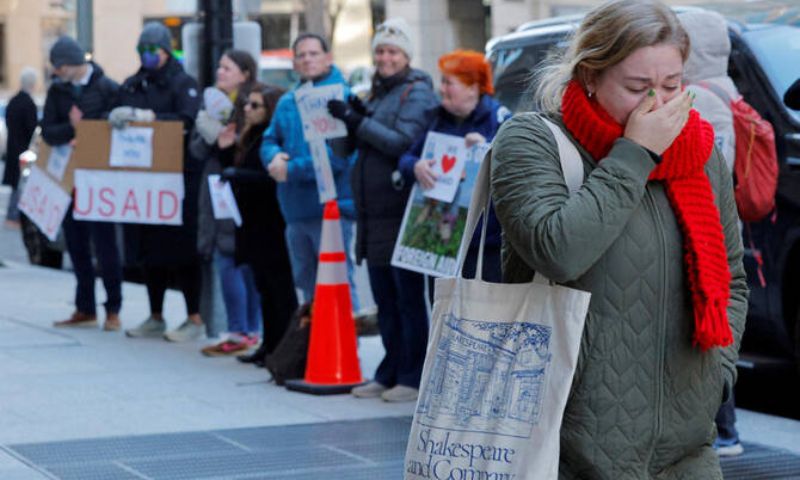
WASHINGTON: A year after the Trump administration shut down the US Agency for International Development (USAID), a new nationwide survey suggests that a majority of Americans continue to support overseas development assistance, particularly when they are informed about its cost and benefits.
The poll, commissioned by the Rockefeller Foundation and conducted by Echelon Insights between June 12 and 16, surveyed 2,022 registered voters across the United States.
It found that backing for foreign aid increased markedly after respondents received factual information about government spending and the role such programmes play in addressing global crises.
Initially, 54 per cent of respondents said they supported foreign aid. However, support climbed to 70 per cent after participants were told that international assistance accounted for only around one per cent of the federal budget before 2025 and were informed about its contribution to disaster relief, disease prevention and global security.
The findings also revealed widespread misconceptions about US foreign aid spending. Nearly all respondents significantly overestimated the amount allocated to overseas assistance, with more than one-third believing it represented about 20 per cent of the national budget.
Support extended beyond Democratic voters. Among Republicans, approval for foreign aid rose to 58 per cent after additional information was provided, while half of respondents identified as supporters of President Donald Trump’s “Make America Great Again” (MAGA) movement also backed continued assistance.
The Trump administration made reducing foreign aid a central part of its “America First” agenda and formally dismantled USAID shortly after President Trump returned to office in January 2025. The agency’s closure led to the dismissal of more than 10,000 employees and contractors, while thousands of international development programmes were terminated.
According to official US figures, American foreign aid spending declined from approximately $72 billion in the 2024 fiscal year to $47 billion in fiscal year 2025 following the agency’s closure.
Researchers have warned that the reductions could have severe humanitarian consequences. A study published in The Lancet last year estimated that the cuts may contribute to more than 14 million additional deaths worldwide by 2030 if critical health and development programmes are not restored.
Overall, 78 per cent of respondents said the United States should either maintain or increase spending on foreign assistance.
John Gans, project lead at the Rockefeller Foundation and a former Pentagon speechwriter, said the findings challenged the perception that Americans had turned against international engagement.
He argued that most voters continue to see value in helping vulnerable populations overseas and recognise the broader benefits of supporting humanitarian programmes.
The survey also found that attitudes shifted considerably when respondents considered specific aid initiatives. Support was particularly strong for programmes aimed at preventing disease outbreaks, promoting peace and responding to humanitarian emergencies.
Among Republican respondents, 62 per cent supported restoring funding to combat the Ebola outbreak in the Democratic Republic of Congo after learning that experts linked reductions in US funding to the worsening spread of the disease. Support among MAGA voters reached 52 per cent.
The Trump administration has since requested more than $1.4 billion in additional funding from Congress to help contain the expanding Ebola outbreak.
When asked about the future of US foreign assistance, 80 per cent of those surveyed favoured reforming aid programmes and strengthening oversight rather than abolishing them altogether. Only 12 per cent supported eliminating foreign aid regardless of its humanitarian or strategic impact.