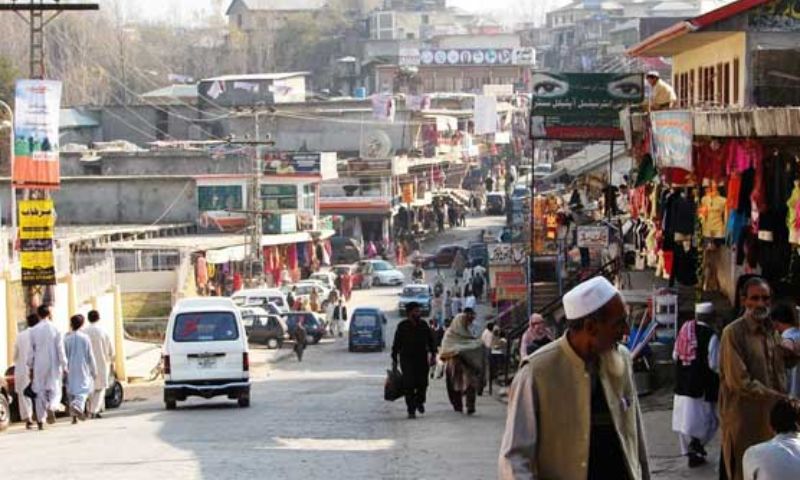
MUZAFFARABAD: Markets, shops, public transport, and most other businesses resumed normal operations across Muzaffarabad and other cities of Azad Jammu and Kashmir (AJK) on Sunday, marking a significant return to normalcy after weeks of disruption linked to elements associated with the proscribed Joint Awami Action Committee (JAAC).
While some localized road blockades and business closures continue in parts of the region, authorities and traders expressed confidence that the disruptions would gradually be cleared within a few days.
The reopening followed an announcement by traders and transporters in the Muzaffarabad division on Saturday, after the administration assured them of adequate security and uninterrupted fuel supply.
The decision signaled the first major easing of the shutdown that had affected commercial and transport activities across parts of AJK.
At a joint press conference at the Central Press Club on Saturday, representatives of leading traders’ associations and the transporters’ union urged shopkeepers to reopen their businesses and appealed for the restoration of internet services to facilitate commercial activity.
They also called on protesters to resolve outstanding issues, if any, through negotiations rather than confrontation involving JAAC elements.
The representatives distanced themselves from the proscribed Joint Awami Action Committee, stating that they had initially supported the movement when it focused on public welfare issues such as subsidised electricity and flour.
However, they said that after June 9, the movement had shifted towards political and constitutional matters beyond the mandate of traders and transporters.
As news of the decision spread, shops in several neighbourhoods of Muzaffarabad began reopening on Saturday afternoon, with commercial activity gathering momentum on Sunday.
Public transport services also resumed across the Muzaffarabad division after operators received assurances regarding fuel availability and security.
Speaking at the press conference, Gohar Kashmiri, senior vice chairman of the Markazi Anjuman-i-Tajran Muzaffarabad, said traders had fully supported the movement while it focused on securing relief for ordinary citizens, including reduced electricity tariffs and subsidised flour.
He added that traders could not support the inclusion of constitutional issues in the movement’s charter of demands, arguing that such matters should be resolved through legal and democratic processes.
Raja Abrar Mustafa, president of the Madina Market Traders Association, said traders had backed the campaign for nearly three years because it focused on basic public issues, but it turned violent later.
He stressed that constitutional matters, including the issue of 12 reserved seats for refugees from occupied Jammu and Kashmir, should be decided by the elected assembly rather than traders.
Khawaja Azam Rasool, president of the Divisional Transport Operators Union, said transport services had remained suspended mainly due to road blockades and fuel shortages that posed risks to public transport vehicles.
Following assurances from the administration, he said, services had resumed across the Muzaffarabad division from Sunday.
Meanwhile, some localized disruptions persist in parts of the Poonch division, where minor sit-ins and road blockades continue on the outskirts of Rawalakot.
Residents in Hajira staged a demonstration demanding the reopening of roads linking the town with Rawalakot and Abbaspur, warning they would remove the barriers themselves if normal traffic was not restored.
Despite these isolated disruptions, commercial activity has largely resumed across Muzaffarabad and many other urban centres of AJK.
Traders and transporters expressed optimism that the remaining closures and blockades would be resolved soon, allowing business and transport operations across the region to return fully to normal in the coming days.
The Azad Jammu and Kashmir government has registered a case under Section 124-A of the Azad Jammu and Kashmir Penal Code (APC) against Khawaja Mehran Arshad, a key ringleader of the proscribed JAAC), following a highly provocative speech targeting the country’s security architecture.
The First Information Report (FIR) was formally lodged at the Civil Secretariat Police Station in Muzaffarabad after intelligence and local monitoring units verified the contents of Arshad’s address, delivered on June 14, 2026, at Dreck, Rawalakot.
According to official sources, Arshad, originally hailing from Dadyal, District Mirpur, openly incited Kashmiri personnel serving within the Armed Forces of Pakistan to revolt against their institution.
Senior officials stated that the speech marks a dangerous departure from the civic and economic narrative the JAAC originally claimed to represent.
“The state displayed maximum tolerance when the group raised domestic economic demands, but actively inciting mutiny within the military crosses the ultimate constitutional red line,” an official stated. “This is no longer dissent; it is an overt act of rebellion against the state’s security apparatus.”
The development came just weeks after the AJK Home Department banned the JAAC under the Anti-Terrorism Act following a string of violent confrontations, attacks on law enforcement, and disruptive blockades across AJK.
Security analysts argue that the timing and nature of Arshad’s remarks point to a deeper, more malicious agenda orchestrated at the behest of external adversaries.
Investigators are currently probing financial and digital footprints to identify potential linkages between the JAAC core committee and hostile foreign elements looking to exploit local fault lines.
The state has vowed to take unyielding action against all facilitators of the network, reiterating that while peaceful negotiation remains open for civic groups, zero tolerance will be extended to entities attempting to orchestrate institutional anarchy.