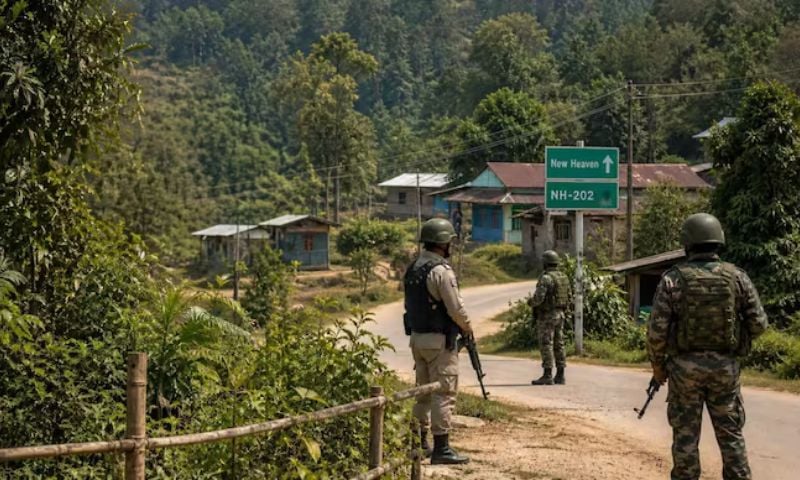
NEW DELHI, India: An economic blockade in India’s Manipur’s Kangpokpi district has triggered a severe humanitarian crisis, with prices of essential commodities spiralling far beyond the reach of ordinary households. Rice, petrol, and cooking gas have all seen sharp increases since May 13, when supply lines along National Highway-2 were severed following ethnic clashes.
The crisis, which has left a 50-kilogram bag of rice at INR 4,000 and an LPG cylinder at INR 5,000, has drawn no concrete response from the Union Home Ministry or the Manipur government, raising questions about the state’s commitment to protecting its most vulnerable citizens.
Manipur’s Kangpokpi district is witnessing a deepening humanitarian crisis as shortages of food, fuel and necessities hit several villages.
In this interview with @vijaita, a Kuki community leader explains how the blockade is affecting daily life, what the government is doing,… pic.twitter.com/JeHYystFAk
— The Hindu (@the_hindu) June 26, 2026
Manipur’s Kangpokpi district is witnessing a deepening humanitarian crisis as shortages of food, fuel and basic necessities hit several villages.
In an interview with The Hindu’s Vijaita Singh, a Kuki community leader from the region has shed light on the grim reality on the ground. The leader explained how the ongoing economic blockade has paralysed daily life, leaving families struggling to afford essentials such as rice, cooking gas and petrol.
He also discussed the government’s response, or lack thereof, and why tensions between the Naga and Kuki communities remain a major concern for the district’s fragile peace.
“The poor are always the worst affected by such incidents,” said Thangminlen Kipgen, president of Sadar Hills (Kangpokpi), a local civil society group. “Because of shortage of cooking gas, people switched to induction tops, which is leading to frequent power cuts of seven to eight hours. The cost of transportation has gone up. There is no way to control this local inflation. It has an effect on all commodities.”
Manipur-
Since Feb 4, after President’s Rule revoked, at least 40 people killed.
Kangpokpi, a Kuki district, cut off due to economic blockade by Naga groups, rice selling for Rs 4000/bag, nil supply of LPG, petrol-around 280/L, 8-10 hour power cuts.
Deputy CM Nemcha Kipgen, also…— Vijaita Singh (@vijaita) June 26, 2026
The human toll behind the blockade
The economic damage extends well beyond the price of rice. Small businesses, the tea stalls, hardware shops, and pharmacies that constitute Kangpokpi’s modest commercial ecosystem, are losing inventory and customers simultaneously.
Farmers who depend on valley markets for their produce are cut off from buyers. Schools that rely on mid-day meal supplies from outside the district face disruption. The blockade does not merely raise prices; it disrupts the everyday economic infrastructure that holds a community together.
The psychological toll, while harder to quantify, is no less significant. When a community watches its supply lines controlled by forces and dynamics it did not choose, the pressure builds in every household.
PRESS HANDOUT SUMMARY
Kuki-Zo Council (KZC) | 25 June 2026The Kuki-Zo Council (KZC) has expressed concern over what it describes as selective security actions, unequal justice, and the continued hardships faced by Kuki-Zo people across Manipur. While condemning the killing of… pic.twitter.com/56pQSFL7ft
— Mighty Warrior Kuki (@Kamginthan40473) June 25, 2026
Roots of the crisis: Ethnic tensions and economic strangulation
The crisis has been triggered by an economic blockade imposed since May 13, when three Thadou pastors were killed in the Kuki-dominated district. Since then, Naga village volunteers have blocked National Highway-2, the arterial road connecting Kangpokpi to Dimapur in Nagaland, cutting off about 70% of daily supplies.
Manipur is home to three major communities: the Meitei, who dominate the Imphal valley, and the tribal Kuki-Zo and Naga people, who largely live in the surrounding hills.
Since ethnic violence first erupted on May 3, 2023, around 300 people have lost their lives. At least 40 people have been killed since February 4, when President’s Rule was revoked and an elected government was restored.
The blockade intensified after the bodies of six missing Naga men, including two pastors, were recovered from Kangpokpi on June 10. They had been abducted on May 13, the same day the three Thadou church leaders were killed in an ambush. At least 44 civilians were reportedly taken hostage by Kuki and Naga groups in Kangpokpi and neighbouring Senapati district.
Political grammar of blockades: Valley controls roads, hills bear the burden
To frame this purely as a supply-chain disruption is to miss the power dynamics underneath. Every blockade in Manipur has a political grammar. The valley controls most arterial roads; hill communities depend on them. When those roads are choked, whether by explicit barricade or by conditions that make transit dangerous, hill communities bear a disproportionate burden.
The Kuki-Zo Council has publicly flagged its alarm in community statements. Meanwhile, Meitei civil society organisations and valley-based groups have their own account of the conflict’s dynamics. Several Meitei groups have previously cited security threats from hill-based armed outfits as justification for road restrictions and have called for stronger state intervention against insurgent activity in the hills.
Community statements have also flagged concern over alleged NSCN-IM activity and allied armed outfits operating along routes that serve as Kangpokpi’s supply arteries. These allegations have not been independently corroborated, and no response from NSCN-IM or associated groups was available as of this report.
The Kuki community expresses deep concern over reports and allegations regarding the activities of NSCN-IM, NSCN Eastern Flank, ZUF (Kamson Group), Shan National Army, and Junta Military elements in parts of Manipur, including Kangpokpi, Ukhrul, Kamjong, and Senapati districts.… pic.twitter.com/S5mJ1LBS9f
— Mighty Warrior Kuki (@Kamginthan40473) June 25, 2026
Deputy Chief Minister unable to reach Imphal
The blockade has become so severe that even senior government officials are unable to travel freely. Deputy Chief Minister Nemcha Kipgen, who represents Kangpokpi in the Manipur Legislative Assembly, has been unable to reach the state capital Imphal since the elected government was restored in February. She continues to attend cabinet meetings virtually, four months after taking oath.
Haokholet Kipgen, MLA from the Saitu constituency in Kangpokpi, confirmed that LPG supply has completely stopped. “There is nil supply of LPG cylinders. The few cylinders already in the district are being sold at ₹5,000,” he told The Hindu.
Government response: Absence of urgency
The Union Home Ministry had not issued a public statement specifically addressing the Kangpokpi blockade as of this report. The Manipur state government has not publicly outlined a concrete relief or road-reopening plan for the district. Article 355 of the Constitution places a duty on the Centre to protect states from internal disturbance, a provision that raises questions about the pace and visibility of Central engagement with the crisis.
In an editorial assessment, Kangpokpi’s marginal weight in national electoral arithmetic, Manipur’s two Lok Sabha seats are already factored into coalition calculations, may partly explain the absence of the kind of high-profile Central mobilisation seen when supply disruptions hit larger or more electorally significant regions.
Compare this with the speed at which the machinery of state, emergency supply airlifts, ministerial statements, NDRF deployments, mobilises when highway blockades disrupt supply to major cities elsewhere in India. The contrast in pace is notable.
Security forces step in – but roads remain blocked
Security forces have launched operations to restore normalcy. According to Manipur police, approximately 30 bunkers set up by village volunteers have been dismantled, and 114 checkpoints have been installed across both hill and valley districts.
Police officials confirmed that 392 vehicles carrying essential items have been able to move along National Highway-37, which connects Manipur to Assam. “Strict security measures have been taken at all vulnerable locations. Security convoys are being provided on sensitive stretches to ensure the free and safe movement of vehicles,” a police statement said.
However, National Highway-2 remains blocked, and the supply situation in Kangpokpi shows no immediate signs of improvement.
The limitless price hike in Kuki-dominated Kangpokpi is not due to US-Iran tension, but due to the indefinite economic blockade imposed upon the Kuki community. The central must intervene on humanitarian grounds@fooddeptgoi @JoshiPralhad @HMOIndia @PMOIndia @MIB_India @vijaita https://t.co/lRuVhcDINf pic.twitter.com/ZC7aluZ5jC
— Sumkawn (@Sumkawn) June 26, 2026
Where is Manipur?
Manipur is a northeastern state of India, bordered by Nagaland to the north, Mizoram to the south, and Assam to the west. It shares an international border with Myanmar to the east.
The state capital is Imphal, located in the central valley. Kangpokpi district lies to the north of Imphal, along the border with Nagaland, and is predominantly inhabited by Kuki-Zo and Naga tribal communities.
What is the Manipur crisis?
The ongoing ethnic conflict stems from long-standing tensions between the valley-dwelling Meitei community and the hill-dwelling tribal communities, primarily the Kuki-Zo and Naga peoples.
Disputes over land, resources, political representation, and Scheduled Tribe status have fuelled decades of mistrust. The violence that erupted in May 2023 has claimed hundreds of lives and displaced tens of thousands.