
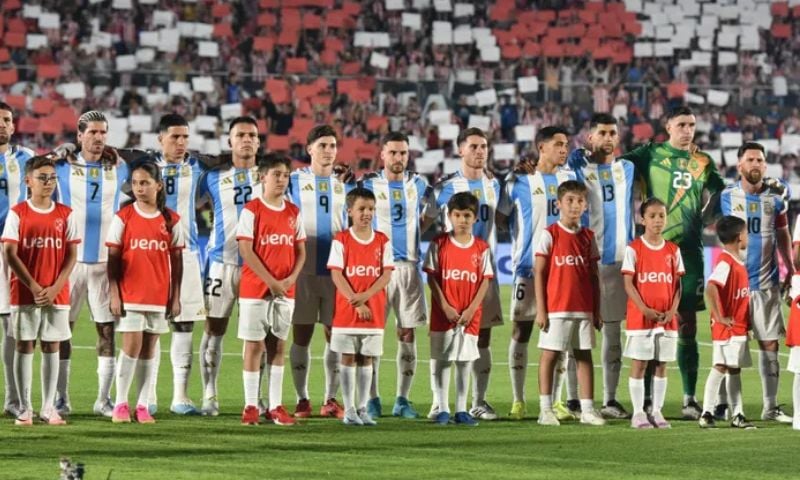
ISLAMABAD: As the FIFA World Cup 2026 enters its thrilling knockout stages, one heartwarming pre-match ritual continues to captivate fans worldwide. Known as “player escorts” or “match mascots,” this tradition sees young children walk onto the pitch hand-in-hand with their footballing heroes, a sight that brings smiles to millions.
Before the action begins and the goals are scored, we watch football’s biggest stars walk onto the pitch, not by themselves, but holding hands with young children who barely come up to their waists.
These lucky kids, between 6 and 12 years old, get to share a special moment with their heroes. WE News English uncovers the history and origins of this cheering custom, tracing its journey from a Brazilian marketing idea to a global symbol of hope and inspiration.
The story begins in Brazil back in 1976, when a clever club official came up with the idea to bring children onto the pitch to attract more fans to the stadium. What started as a simple marketing trick has since grown into a beloved tradition seen at the biggest football events in the world.
Today, at the 2026 World Cup, this practice reminds us that football is not just about winning; it’s also about inspiring the youngest fans and giving them a moment they will treasure forever.
Do you know why players do this?
👇🏽👇🏽👇🏾Footballers walk out onto the pitch holding hands with children, known as “player escorts,” “match mascots,” or “mascot children.”
It started in Brazil in the 1970s. Public relations director, Ronan Ramos Oliveira at Clube Atlético… pic.twitter.com/DAhykYvkod
— Alex Kabari (@alexblac_ink) June 2, 2026
A Brazilian brainwave: The birth of a tradition
The story begins in Brazil during the 1970s, a golden era for Brazilian football but a challenging time for many clubs’ finances. Ronan Ramos Oliveira, the public relations director at Clube Atlético Mineiro, faced a persistent headache: dwindling crowds and mounting debts. His solution, implemented on September 5, 1976, during a match against América Mineiro, was deceptively simple yet brilliantly effective.
Oliveira proposed that children accompany the players onto the field before kickoff. The strategy served a dual purpose: it would draw families to the stadium, and, crucially, each child’s presence guaranteed at least one adult ticket sold.
But the original concept featured a fascinating twist that has since faded from practice. The children were not randomly selected; they were chosen to be doppelgangers of the players they escorted, bearing striking physical resemblances to their footballing heroes.
Furthermore, the Brazilian club would sometimes send out as many as 22 children with the squad, a far cry from the single escort per player we see in modern European football.
FIFA World Cup 2026 ..Why do
soccer players are always escorted
by children before the game?.🤔 pic.twitter.com/hHi6rN5N63— DMN4ever😘 (@DMN4ever) April 21, 2026
Crossing the Atlantic: Europe embraces the ritual
The tradition remained largely a Brazilian phenomenon until the 1990s, when it caught the attention of Willi Lemke, the director of German club Werder Bremen.
During a scouting trip to Brazil, Lemke observed children walking out with players and was so impressed that he championed its introduction to the Bundesliga. By the 1995/96 season, German football had formally adopted the practice.
Around the same time, England began experimenting with the ritual. The tradition gained early prominence through a now-famous photograph taken during the Liverpool vs Everton derby in November 1996.
Published by the Liverpool Echo, the image captured the Everton squad walking out accompanied by child escorts. Among them was a young boy whose face would become globally recognizable years later, none other than a 10-year-old Wayne Rooney, long before he became Manchester United and England’s all-time leading goalscorer.
FIFA and UNICEF: A Charitable Transformation
The tradition received its most significant elevation at the 2002 FIFA World Cup, when the governing body joined forces with UNICEF for the “Say Yes For Children” campaign. The initiative aimed to “promote and protect the right of all children to healthy recreation and quality primary education.”
At the tournament, children escorted players onto the pitch wearing FIFA/UNICEF “Say Yes” t-shirts, serving as powerful visual ambassadors for children’s rights. A UNICEF release at the time captured the symbolism: “Children are being given a prime role at each match, accompanying each player on to the pitch in a symbolic action reminding football enthusiasts that they have a major role to play in building a world fit for children.”
This partnership cemented the tradition’s charitable dimension and transformed it from a club-level marketing tactic into a global platform for advocacy. UEFA Euro 2000 was among the first major tournaments to feature every player accompanied by a child escort, replacing the older practice of players linking arms with each other.
Wayne Rooney, Everton mascot during the Merseyside derby back in 1996. 🔵🔴 pic.twitter.com/SG6DVrQjqO
— Football Tweet ⚽ (@Footballtweet) February 20, 2021
Why the tradition endures: Five compelling reasons
The tradition has persisted and flourished for a constellation of meaningful reasons:
Humanising the Stars: Walking onto the pitch hand-in-hand with children reminds spectators, and the players themselves, that footballers are not merely athletes but fathers, brothers, and human beings, tempering the fierce competitiveness of professional sport with a touch of warmth.
Advocating for Children’s Rights: The ritual serves as a daily global reminder of football’s responsibility to protect and nurture the younger generation, reinforcing campaigns against violence, racism, and child exploitation.
Creating Lifelong Memories: For child escorts, typically aged between 6 and 12, the experience of walking out with their heroes creates an indelible memory and inspires dreams of their own footballing futures.
Calming Pre-Match Nerves: Many believe the presence of children, symbols of innocence and purity, helps soothe players’ anxiety before kickoff and brings good fortune to the team.
Deterring Hooliganism: There is a practical safety element as well; fans are far less likely to throw objects or engage in violent behavior when children are present on the pitch alongside the players.
Diogo Jota’s children walked out with Virgil van Dijk ahead of their match against Wolves ❤️ pic.twitter.com/vKIu4fVnp4
— Football on TNT Sports (@footballontnt) December 27, 2025
Selection and evolution
Today, the selection process for child escorts varies by competition. For domestic matches, clubs typically partner with local schools or youth teams, selecting mascots based on athletic achievement or through competitions.
Some Premier League clubs charge between £350 and £600 for the experience, while others offer free places through charities and community programs. For major international tournaments, escorts are usually selected through sponsorship programs, most notably McDonald’s Player Escort Program, which has been choosing children for FIFA competitions for decades.
This Swansea mascot’s reaction when he realises he’s stood next to @WayneRooney is just brilliant! 🤩 pic.twitter.com/EE3RPZHSVi
— Sky Sports Premier League (@SkySportsPL) May 12, 2020
What began as a pragmatic solution to Brazilian attendance woes has become one of football’s most enduring and beloved rituals. From the creative mind of Ronan Ramos Oliveira in 1976 to the grand stages of the World Cup and European Championship, the tradition of walking out with children has evolved into a powerful symbol of football’s capacity for hope, inclusion, and human connection, reminding us all that beneath the glitz and glory, the beautiful game belongs to every generation.