ISLAMABAD: Pakistan’s southwestern province of Balochistan has recorded the most significant decline in out-of-school children across Pakistan’s provinces, marking a notable improvement in education access and participation, according to official data.
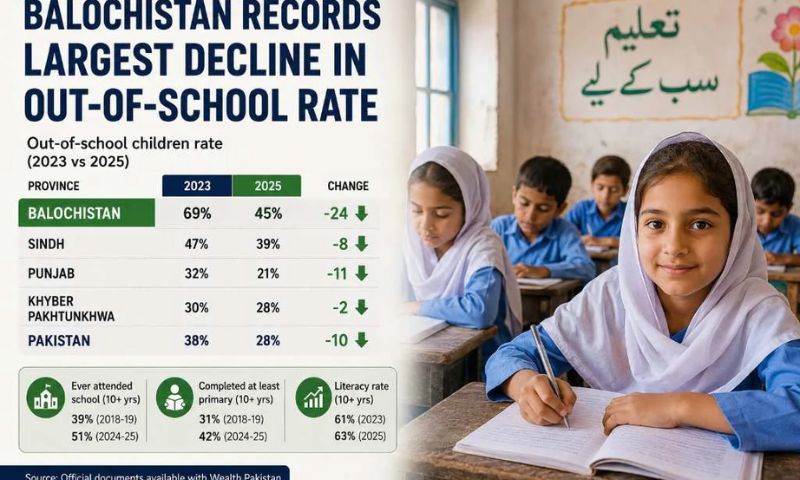
The proportion of out-of-school children in the province fell sharply from 69 per cent in 2023 to 45 per cent in 2025, reflecting a 24 percentage-point reduction — the largest among all provinces.
The figures, cited in official documents, show a broader national trend of improvement in school attendance and literacy during the same period.
Nationwide, the out-of-school children rate declined from 38 per cent in 2023 to 28 per cent in 2025. The data further indicates a gender-based improvement, with the rate falling from 35 per cent to 25 per cent among boys and from 42 per cent to 31 per cent among girls.
Among other provinces, Punjab saw its rate decrease from 32 per cent to 21 per cent, Sindh from 47 per cent to 39 per cent, and Khyber Pakhtunkhwa from 30 per cent to 28 per cent.
Balochistan also showed progress in broader education indicators. The share of people aged 10 years and above who had ever attended school rose from 39 per cent in 2018-19 to 51 per cent in 2024-25. Male school participation increased from 52 per cent to 66 per cent, while female participation rose from 24 per cent to 34 per cent.
Educational attainment also improved significantly in the province, with the proportion of individuals aged 10 years and above completing at least primary education rising from 31 per cent to 42 per cent over the same period.
According to the data, enrolment levels have also strengthened. At the primary level, Balochistan’s Gross Enrolment Rate (GER) reached 59 per cent, while middle and matric-level enrolments stood at 43 per cent and 40 per cent respectively. Female participation continued to show gradual improvement across all levels.
Officials noted that the nationwide reduction in out-of-school children reflects ongoing efforts to expand access to education and improve retention rates. Pakistan’s overall literacy rate for those aged 10 and above rose from 61 per cent to 63 per cent during the period, with rural and female literacy contributing to the upward trend.
Balochistan spends nearly twice as much per student as Punjab
Despite having an education budget nearly five times smaller than Punjab’s, Balochistan spends almost twice as much per person on education.
According to recent budget figures, the federal government has earmarked Rs300 billion for education, while Punjab leads provincial allocations with Rs750 billion.
Sindh has set aside Rs620 billion, followed by Khyber Pakhtunkhwa at Rs408 billion, Balochistan at Rs144 billion, Azad Jammu and Kashmir (AJK) at Rs57 billion, and Gilgit-Baltistan (GB) at Rs30 billion.
The Rs144 billion budget in Balochistan for the Education Department in the fiscal year 2026-27 shows an increase of 15 percent from the previous year’s allocation. This includes Rs115 billion earmarked strictly for school education and Rs12 billion for development, alongside the creation of 3,000 new teaching posts.
At first glance, Punjab appears to dominate education spending. However, when population size is taken into account, a different picture emerges. Punjab’s education budget is spread across an estimated population of 140 million people, while Balochistan’s Rs144 billion allocation serves a population of around 14 million.
This translates into substantially higher per-capita education spending in Balochistan compared with Punjab, highlighting the importance of measuring investment relative to population rather than relying solely on total budget figures.
This shows the unique challenges faced by Balochistan, Pakistan’s largest province by area but one of its least densely populated regions. Higher per-capita spending is often required to fund schools, teachers, and infrastructure across remote and geographically dispersed communities.
The comparison is not limited to education. Budget figures show that Balochistan also allocates substantially more resources to healthcare on a per-capita basis. While Punjab has earmarked Rs500.62 billion for the health sector, its large population reduces per-capita spending to approximately Rs3,942.
In contrast, Balochistan’s health allocation translates into roughly Rs8,067 per resident, meaning the province spends more than twice as much per person on healthcare as Punjab.
As Pakistan continues efforts to improve literacy rates and educational outcomes, the effectiveness of spending—not just the amount allocated—is likely to remain a key focus for policymakers.
Policy analysts note that per-capita spending is often a more accurate indicator of government priorities than total budget figures, particularly when comparing provinces with vastly different population sizes.
The FY 2026-27 budget figures suggest that education and health remain among the province’s top spending priorities. The data also highlights the importance of examining per-capita allocations rather than relying solely on overall budget totals when assessing public sector investment.
The comparison challenges the perception that Balochistan receives limited government spending in these sectors. Budget figures show that, relative to its population, the province is allocating significantly more resources to education and health than Punjab.
As discussions continue regarding development and public investment in Balochistan, the latest budget data provides an important factual benchmark: on a per-person basis, the province is among the country’s highest spenders on education and health; Balochistan’s education budget is double that of Punjab.