Key Points
- Musk’s inclusion reflects Tesla’s deep exposure to China’s EV market
- Huang’s presence highlights Nvidia’s central role in the AI chip race
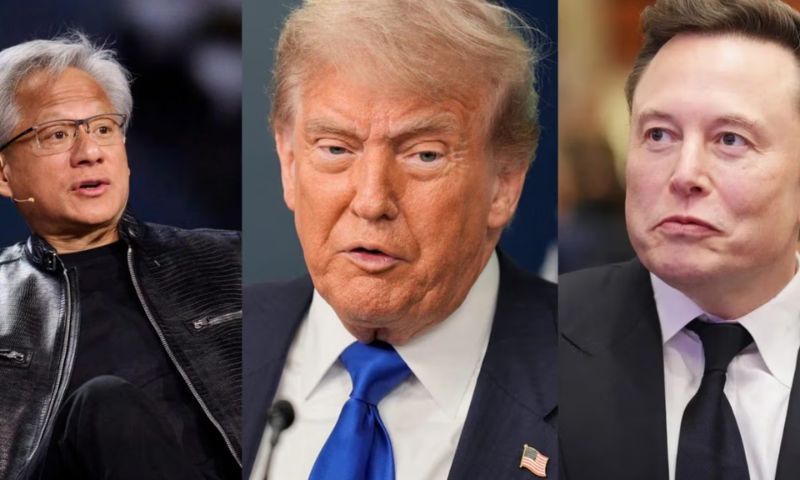
ISLAMABAD: US President Donald Trump has brought two of America’s most influential technology executives, Elon Musk and Jensen Huang, into his delegation to China.Keeping the tech and AI professionals along reflects the deep entanglement of geopolitics with artificial intelligence, electric vehicles and semiconductor supply chains.
The visit, centred on trade recalibration and strategic dialogue with Chinese President Xi Jinping, is being closely watched for its potential to shape the next phase of US-China economic competition.
Experts describe Musk and Huang as “commercial extensions of state leverage” in sectors where Washington and Beijing are locked in structural rivalry.
A senior Washington-based Asia policy analyst said Musk’s presence is tied to Tesla’s exposure to China, its largest overseas manufacturing hub.
Tesla finds that regulatory approvals, autonomous driving permissions and production stability depend heavily on government policy in China.
“Elon Musk effectively represents the EV and advanced manufacturing bridge between the two economies,” the analyst noted, adding that Tesla’s Shanghai operations make him a “natural stakeholder in any attempt to stabilise US-China trade tensions.”
Huang’s inclusion, experts say, is even more strategically sensitive. NVIDIA sits at the center of global artificial intelligence development.
The company’s advanced chips are subject to strict US export controls aimed at limiting China’s access to frontier AI computing power.
A semiconductor policy expert said Huang’s presence signals “controlled commercial engagement under strategic restriction. ”
It also explains that Washington is attempting to balance economic opportunity with national security concerns.
“China is one of the largest potential markets for AI infrastructure, but it is also viewed in Washington as a strategic competitor,” the expert said. “Nvidia is caught directly in that tension.”
The dispute between the two countries has increasingly focused on semiconductors, AI systems, and high-end manufacturing equipment.
US restrictions on advanced chips have pushed China to accelerate the domestic alternatives, intensifying a technology race that both sides frame as critical to national security.
Musk’s engagement with China has also been politically sensitive in Washington due to Tesla’s reliance on Chinese supply chains and Beijing’s long-standing support for the Shanghai gigafactory’s expansion.
Analysts say this makes him a rare corporate figure with “operational stakes on both sides of the geopolitical divide.”
Huang, meanwhile, has repeatedly argued that restricting technology flows risks accelerating China’s independent chip ecosystem, a view that has divided policymakers in the United States.
Analysts say their inclusion in the delegation underscores a broader US strategy: using leading CEOs not just as investors, but as informal channels of economic diplomacy at a time when formal trade negotiations remain constrained by mistrust.
The trip comes as Washington and Beijing attempt to stabilise relations amid disputes over tariffs, export controls, rare earth supplies and artificial intelligence governance. These are the issues that now define the global economic order.
China-backed Pakistan’s mediation efforts for a peace deal between the US and Iran are also likely to take centre stage during the Trump-Xi Summit.
Officials in Islamabad believe China could be one of the potential guarantors of the deal, which Trump repeatedly tells his audience is near.