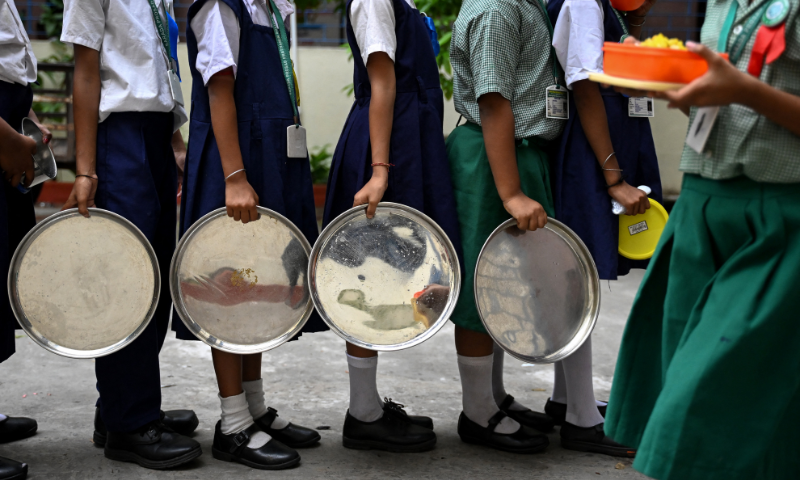



KOLKATA: The removal of eggs from government school meals in India’s eastern state of West Bengal has triggered a political and public health controversy, with teachers, nutrition experts and opposition leaders warning that the decision could harm child nutrition, reduce school attendance and reflect an attempt to impose a vegetarian ideology.
The BJP-led state government recently replaced eggs in school lunches with vegetarian alternatives after handing the meal programme to the International Society for Krishna Consciousness (ISKCON), a Hindu religious organisation that serves only vegetarian food.
The decision has reignited a long-running debate over the intersection of religion, politics and public policy in India, where food choices have increasingly become politically sensitive.
Teachers Fear Falling Attendance
Teachers say the weekly serving of eggs had long encouraged children, particularly from low-income families, to attend school regularly.
“The mid-day meals have been one of the biggest attractions in state-run primary schools,” teacher Raja Dey told AFP.
He added that students were noticeably more likely to attend classes on days when eggs were served.
Evidence from the southern state of Karnataka appears to support those concerns. Official figures released last year showed school attendance increased from 93.5 percent to 98.97 percent after eggs were provided six days a week under the state’s meal programme.
India’s school lunch programme, recognised by the United Nations as the world’s largest, has been widely credited with improving enrolment and reducing classroom absenteeism.
Several peer-reviewed studies have linked the programme to enrolment increases of up to 15 percent, while a 2021 report by the International Food Policy Research Institute found it had contributed significantly to reducing child stunting.
Opposition Alleges Ideological Agenda
Former West Bengal Chief Minister Mamata Banerjee condemned the decision, describing it as being “against the culture” of West Bengal, where eggs, fish and meat form a regular part of most diets.
“The BJP government is trying to impose vegetarianism on school children,” Trinamool Congress (TMC) lawmaker Dola Sen told AFP.
Prime Minister Narendra Modi’s Bharatiya Janata Party (BJP), which came to power in West Bengal for the first time in May’s regional elections, has frequently promoted vegetarianism alongside its broader Hindu nationalist agenda.
Critics argue that the latest decision reflects an ideological approach to public policy rather than one based on nutritional evidence.
Nutrition Experts Raise Concerns
Public health experts have warned that replacing eggs with plant-based alternatives could disproportionately affect children from poorer households who rely on school meals as an important source of protein.
Community health physician Sylvia Karpagam described eggs as “the gold standard for protein quality,” warning that policies not grounded in scientific evidence risk undermining children’s health.
Without “fact-based information… the country faces a looming crisis in nutrition and health outcomes,” she told Frontline magazine.
ISKCON has defended the menu change, saying meals containing soya chunks, lentils and cottage cheese would provide equal or better nutrition.
“We will ensure that whatever nutrients a child gets from eggs will be matched or exceeded by superior quality protein and vitamins in our meals,” senior ISKCON member Surovijoy Govinda Das told AFP.
State Education Minister Dipak Barman also defended the policy, saying many Indians lead healthy lives on vegetarian diets.
Legal Challenge
The controversy has reached the Calcutta High Court, which has sought an explanation from the state government over its decision to entrust the school meal programme to ISKCON. The next hearing is scheduled for next month.
The dispute has renewed concerns among opposition parties and education advocates that ideological considerations are increasingly shaping public welfare programmes, particularly those affecting children from economically disadvantaged families.