


WASHINGTON: President Donald Trump has formally notified Congress that the United States has resumed military operations against Iran, the White House confirmed, granting the Pentagon an additional 60 days to continue military action without congressional approval as Washington sharply escalates pressure on Tehran.
The notification came as Trump announced plans to reimpose a blockade on Iranian ports, impose a 20 percent fee on cargo passing through the Strait of Hormuz and warned of possible strikes on additional Iranian nuclear facilities, despite insisting that a diplomatic settlement remained achievable.
Trump Threatens Further Military Action
In addition to the planned blockade, Trump threatened to target Pickaxe Mountain, a deeply buried nuclear site near Natanz that Western intelligence agencies suspect is being developed as an undeclared uranium enrichment facility.
“Tell the Iranians to be ready. Let them know we’re coming (and) there’s not a damn thing they can do about it,” he told conservative radio host Hugh Hewitt.
On Truth Social, Trump declared that the United States would be “known as ‘THE GUARDIAN OF THE HORMUZ STRAIT'” and announced a 20 percent fee on all cargo transiting the strategic waterway.
While saying Iranian ports would again be blockaded, Trump added that “all other countries will have fair and open use of the strait.”
Iran Mocks Hormuz Levy
Iranian Foreign Minister Abbas Araghchi mocked Trump’s proposal on X, saying the US president was “absolutely right” that those ensuring safe navigation should be compensated, but quipped that Tehran would charge less.
“20% is, of course, too much,” he said.
Washington has consistently opposed Iranian proposals to impose tolls on vessels using the Strait of Hormuz, arguing that such measures violate international law.
Tehran Says June Deal ‘In Crisis’
Despite the renewed escalation, Trump said on Monday that an agreement to end the conflict remained possible.
Iranian Foreign Ministry spokesman Esmaeil Baqaei, however, said the June memorandum of understanding that had eased tensions and led to the lifting of the US blockade was now “in crisis.”
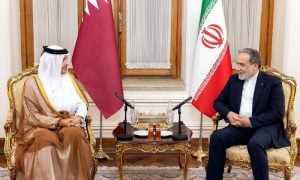
Baqaei said Tehran would suspend its commitments if Washington abandoned its own obligations, but stressed that Iran remained engaged with mediators from Qatar, Pakistan and Oman in an effort to prevent further escalation.
Bader Al-Saif, an associate fellow at Chatham House, said the latest military exchanges were likely to postpone rather than resolve the conflict.
“Both sides want to end the impasse on their own terms, and they are increasingly finding it difficult to do so,” he said.
“Hence the return to and increase in the scale of attacks.”
Third Night of US Strikes
The developments followed a third consecutive night of US strikes on Iranian targets. According to the US military, the five-hour operation hit sites across Iran, including Bushehr and Bandar Abbas, to “degrade Iran’s ability to attack commercial shipping.”
Iran responded by launching missiles and drones at Bahrain, targeting a residential building housing US forces and other facilities, according to the Iranian Revolutionary Guards.
“We’re going to hit them very hard tonight, and we’re going to hit them hard tomorrow,” Trump said at the White House on Monday.
US Central Command (CENTCOM) said Iranian ports along the Strait of Hormuz would be blockaded from 2000 GMT on Tuesday.
The renewed hostilities pushed global oil prices sharply higher, with crude gaining more than nine percent on Monday before extending gains on Tuesday amid fears of prolonged disruption to energy supplies.
Iran also launched attacks against other US allies in the region, including Jordan, which said it intercepted four Iranian missiles.
The Revolutionary Guards said their strikes targeted US forces at an air base and urged Jordanians to issue a “serious demand for the removal of the occupying American bases from the region.”
Iran also announced attacks on Bahrain, Jordan, Kuwait and Oman, while warning that any Gulf state assisting US military operations would be regarded as committing “an act of war.”