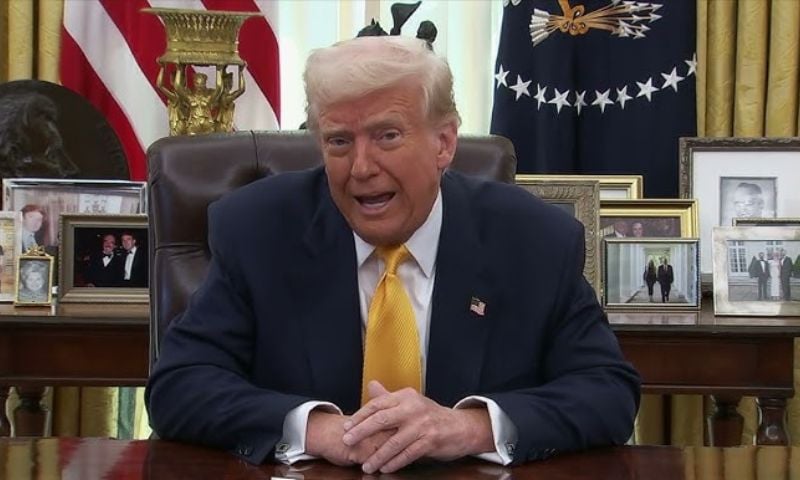
WASHINGTON: US President Donald Trump said on Saturday that talks with Iran were “going very well”, as Pakistan intensified diplomatic efforts to broker a peace deal and likely host a second round of negotiations in Islamabad in the coming week.
Speaking to reporters in the Oval Office, Trump said Washington was engaged in active discussions with Tehran and expected further clarity by the end of the day.
He said discussions with Tehran were ongoing and described them as “very good conversations.”
“It’s going actually along very well, and we’ll see, but we’ll have some information by the end of the day,” Trump said, adding that his administration is currently talking to Iran.
He also warned Iran against using the Strait of Hormuz as leverage, saying, “They wanted to close up the strait again … and they can’t blackmail us.”
Iran’s military on Saturday declared the strait, through which about one-fifth of the world’s crude and liquefied natural gas normally passes, was once again closed, a day after saying it was open.
President Trump Signs an Executive Order, Apr. 18, 2026 https://t.co/xsVqeJG8i9
— The White House (@WhiteHouse) April 18, 2026
The remarks come as Pakistan steps up its mediation efforts following the historic direct talks between the US and Iran in Islamabad — the highest-level engagement between the two sides in decades.
Diplomatic sources indicate that a second round of talks could take place in the coming days, with Islamabad positioning itself as a key facilitator for a broader agreement aimed at de-escalation and a long-term settlement.
Trump said there would be “some information” about Iran later in the day, adding: “We’re taking a tough stand.”
Continued US-Iran engagement
Trump emphasised that Washington would not allow itself to be pressured, stating that Iran would not be permitted to use threats or leverage against the United States.
However, despite the firm language, he also indicated that diplomatic engagement is still active and progressing.
According to earlier statements and reporting, both sides have been involved in talks aimed at reducing tensions following months of escalation in the region.
Iran and the United States have recently held Pakistan-mediated direct talks in Islamabad, focusing on security issues, maritime routes, and broader regional stability.
While Trump maintained a tough public stance, he simultaneously signalled optimism about the negotiation process, suggesting that discussions with Iranian officials are still underway.
‘Pretty good news’ on Iran
On Friday, while speaking to reporters aboard Air Force One, Trump said he had received “some pretty good news” on Iran.
He said he had received “some pretty good news” regarding Iran, though he declined to provide further details while speaking to reporters aboard Air Force One late on Friday.
“It seems to be going very well in the Middle East with Iran,” Trump said while returning to Washington from Phoenix, Arizona.
“We’re negotiating over the weekend. I expect things to go well. Many of these things have been negotiated and agreed to.”
Iran reviewing ‘new proposals’ from US
Iran’s Supreme National Security Council says new peace proposals have been put forward by the United States and are being reviewed, state-run broadcaster PressTV reports.
🔺Recently, with the Pakistani army commander in Tehran as mediator, new proposals have been put forward by the Americans. The Islamic Republic of Iran is reviewing them and has not yet responded.
— Press TV 🔻 (@PressTV) April 18, 2026
Meanwhile, Iran’s top national security body has said it will prevent the conditional and limited opening of the Strait of Hormuz “as long as the enemy intends to disrupt the passage of vessels and employ methods such as naval blockade”, Fars news agency reports.
It further said that ships must pay the costs of providing security and protecting the environment to pass through the Strait of Hormuz.
Pakistan has been actively mediating between the United States and Iran since the war began on February 28, hosting the highest-level talks between the two sides since they severed diplomatic ties in 1979.
Islamabad’s “objective is not ceasefire extension. Our main objective is the permanent termination of war,” Deputy Prime Minister Ishaq Dar said, stressing the need for a formal agreement between the parties.
Providing an update on the progress of negotiations, Dar expressed confidence that a breakthrough could be within reach.
About Pakistan’s ongoing mediation, Dar said: “More than 80% of the work has been done. And a couple of things are (remaining)… both parties have to show flexibility.”
Pakistan intensifies diplomatic efforts
Pakistan had earlier secured a 14-day ceasefire between the United States and Iran on April 8, helping stabilise a situation that had severely disrupted global energy supplies and maritime traffic.
Tehran on Friday declared the Strait of Hormuz “completely open” for commercial shipping for the first time since the war began, a move seen as a significant confidence-building measure.
The strategic waterway had been restricted by Iran following the launch of US and Israeli military operations on February 28, raising concerns over global oil flows and supply chains.
Pakistan has continued high-level engagement with regional stakeholders, including recent meetings in Tehran between Army Chief Field Marshal Asim Munir and Iran’s top leadership, aimed at sustaining dialogue and narrowing differences.
Pakistan’s role as a mediator has drawn increasing international attention, with officials and analysts noting its ability to maintain communication with both sides and facilitate talks at a time of heightened tensions.
As negotiations continue, Islamabad has positioned itself at the centre of diplomatic efforts to transform the fragile ceasefire into a lasting peace agreement, with Dar reiterating that flexibility from both sides will be key to ending the conflict permanently.
Pakistan seeks ‘permanent’ end to war
Pakistan has called for a “permanent termination” of the US-Israeli war on Iran, urging both Washington and Tehran to demonstrate flexibility as diplomatic efforts move closer to a potential agreement.
Speaking at the Antalya Diplomacy Forum in Türkiye, Foreign Minister Ishaq Dar said Islamabad’s objective goes beyond extending the current ceasefire, focusing instead on securing a durable and comprehensive end to the conflict, reports Turkish news agency Anadolu.
Pakistan wants a “permanent termination” of the US-Israeli war on Iran, Foreign Minister Ishaq Dar told Antalya Diplomacy Forum on Friday, calling on Washington and Tehran to “show flexibility.”
Pakistan has been actively mediating between the United States and Iran since the war began on February 28, hosting the highest-level talks between the two sides since they severed diplomatic ties in 1979.
Islamabad’s “objective is not ceasefire extension. Our main objective is the permanent termination of war,” Dar said, stressing the need for a formal agreement between the parties.
Providing an update on the progress of negotiations, Dar expressed confidence that a breakthrough could be within reach.
About Pakistan’s ongoing mediation, Dar said: “More than 80% of the work has been done. And a couple of things are (remaining)… both parties have to show flexibility.”