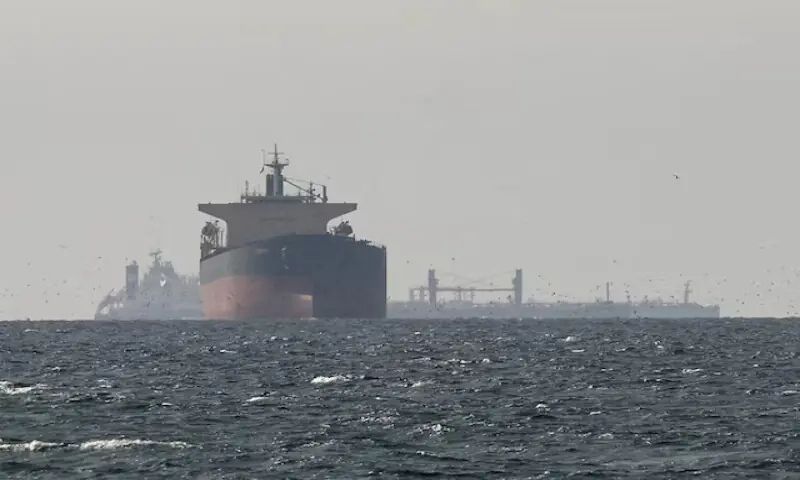
DUBAI: Two Indian ships were “forced back west out of the Strait of Hormuz” after coming under fire from Iran’s Islamic Revolutionary Guard Corps (IRGC) navy on Saturday, NDTV reported. The two ships had to turn back after the incident northeast of Oman in the shipping lane critical for the oil trade.
The Indian vessels were carrying crude oil at the time of the incident. The source said the crew and the ships were safe after the attack.
One of the two vessels involved in the incident is a very large crude carrier (VLCC), a classification given to tankers that are massive in size and designed for long-haul crude transport, according to NDTV.
Tanker monitoring service TankerTrackers said two Indian vessels were “forced back west out of the Strait of Hormuz” by Iran’s Islamic Revolutionary Guard Corps (IRGC) navy.
The report, based on maritime radio recordings on the international distress channel, said firing was involved.
One of the vessels was described as an Indian-flagged very large crude carrier transporting around two million barrels of Iraqi oil.
“Firing was involved. One of the vessels is an Indian-flagged VLCC supertanker carrying 2 million barrels of Iraqi oil,” it added.
According to two Channel 16 audio recordings captured today, two Indian vessels were forced back west out of the Strait of Hormuz by Iran's Sepah (IRGC) Navy. Firing was involved. One of the vessels is an Indian-flagged VLCC supertanker carrying 2 million barrels of Iraqi oil.… pic.twitter.com/c1uOvmKDNO
— TankerTrackers.com, Inc. (@TankerTrackers) April 18, 2026
India summons Iranian ambassador
India summoned Iran’s ambassador over what it described as a serious “shooting incident” involving Indian-flagged ships, the foreign ministry said in a statement.
“During the meeting, the foreign secretary conveyed India’s deep concern at the shooting incident earlier today involving two Indian-flagged ships in the Strait of Hormuz,” the ministry said.
The statement stressed the importance of ensuring the safety of merchant shipping and mariners.
“Reiterating his concern at this serious incident of firing on merchant ships, the foreign secretary urged the ambassador to convey India’s views to the authorities in Iran and resume at the earliest the process of facilitating India-bound ships across the strait,” it added.
Our statement regarding Iran ⬇️
🔗 https://t.co/05hycXPgJ6 pic.twitter.com/HwhqdNL9M8
— Randhir Jaiswal (@MEAIndia) April 18, 2026
The incident followed an IRGC joint command statement earlier in the day claiming that the Strait of Hormuz had returned to its “previous state” under the control of Iran’s armed forces, citing the ongoing US blockade of Iranian ports.
On Friday, Iranian Foreign Minister Abbas Araghchi declared the strait “completely open” for all commercial vessels.
The decision was made “in line with the ceasefire in Lebanon,” he said on the US social media platform X.
Washington and Tehran held talks in Pakistan last weekend, and efforts for another session in Islamabad are underway.
India–Iran ties strained after US attack on Iranian warship
Relations between India and Iran came under strain in early March after an Iranian naval vessel, the IRIS Dena, was attacked shortly after departing an Indian port following a goodwill visit.
The Iranian warship, IRIS Dena, was torpedoed by a US submarine just 44 nautical miles off (81km) southern Sri Lanka.
The frigate had participated in multilateral naval exercises hosted by India and was described by Tehran as a “guest” of the Indian Navy.
Its sinking in the Indian Ocean by a US submarine triggered anger in Iran, which viewed the incident as an attack on a vessel returning from an official engagement with India.
Neither New Delhi nor the Navy has criticised — even mildly — the decision by the US to sink the Iranian warship.
However, it took the Indian Navy more than 24 hours after the Iranian warship was struck to respond formally to the attack.
Iranian officials underscored that the ship had been invited by New Delhi, intensifying expectations that India would respond more forcefully to the strike.
However, India’s muted reaction — limited to delayed operational statements and no direct criticism of the United States — fuelled unease in Tehran and raised questions over New Delhi’s strategic positioning.
Now, the IRIS Dena is at the bottom of the Indian Ocean, and more than 80 Iranian sailors, who marched during joint parades and posed for selfies with Indian naval officers during their two-week visit, are dead.
What has also fallen, said retired Indian naval officers and analysts, is India’s self-image as a security provider in the Indian Ocean.
Instead, they said, the US attack on the Dena has exposed the limits of India’s power and influence in its own maritime backyard.
After participating in the naval exercises, IRIS Dena left Visakhapatnam on India’s eastern coast on February 26.
It was hit in international waters, just south of Sri Lanka’s territorial waters, in the early hours of March 4, local time.
In response, Sri Lankan Navy rescuers recovered more than 80 bodies and picked up 32 survivors, reportedly including the commander and some senior officers from the warship. More than 100 men are still missing, according to reports.
Modi’s visit to Israel ahead of attack on Iran
In the broader geopolitical backdrop, Indian Prime Minister Narendra Modi was on an official visit to Israel ahead of the US–Israel military strike on Iran on February 28.
The visit underscored the deepening strategic partnership between India and Israel, which spans defence and intelligence sharing cooperation.
The timing of the visit, coupled with the close security alignment between New Delhi and Tel Aviv, has been viewed by analysts as tacit approval for subsequent airstrikes on Iran that have sparked a crisis in the region.
India’s opposition parties criticised Modi for his trip to Israel just ahead of strikes on Iran.
The main Indian National Congress said that Modi’s visit to Israel was ill-timed and gave the perception of “partisan alignment and tacit endorsement” of Israel’s coordinated strikes with the US on Iran.
Congress party spokesman Jairam Ramesh said Sunday that the Modi government’s response has been a “betrayal of India’s values, principles, concerns, and interests”.
A retired Indian diplomat based in Bangalore said that Modi’s decision to head to Israel, when an Israel-US attack on Iran was imminent, and his strong words of support for Israel’s actions against Iran have “diminished India’s stature in the eyes of the world”.
The timing of the visit — the US-Israel military strikes on Iran began less than 48 hours after Modi left Israel — suggests that “he may have been briefed by the Israeli prime minister on the proposed Israel-US military action,” he claimed.
Accusing Modi of “the highest moral cowardice” for not speaking up on Israel’s war on Gazans, Jairam Ramesh, a senior parliamentarian of the Congress, India’s main opposition party, said: “This Israel visit was shameful and it is even more so in light of the war that has been launched by two of Mr. Modi’s ‘good friends,’” — Netanyahu and US President Donald Trump.