KEY POINTS
- Full UK participation in Erasmus+ expected from 2027.
- Deal ends uncertainty after Brexit-era exit from programme.
- Erasmus+ re-entry marks milestone in UK–EU relations.
- Programme promotes cultural exchange and global citizenship.
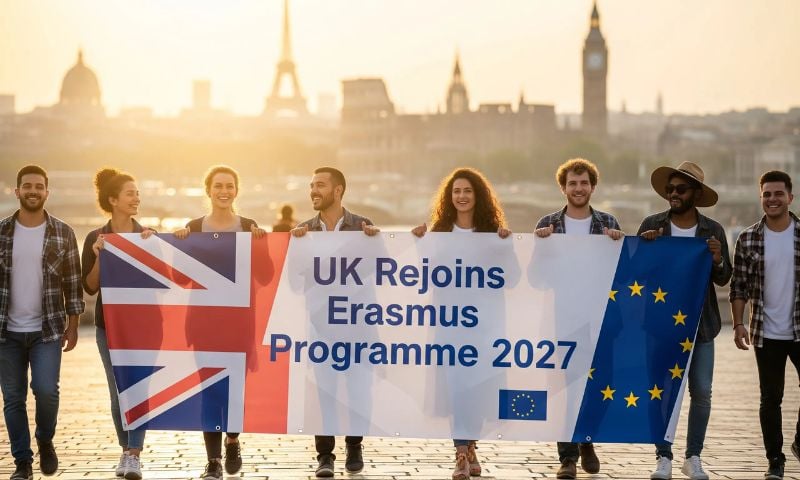
ISLAMABAD: The United Kingdom has taken the final steps to formally rejoin the European Union’s Erasmus+ programme, with the British Council designated as the country’s National Agency for its implementation.
The move was officially confirmed on Wednesday under the EU–UK Trade and Cooperation Agreement, marking a major milestone in UK–EU relations and ending years of uncertainty following Britain’s departure from the scheme after Brexit.
The UK is expected to fully participate in Erasmus+ from 2027, re-entering the programme six years after leaving in 2020.
British Council role
The British Council’s appointment as National Agency places it at the centre of delivery and coordination, working in close collaboration with the UK Department for Education, devolved administrations, and the European Commission.
British Council Chief Executive Scott McDonald described the return as a significant opportunity for students, educators, and institutions across the UK.
He said rejoining Erasmus+ would bring “enormous benefit to a range of people from different backgrounds throughout the UK, giving them a global outlook and a whole range of skills of value both to themselves and to the UK”.
McDonald added that the organisation would work to “make the most of the opportunities of the programme”, highlighting its role in promoting cultural exchange, skills development, and global citizenship across higher education, vocational training, schools, and sports.
Sector welcomes move
Erasmus+ previously delivered large-scale educational exchange programmes in the UK between 2014 and 2020, funding more than 8,000 projects, engaging nearly 600,000 participants, and supporting UK organisations with €1.1 billion in funding.
Education sector bodies have broadly welcomed the announcement, calling it a step that provides clarity for universities and institutions preparing for participation ahead of 2027.