Key Points:
- Ministers term the comments “dangerous and inflammatory”, calling them a violation of international law and the United Nations Charter.
- Reaffirm rejection of any annexation of the West Bank and stress support for a two-state solution based on 1967 borders with East Jerusalem as capital.
- Warn that expansionist rhetoric threatens regional security and stability in the Middle East.
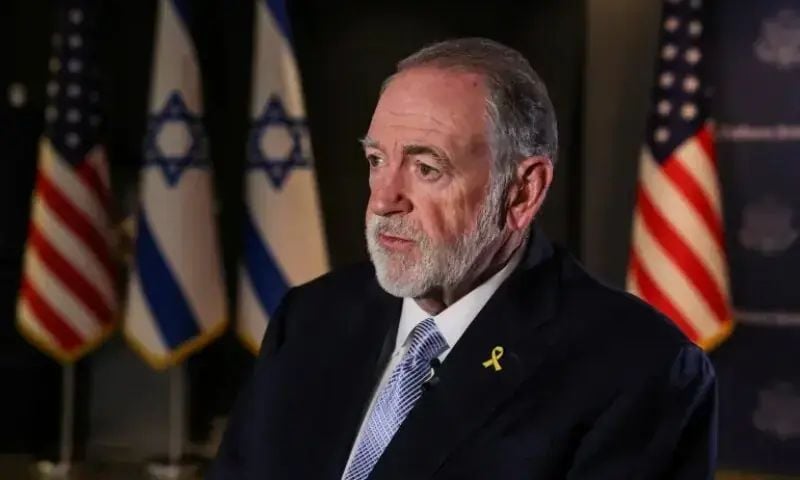
ISLAMABAD: Fourteen Muslim nations have strongly condemned remarks by US Ambassador to Israel Mike Huckabee, in which he reportedly indicated he would not oppose Israel asserting control over large parts of the Middle East, including the occupied West Bank, the Foreign Office said on Sunday.
The comments were described as unacceptable and contrary to international law.
The foreign ministers of Pakistan, Egypt, Jordan, the United Arab Emirates, Indonesia, Türkiye, Saudi Arabia, Qatar, Kuwait, Oman, Bahrain, Lebanon, Syria and Palestine – along with the secretariats of the Organization of Islamic Cooperation, League of Arab States and Gulf Cooperation Council – expressed “strong condemnation and profound concern” over the envoy’s statements.
In their joint declaration, the ministers described the comments as “dangerous and inflammatory,” asserting that they constitute a flagrant violation of international law and the principles enshrined in the United Nations Charter.
They warned that such rhetoric poses a grave threat to the security and stability of the Middle East.
The statement emphasized that the remarks directly contradict the vision articulated by U.S. President Donald J. Trump and the Comprehensive Plan to End the Gaza Conflict, which they said aims to contain escalation and create a political pathway toward a comprehensive settlement.
According to the ministers, any suggestion that legitimizes control over occupied or sovereign Arab lands undermines efforts to promote tolerance, peaceful coexistence, and a viable two-state solution.
Reaffirming their unified position, the signatories stressed that Israel holds no sovereignty over the Occupied Palestinian Territory or any other occupied Arab land.
They reiterated their categorical rejection of any attempts to annex the West Bank or to separate it from the Gaza Strip, as well as their firm opposition to continued settlement expansion.
The joint statement further rejected any threats to the sovereignty of Arab states, cautioning that continued expansionist policies and unlawful measures would only inflame violence and deepen instability in the region.
The ministers underscored their unwavering commitment to the inalienable right of the Palestinian people to self-determination, including the establishment of an independent state along the borders of 4 June 1967, with East Jerusalem as its capital.
They called for an immediate end to what they described as incendiary statements and actions that hinder prospects for peace.
The coordinated response highlights growing regional unity on the Palestinian issue and signals heightened diplomatic resistance to any proposals perceived as altering the legal and political status of occupied territories.