MOSCOW: The Kremlin warned on Tuesday that the world is heading into a “dangerous” moment as the last nuclear arms control treaty between Russia and the United States is set to expire this week.
The New START treaty, signed in 2010, is due to expire on Thursday unless a last-minute understanding is reached between Washington and Moscow.
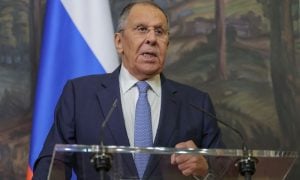
“In just a few days, the world will be in a more dangerous position than it has ever been before,” Kremlin spokesman Dmitry Peskov told reporters.
The Kremlin spokesperson warned that the expiry would leave the United States and Russia “without a fundamental document that would limit and control these arsenals”.
Russia says extension offer still unanswered
Peskov said a proposal by President Vladimir Putin to extend the treaty’s limits for another year remains on the table but has received no response from Washington.
“The initiative put forward by President Putin remains in force. We have not yet received any response from the Americans,” he said.
Putin said in September that Russia was ready to continue observing the treaty’s quantitative limits beyond its February expiry, provided the United States did the same.
New START caps the number of deployed strategic nuclear warheads at 1,550 for each side and limits long-range missiles and bombers.
It also allows on-site inspections, although Russia suspended such monitoring during the COVID-19 pandemic and later froze its participation in the treaty in 2023, while continuing to adhere to its limits voluntarily.
The agreement was extended in 2021 for five years under former US President Joe Biden. Talks on a further extension have since stalled amid deep tensions over the war in Ukraine.
No ‘arms race’, but rising risks
Russia’s Deputy Foreign Minister Sergey Ryabkov said Moscow would not initiate an arms race after the treaty expires but warned that Russia was ready to respond if US military deployments threatened its security.
“If the Americans opt to deploy weapons systems or elements of their ‘Golden Dome’ missile defence concept in Greenland, it would require military and technical compensatory measures,” Ryabkov told reporters at the Russian embassy in China, according to state news agency TASS.
He said Russia would send no further communications to Washington on New START. “The lack of a response is also a response,” he added.
Ryabkov said any revival of strategic security dialogue would require a major shift in US policy towards Moscow.
Nuclear competition
According to POLITICO, the expiration of New START could trigger a global nuclear arms race for the first time since the Cold War.
The outlet reported, citing people familiar with the matter, that Russia made initial overtures about renewing the pact in September but the Trump administration has not formally responded.
The US Defence Department, according to POLITICO, has held internal meetings to prepare for a post–New START environment.
“We’re looking at a very uncertain path ahead,” Daryl Kimball, executive director of the Arms Control Association, was quoted as saying.
“Unless Trump and Putin reach some sort of understanding soon, it’s not unlikely that Russia and the US will start to upload more warheads on their missiles.”
President Donald Trump has said he favours a new agreement but wants China included, according to POLITICO. Putin has also demanded that Britain and France take part in any future pact.
US stance and allied concerns
The White House said Trump would decide the path forward on nuclear arms control “on his own timeline”.
Trump has downplayed the risks of allowing the treaty to lapse, saying in a January interview with The New York Times: “If it expires, it expires. We’ll just do a better agreement.”
New START’s expiration would mark the first time in nearly 40 years that the United States has no nuclear arms control treaty with Russia.
POLITICO reported that European allies are debating their own nuclear security arrangements.
German Chancellor Friedrich Merz said discussions had begun on a shared European nuclear umbrella, while Sweden has opened talks with France and Britain on deeper nuclear cooperation.
Peskov said the lapse of New START would remove the last barrier to unchecked expansion of nuclear arsenals.
“In just a few days, the world will be left without limits and control mechanisms over the strategic arsenals of the two largest nuclear powers,” he said.