THE HAGUE: The International Criminal Court (ICC) has issued arrest warrants for Taliban Supreme Leader Haibatullah Akhundzada and the group’s Chief Justice Abdul Hakim Haqqani over crimes against humanity involving the persecution of women, girls and others on gender and political grounds.
In a statement, the ICC said Pre-Trial Chamber II found reasonable grounds to believe that both men bear criminal responsibility for ordering, inducing or soliciting gender-based persecution since the Taliban returned to power in Afghanistan on August 15, 2021.
The court said the alleged crimes targeted girls, women and people who did not conform to the Taliban’s policies on gender, gender identity or expression, as well as individuals perceived to support women’s rights.
Investigation
The ICC authorised an investigation into war crimes and crimes against humanity in Afghanistan in March 2020 after overturning an earlier decision that had rejected the probe.
The investigation covers crimes committed on Afghan territory since May 1, 2003, as well as related crimes connected to the conflict that were committed in other states parties to the Rome Statute.
In October 2022, ICC judges authorised prosecutors to resume the investigation after concluding that Afghan authorities were not carrying out genuine national investigations into the crimes.
Referral and Arrest Requests
In November 2024, six countries—Chile, Costa Rica, Spain, France, Luxembourg and Mexico—referred the Afghanistan situation to the ICC Prosecutor, supporting the court’s ongoing investigation.
On January 23, 2025, ICC Prosecutor Karim Khan announced that his office had requested arrest warrants for Akhundzada and Haqqani over the crime against humanity of persecution on gender grounds.
Pre-Trial Chamber II formally issued the warrants on July 8, 2025.
The Taliban administration has not recognised the jurisdiction of the ICC, and the court has no police force of its own, relying on member states to execute arrest warrants.
Background
The ICC said there are reasonable grounds to believe that both men, who have exercised de facto authority in Afghanistan since the Taliban returned to power on August 15, 2021, are responsible for ordering, inducing or soliciting the crime against humanity of persecution on gender grounds under Article 7(1)(h) of the Rome Statute.
The persecution targeted girls, women and other people who did not conform to the Taliban’s policies on gender, gender identity or expression, as well as individuals perceived to be allies of girls and women.
The Afghanistan investigation also covers a wider range of war crimes and crimes against humanity committed during the country’s armed conflict, including murder, cruel treatment, unlawful imprisonment, attacks against civilians and humanitarian missions, and executions carried out without proper judicial authority.
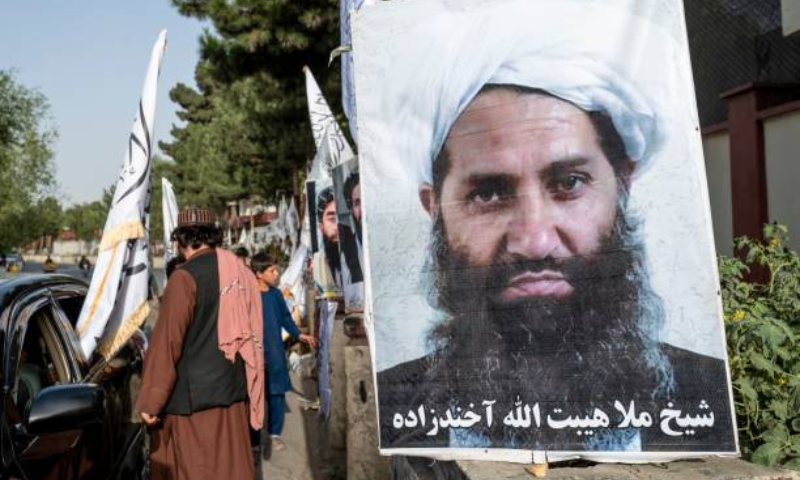
Who Is Haibatullah Akhundzada?
Mullah Haibatullah Akhundzada is the Supreme Leader of the Taliban and Afghanistan’s de facto ruler. He became the Taliban’s leader in May 2016 after his predecessor, Mullah Akhtar Mansour, was killed in a US drone strike, and assumed control of Afghanistan when the Taliban returned to power on August 15, 2021.
Holding the title of Amir al-Mu’minin (Commander of the Faithful), Akhundzada exercises ultimate authority over the Taliban administration, with the final say on legislation, judicial matters, government appointments and major policy decisions.
Before becoming the movement’s leader, he headed the Taliban’s judicial system and was responsible for issuing many of its religious rulings.
Akhundzada is also one of the Taliban’s most secretive leaders. Based mainly in Kandahar, he rarely appears in public, avoids media exposure and has released very few authenticated photographs.
Global Criticism
Under his leadership, the Taliban has imposed sweeping restrictions on women and girls, including bans on secondary and higher education, tighter controls on employment and public life, and broader limitations on civil liberties.
The United Nations and the United States have both strongly criticised Haibatullah Akhundzada’s leadership over the Taliban’s human rights record, particularly its sweeping restrictions on women and girls.
The UN has kept Akhundzada under Security Council sanctions, including a travel ban, asset freeze and arms embargo, and has repeatedly called on the Taliban to reverse policies restricting women’s education, employment and public life.
The United States does not recognise the Taliban as Afghanistan’s legitimate government and has consistently urged the group’s leadership to respect human rights, form an inclusive government, sever ties with terrorist organisations and uphold its international commitments.