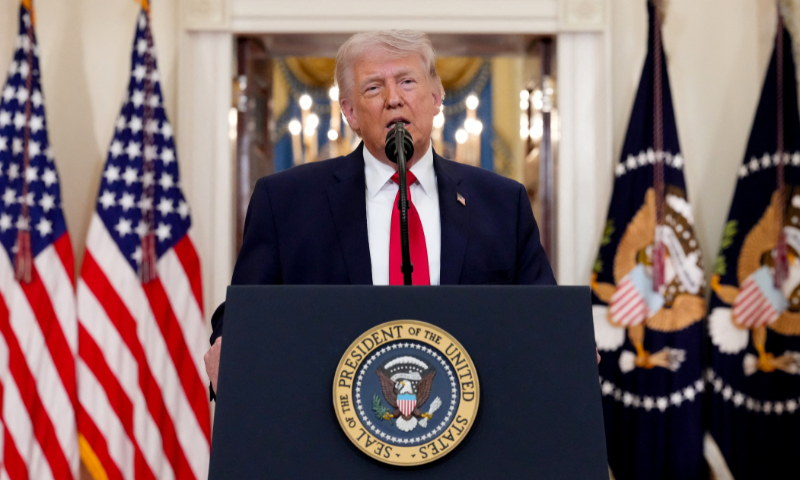
WASHINGTON: US President Donald Trump said Wednesday that the United States was close to victory in Iran, as he sought to justify the war more than a month after it began — a conflict that has weighed heavily on his approval ratings.
In a prime-time address from the White House, Trump offered little new clarity on how the war would conclude but pledged to continue “extremely hard” strikes against Iran for another two to three weeks.
“Tonight, I’m pleased to say that these core strategic objectives are nearing completion,” Trump said,
“In these past four weeks, our armed forces have delivered swift, decisive, overwhelming victories on the battlefield — victories like few people have ever seen before,” he added.
PRESIDENT TRUMP: Iran’s navy is gone. Their air force is in ruins. Most of their leaders are dead. The commanding control of the Islamic Revolutionary Guard Corps is being decimated.
Our enemies are losing and America is winning. pic.twitter.com/Qg0EO9KG0m
— Department of State (@StateDept) April 2, 2026
Trump said the United States had effectively dismantled Iran’s military capabilities, claiming sweeping battlefield success.
“We’ve done all of it. Their navy is gone. Their air force is gone. Their missiles are just about used up or beaten,” he said.
“Taken together, these actions will cripple Iran’s military, crush their ability to support terrorist proxies, and deny them the ability to build a nuclear bomb. Our armed forces have been extraordinary.”
“We are going to finish the job, and we’re going to finish it very fast. We’re getting very close,” he said, reiterating points that have featured prominently in his recent social media posts and media appearances.
Rising Oil Prices
With his approval ratings falling and Americans increasingly feeling the impact of rising oil prices, Trump used the address to retrospectively explain his decision to join Israel in launching the military campaign on February 28.
Standing before a backdrop of American flags, Trump delivered a speech more typical of the opening phase of a war. By contrast, on the day the conflict began, he had announced US involvement through a video message while dressed casually in a baseball cap and without a tie.
PRESIDENT TRUMP: Thanks to the progress we’ve made, I can say that we are on track to complete all of our military objectives shortly.
We’re going to hit them very hard over the next few weeks and bring them back to the Stone Ages where they belong. 💪 pic.twitter.com/AVPkolIoOh
— Department of State (@StateDept) April 2, 2026
In Wednesday’s remarks, Trump outlined Washington’s objectives: dismantling Iran’s military capabilities, ending its support for regional armed groups, and preventing it from acquiring a nuclear weapon — a threat that the UN nuclear watchdog and many analysts have said was not imminent.
Trump called on countries reliant on oil shipments through the Strait of Hormuz to show “courage” and take control of the key waterway, while vowing that Washington would protect its Middle East allies.
“The countries of the world that receive oil through the Hormuz Strait must take care of that passage,” Trump said in his first prime-time address since the start of the war with Iran. “Just take it, protect it, use it for yourselves.”
He also praised key regional partners, thanking “our allies in the Middle East — Israel, Saudi Arabia, Qatar, the UAE, Kuwait and Bahrain,” and added: “They’ve been great, and we will not let them get hurt or fail in any way, shape or form.”
PRESIDENT TRUMP: I want to thank our allies in the Middle East: Israel, Saudi Arabia, Qatar, the UAE, Kuwait, and Bahrain. They’ve been great and we will not let them get hurt or fail in any way, shape, or form. pic.twitter.com/guvwuYgcDL
— Department of State (@StateDept) April 2, 2026
He also highlighted early battlefield developments, noting that Israel had killed Iran’s longtime supreme leader Ayatollah Ali Khamenei on the first day of the conflict, and claimed that “their leaders — most of them” in the Islamic Republic are now dead.
However, Iran has responded with significant countermeasures, including taking control of the Strait of Hormuz — a critical global oil route through which around one-fifth of the world’s supply passes. The waterway had remained open before the war.
The economic impact has been increasingly visible in the United States. Gasoline prices have surged above $4 a gallon (over $1 a litre) for the first time in years, while consumer confidence has weakened, further eroding Trump’s standing on the economy.
Markets reacted swiftly following the speech, with oil prices rising again in early trading Thursday while global equities fell, as investors expressed disappointment that Trump did not signal a rapid end to the conflict.
Anyone watching that speech has no idea whether Trump is escalating or deescalating the war with Iran. But to be fair, neither does he so🤷♂️.
— Chris Murphy 🟧 (@ChrisMurphyCT) April 2, 2026
Criticism also emerged from within Washington. Democratic Senator Chris Murphy said, “Anyone watching that speech has no idea whether Trump is escalating or de-escalating the war with Iran.”
“But to be fair, neither does he so,” Murphy wrote on X.
Bomb to ‘Stone Ages’
Trump again warned that failure by Iran to reach a negotiated settlement could trigger further escalation, including direct attacks on critical infrastructure.
He said the United States would “hit each and every one of their electric generating plants” if Tehran did not comply — a move that could raise serious legal concerns, as strikes on civilian energy infrastructure are widely viewed as violations of the laws of war and could amount to war crimes.
“Over the next two to three weeks, we are going to bring them back to the Stone Ages, where they belong,” Trump said.
Despite the escalating rhetoric, the address contained little detail on diplomatic efforts.
Syed Muhammad Ali, an Islamabad-based security analyst, said the situation presents a crucial opportunity for de-escalation, warning that Tehran risks severe consequences if it fails to respond in time.
“It’s a critical moment for Iran to recognize the US desire to de-escalate because if Tehran doesn’t timely reciprocate to Trump’s olive branch, then it can face much more painful punishment than before, including destruction of its oil production facilities, forming its economic backbone,” he said.
Earlier in the day, Trump claimed that Iranian President Masoud Pezeshkian was seeking a ceasefire — a statement quickly rejected by Iran’s foreign ministry, which described it as “false and baseless” and accused Washington of making “maximalist and irrational” demands.
Emphasising US military strength, Trump repeated one of his familiar lines: “We have all the cards. They have none.”
Trump again criticised European allies for declining to support the war effort — a campaign he launched without prior consultation — while noting their reliance on Gulf energy supplies.
The countries that “receive oil through the Hormuz Strait must take care of that passage,” Trump said, urging them to “build up some delayed courage.”
Mushahid Hussain Sayed, a Pakistani politician and former senator, sharply criticised Trump’s address, calling it “incoherent” and lacking strategic direction.
Trump’s speech was an incoherent, confused address of a failed warmonger: 3 key takeaways: 1) no Strategic Clarity on how & when to end War, 2) Trump remains hostage to Netanyahu/Israeli Lobby; 3) surrendered to Iran on control of Strait of Hormuz, saying it’ll ‘open naturally’!… pic.twitter.com/e5gKi8WmF3
— Mushahid Hussain Sayed (@Mushahid) April 2, 2026
“Trump’s speech was an incoherent, confused address of a failed warmonger,” he said, outlining three key takeaways: “no strategic clarity on how and when to end the war; Trump remains hostage to Netanyahu and the Israeli lobby; and he has effectively surrendered to Iran on control of the Strait of Hormuz, saying it will ‘open naturally’.”
He added that the speech appeared aimed at both domestic and international audiences but was unlikely to achieve either objective.
“American people won’t be reassured, and Iran won’t be impressed by Trump’s threats,” he said.