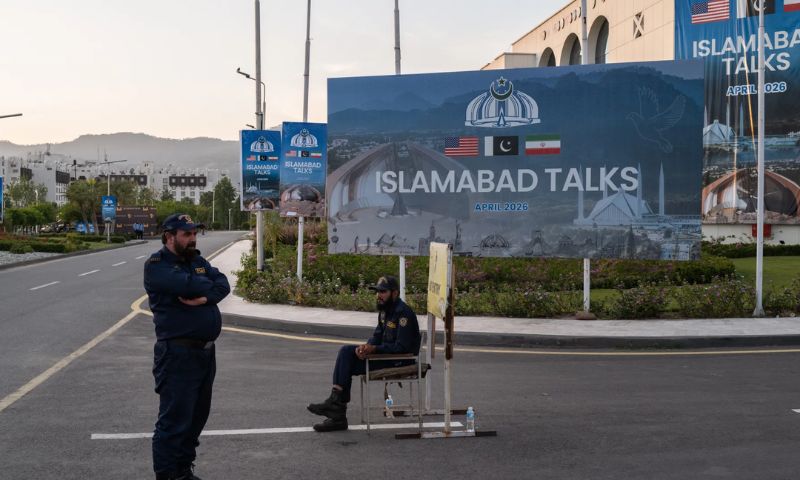
ISLAMABAD: Negotiating teams from the United States and Iran could return to Islamabad later this week for a renewed round of peace talks, Reuters and other credible international media outlets reported on Tuesday, citing multiple sources, days after the highest-level discussions between the two countries in decades ended without a breakthrough.
Citing one of the sources involved in the negotiations, Reuters reported that no firm date has yet been decided, but both sides could return as early as the end of this week. “No firm date has been set, with the delegations keeping Friday through Sunday open,” a senior Iranian source said.
According to multiple diplomatic and regional sources, a proposal has already been circulated to both Washington and Tehran suggesting that delegations reconvene in Islamabad to continue discussions aimed at narrowing differences on key security and geopolitical issues.
Two Pakistani sources familiar with the matter said Islamabad has been actively communicating with both sides regarding the timing of the next round of talks, and that a weekend meeting remains the most likely option if negotiations proceed.
“We have reached out to Iran and we got a positive response that they will be open to a second round of talks,” a senior Pakistani government official said. However, Pakistan’s foreign ministry, military, and prime minister’s office did not respond to requests for comment, while the White House also did not immediately issue a statement on the reported developments, Reuters reported.
The potential resumption of talks follows a rare and significant diplomatic engagement held in Islamabad, which marked the highest-level contact between U.S. and Iranian officials in more than a decade. It was also described by observers as the most senior interaction since Iran’s 1979 Islamic Revolution.
The previous round of negotiations was led by U.S. Vice President JD Vance and Iranian Parliamentary Speaker Mohammad Baqer Qalibaf, who headed their respective delegations in discussions covering a wide range of sensitive issues.
Among the key topics were Iran’s nuclear programme, sanctions relief, regional security concerns, and tensions surrounding the Strait of Hormuz, a critical maritime chokepoint for global energy supplies. Iran has in the past threatened disruptions in the waterway, while the United States has repeatedly emphasized the need to ensure its uninterrupted flow.
Speaking after the talks concluded, Vice President Vance described the U.S. position as firm, stating that Washington had presented what he called its “final and best offer.” “We leave here with a very simple proposal, a method of understanding that is our final and best offer,” Vance told reporters, underscoring the seriousness of the U.S. negotiating stance.
Despite the lack of an immediate breakthrough, diplomatic sources say both sides have continued indirect communication since the last meeting, suggesting that channels remain open even as significant disagreements persist.
One Iranian source said delegations were maintaining flexibility over scheduling, with Friday through Sunday being kept open as a possible window for renewed discussions. Pakistani officials, meanwhile, are said to be facilitating coordination between the two sides in an effort to sustain momentum.
Analysts caution that while the potential return to talks signals cautious optimism, major obstacles remain unresolved, particularly regarding Iran’s nuclear enrichment activities and the scope of sanctions relief demanded by Tehran. Still, the willingness of both sides to consider another round of negotiations is being interpreted as a sign that diplomatic engagement has not collapsed entirely.
For now, the proposed Islamabad meeting remains unconfirmed, but multiple sources indicate that planning is underway for a possible continuation of what has emerged as one of the most significant U.S.–Iran diplomatic tracks in recent years.