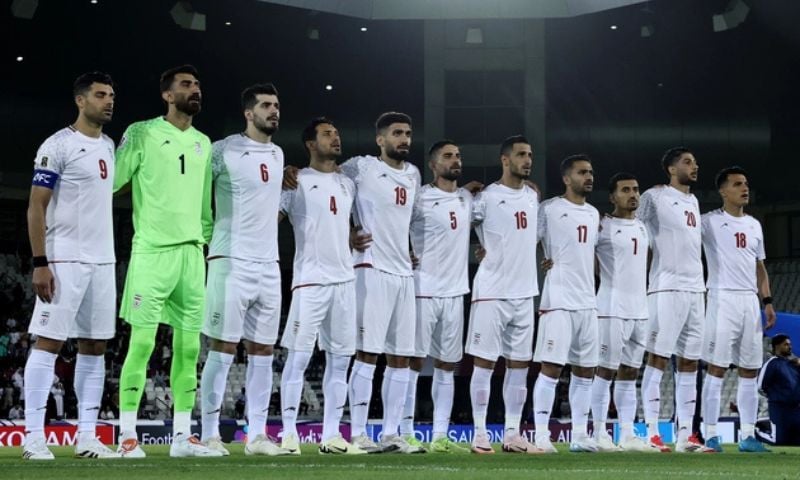
LOS ANGELES: The United States has eased travel restrictions on Iran’s national football team, allowing the squad to arrive in Seattle two days before its next FIFA World Cup match, the US Department of Homeland Security said on Tuesday.
Iranian team officials had previously expressed concerns that the squad was only permitted to arrive in host cities one day before matches and was required to depart shortly after games concluded.
“For the Iranian team’s third match in Seattle on June 26, the team has been permitted to come into the US two days before the match,” a Department of Homeland Security spokesperson said.
“The Iran team will still be required to leave the day the match ends. The overall security measures and protocol are the same. We remain committed to providing the safest tournament possible for players, staff, and fans alike.”
An Iranian team spokesperson confirmed that Team Melli will depart from Tijuana, Mexico, where the squad has been based during the tournament, on Wednesday, ahead of Friday’s match against Egypt.
Tournament Campaign
Iran has collected two points from its opening two matches, drawing 2-2 with New Zealand on June 15 before securing a goalless draw against a 10-man Belgium side on Sunday.
Head coach Amir Ghalenoei praised his players for their performances under what he described as difficult circumstances. He has previously referred to Iran as the “most oppressed team in the World Cup.”
The Seattle fixture against Egypt is expected to play a key role in determining Iran’s chances of progressing from the group stage.
FIFA Travel Protocols
Several teams participating in the World Cup have travelled to host cities one day before their matches, a practice that aligns with standard FIFA tournament regulations.
However, FIFA rules also allow teams to arrive two days before matches in exceptional circumstances, a provision that appears to have been applied in Iran’s case.
Challenges Before the Tournament
Iran’s preparations for the tournament, jointly hosted by the United States, Canada and Mexico, were affected by a number of logistical and political challenges.
The team had originally planned to establish its base camp in Arizona but later relocated to Tijuana. In addition, US authorities declined visas for several members of Iran’s support staff.
Uncertainty surrounding Iran’s participation also persisted in the lead-up to the tournament amid heightened regional tensions and conflict involving Iran, the United States and Israel.