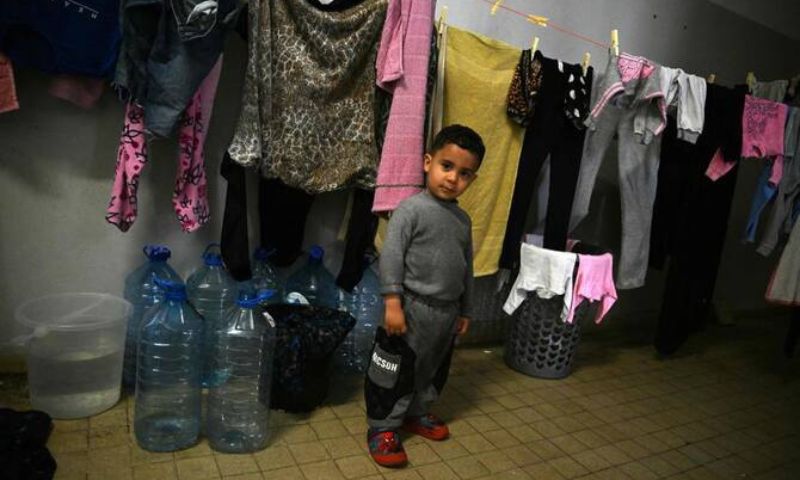
BEIRUT: United Nations refugee chief Barham Salih on Wednesday urged the international community to step up urgent support for Lebanon, warning that the ongoing Israel-Hezbollah war has displaced nearly a fifth of the country’s population.
“I call upon the international community to provide urgent support and relief to Lebanon,” he said after meeting Lebanese Prime Minister Nawaf Salam.
“The humanitarian consequences of this war are immense, and I emphasise the need to spare civilians and civilian infrastructure from the ravages of attack. Lebanon does not deserve to be trapped in a recurring cycle of violence; it deserves support and stability.”
He added that the UNHCR has so far received only part of the $61 million it requested during the war to assist Lebanon in what it described as an “unprecedented” displacement crisis. More than one million people—around a fifth of Lebanon—have been displaced by the conflict, including over 140,000 currently housed in government shelters.
The $61 million forms part of the broader Lebanon Flash Appeal, launched last month by UN Secretary-General Antonio Guterres to raise $308 million in aid for the country.
Lebanon, already battered by years of economic collapse since 2019, was still struggling to recover from the 2024 Israel-Hezbollah war.
Lebanon and Israel held their first direct diplomatic talks in decades on Tuesday in Washington, following more than a month of conflict between Israel and Hezbollah.
The diplomatic engagement marks a significant moment, though Israel ruling out any discussion of a ceasefire and pressing Beirut to disarm the group.
The meeting comes at a critical point in the broader Middle East crisis, just a week into a two-week ceasefire involving the United States, Israel, and Iran.
Iran has insisted that Israel’s operations against Hezbollah in Lebanon must be addressed as part of any comprehensive agreement to end the wider conflict.
US Secretary of State Marco Rubio described the meeting as a “historic opportunity,” while cautioning that no immediate breakthrough was expected.
Rubio said the Trump administration was “very happy” to facilitate the discussions, but acknowledged the deep-rooted challenges, noting that “we understand we’re working against decades of history and complexities” that cannot be resolved quickly.
Hezbollah, which opposes the talks, was not represented, and appeared to intensify its attacks on northern Israel as the negotiations got underway.