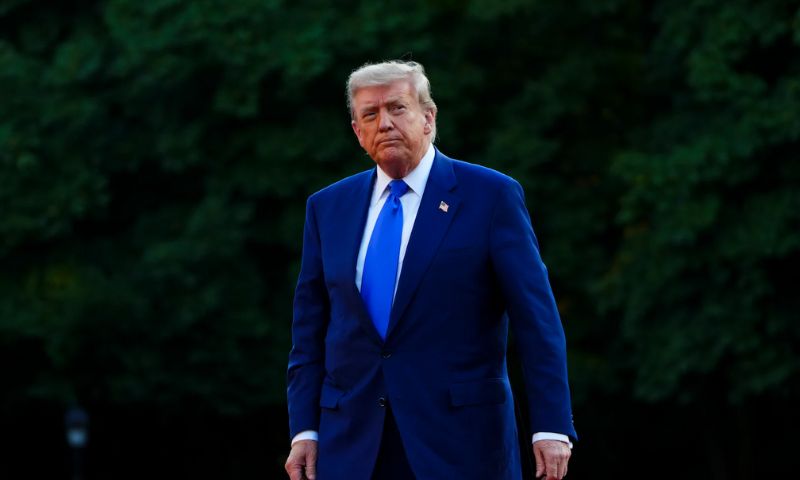
WASHINGTON: U.S President Donald Trump has reiterated a controversial pledge that the United States will acquire Greenland — “one way or the other” — a statement that has sharply increased diplomatic tension with Denmark and raised alarms across Europe about U.S. foreign policy and NATO cohesion.
Speaking aboard Air Force One on Sunday, Trump said the United States would secure control of the vast Arctic island — an autonomous territory of the Kingdom of Denmark — either through negotiation or by unspecified alternative means, according to The Guardian.
He framed the effort as essential to U.S. and international security, warning that Russia or China might otherwise “take” the island.
“If we don’t take Greenland, Russia or China will take Greenland, and I am not going to let that happen,” Trump told reporters, according to multiple sources. “I’d love to make a deal with them. It’s easier, but one way or the other, we’re going to have Greenland.”
The president also dismissed Greenland’s limited defense capabilities — a remark critics characterized as insensitive — and suggested that if the issue affects NATO, it is because “they need us much more than we need them.”
Diplomatic Backlash and NATO Strain
Denmark’s leadership responded sharply. Prime Minister Mette Frederiksen described the developments as a “fateful moment” for her country and warned that unilateral U.S. action against a fellow NATO ally could threaten the alliance’s future.
Danish and Greenlandic officials have insisted that Greenland is not for sale and that any future status should be decided by its people.
Leaders in Greenland have echoed that position, reaffirming their right to self-determination. A joint statement signed by Greenlandic party leaders emphatically rejected U.S. overtures, saying the people of Greenland “do not want to be Americans” and should chart their own future.
European allies have also weighed in. Discussions are underway among NATO members — including the United Kingdom and others — about strengthening Arctic security cooperation to counter broader regional challenges posed by Russia and China, but many have stopped short of supporting any U.S. bid for sovereignty over Greenland.
U.S–Denmark Engagement Continues
Despite the rhetoric, Trump administration officials are scheduled to meet Danish counterparts later this week, signaling that diplomatic channels remain open even as tensions rise.
The talks come against a backdrop of complex bilateral ties: Denmark hosts a U.S. military base on Greenland under a long-standing defense agreement, yet unequivocally rejects efforts to transfer sovereignty.
The White House insists it would prefer a negotiated agreement with Greenland and Denmark, but Trump’s repeated references to alternative pathways have left European capitals and some U.S. lawmakers uneasy.
Strategic Stakes in the Arctic
Greenland’s strategic value stems from its location between North America, Europe, and the Arctic — a region of growing geopolitical competition as climate change opens new military and commercial pathways.
Control over Greenland would offer significant advantages in terms of early-warning defense systems, shipping routes, and access to critical natural resources.
However, experts note that neither Russia nor China has formal claims on Greenland, and increased military activity by those powers in the wider Arctic has so far focused on broader regional presence rather than territorial acquisition.
Uncertain Path Forward
The unfolding dispute over Greenland reflects broader strains in U.S.–European relations and raises questions about how far Washington might go to assert its interests in strategic regions. While the White House emphasizes national security imperatives, allies stress the importance of respecting sovereignty, international law, and alliance commitments.
For now, Greenland — home to roughly 57,000 people — remains under Danish sovereignty, with its future direction firmly contested on diplomatic, political, and public fronts.
Why Greenland Matters Geopolitically
Strategic Military Location
Greenland sits between North America and Europe, near the critical GIUK Gap (Greenland–Iceland–UK). This corridor has historically been key for monitoring naval and submarine movement between the Atlantic and Arctic. Control or influence over Greenland enhances early-warning radar coverage, airspace monitoring, and missile defense.
The U.S. already maintains Pituffik Space Base (formerly Thule Air Base) in northwest Greenland—a strategic site for missile warning and space surveillance under longstanding defence agreements with Denmark.
Great-Power Competition
As Arctic ice melts due to climate change, new shipping routes (like the Northwest Passage and potential trans-Arctic routes) are becoming more navigable. These could shorten global trade routes and make Arctic geopolitics more economically and militarily significant.
According to media reports, Russia has been expanding its Arctic military footprint, and China, which describes itself as a “near-Arctic state,” has shown interest in Arctic infrastructure and resources—raising strategic competition in the region.
Some U.S. officials argue Greenland is needed to deter rival powers from gaining influence, though Nordic sources dispute claims of active Russian or Chinese military encirclement of the island.
Natural Resources and Future Tech
Beneath its ice, Greenland holds rich deposits of rare earth elements, critical minerals, and potentially oil and gas—materials essential for advanced technologies, renewable energy systems, and defence industries.
These resources are increasingly valuable as nations seek to diversify supply chains and reduce reliance on dominant producers, especially in areas like rare earth processing.
Legal and Political Context
Greenland is an autonomous territory of Denmark with growing aspirations for full independence. Under international law, its people have the right to self-determination, and both Danish and Greenlandic leaders have rejected any sale or transfer to the United States.
Timeline
Trump’s First Proposal to Buy Greenland:
In 2019, President Trump floated the idea of the U.S. buying Greenland from Denmark, framing it as a “real estate deal.” Denmark called the notion “absurd,” and Greenlandic leaders stressed it was not for sale. This early controversy raised global awareness of the island’s strategic profile.
2020–2024
Quiet Period:
After the initial 2019 episode, Greenland receded from the U.S. political spotlight, though Arctic security and Danish cooperation remained part of broader NATO and U.S. defence discussions.
2025
Renewed U.S. Focus:
As Trump campaigned and later returned to power, he revived his interest in Greenland, saying the U.S. must own it to keep rival powers, especially Russia and China, at bay.
Greenlandic Reaction:
Greenland’s political leaders—across parties—united in rejecting any notion that Greenland should be transferred to U.S. control, emphasizing the territory’s right to decide its future.
Danish Response:
Denmark’s prime minister and defence officials firmly countered the idea, asserting the U.S. has no right to annex a NATO ally’s territory and reaffirming support for Greenlandic self-determination.
January 2026
Public “One Way or the Other” Claim:
President Trump publicly stated the U.S. would take Greenland “one way or the other,” implying that the U.S. might pursue acquisition even without Greenlandic or Danish consent—justifying it on national security grounds.
This renewed rhetoric has triggered diplomatic pushback from Denmark, intensified debates within NATO about Arctic strategy, and reinforced Greenland’s determination to control its own future.
Key Takeaways
Greenland’s importance arises not from a single factor but from a mix of location, military value, natural resources, and emerging Arctic geoeconomics.
Trump’s repeated focus on the island reflects broader concerns about rival powers and changing strategic landscapes, but it clashes with established international norms and the clear preferences of Greenland’s people and government.