ISLAMABAD: Takht Mahal Railway Station, a name that conjures images of royal thrones and majestic palaces, lies quietly in the Bahawalnagar District of Punjab, Pakistan. Situated approximately 15 kilometers southwest of Bahawalnagar city, this small station once served as a vital link in the subcontinent’s vast railway network.
Today, it stands as a poignant relic of a bygone era, its red-brick walls whispering tales of travelers, traders, and the rhythmic chug of steam locomotives that once echoed across the arid plains.
Origin: Born in the British era
Takht Mahal Railway Station was established in 1897 as part of the Delhi–Samasata broad gauge main line, developed by the Southern Punjab Railway Company.
This 642-kilometer route linked Delhi through Bhatinda and Fazilka to Samasata Junction, marking a significant expansion in the colonial railway network under British administration. The station was strategically positioned on the Samasata Bhatinda Delhi line, connecting the princely state of Bahawalpur to the vast expanses of British India.
تخت محل جو اجڑ گیا
بہاول نگر سے بہاول پور کو جاتی سڑک کے دائیں کنارے پہ یہ چھوٹا سا ریلوے اسٹیشن موجود ہے۔ تخت محل ریلوے اسٹیشن۔ نام کتنا خوب صورت ہے۔ تخت۔ محل۔ جیسے کسی بادشاہ نے محل بنوایا ہو، تخت سجایا ہو، دربار لگایا ہو، داد رسی کی ہو۔ اور پھر کوچ کر گیا ہو کہیں۔
بہاول نگر… pic.twitter.com/JqV8c6Kgpe
— Pakistan Tourism (@PakistanJannatt) July 13, 2026
The station’s construction aligned with the North Western State Railway’s overarching strategy following its formation in 1886, which absorbed earlier companies to consolidate operations. Its primary purpose was to bolster trade along the Punjab frontier by transporting agricultural goods, including cotton and grains, while facilitating military logistics and troop deployments toward the northwest border regions.
Historical significance: Cross-border connectivity
During its heyday, Takht Mahal was a bustling stop where travelers from Bahawalnagar, Minchinabad, and beyond would board trains journeying toward Delhi, Bhuchinda, Ferozepur, and even Karachi.
The station played a pivotal role in integrating local agricultural economies with broader trade networks, supporting the export-oriented agriculture that underpinned the colonial economy.
Prior to the 1947 partition, the station facilitated cross-border commerce and social mobility, connecting rural villages to urban centers like Lahore and enabling pilgrims, migrant workers, and traders to traverse the region with ease. The station’s freight rates, still inscribed on its aging walls, reflect an era when this modest halt was the heartbeat of regional connectivity.
Functioning: Operations and services
Takht Mahal railway station, assigned the official code TKM, historically supported both passenger and freight services on the Samasata–Amruka Branch Line. The station featured low-level platforms, a modest ticket office, water towers for steam locomotives, and a goods shed, all standard elements of colonial-era halt stations.
However, the station’s passenger operations were discontinued on July 26, 2011, due to low usage and maintenance challenges. Since then, no regular passenger trains have stopped at Takht Mahal, and passenger volume has become negligible. The station now primarily supports occasional freight movements, though even these are infrequent.
The branch line itself was closed in 2011, and while restoration efforts estimated at PKR 7.735 billion have been discussed, work remains suspended as of 2024. The station’s signaling systems, once reliant on semaphore technology, have seen minimal upgrades, reflecting the broader financial constraints facing Pakistan Railways.
Current status: A picture of neglect
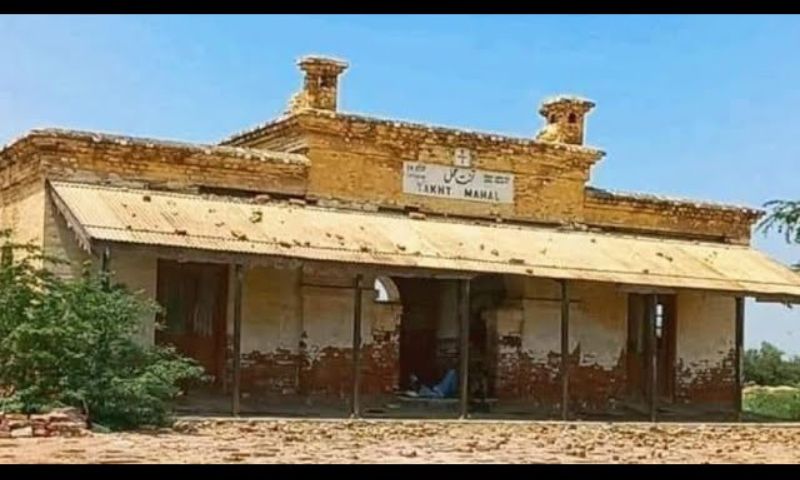
Today, Takht Mahal Railway Station stands as a haunting symbol of decay and neglect. The station building, constructed with locally sourced red bricks and lime mortar, shows significant signs of weathering due to the harsh desert climate. Its elevated water tank, once a prominent feature, now stands dry, and the surrounding fenced land is overgrown with bushes.
The station’s proximity to the India-Pakistan border imposes security restrictions that limit access and operational flexibility. Maintenance responsibilities fall under the Lahore division of Pakistan Railways, but chronic underfunding has deferred comprehensive upgrades for years. The tracks, once part of a thriving network, now lie silent, with only stray animals and shepherds dotting the desolate landscape.
Despite its dilapidated state, Takht Mahal retains symbolic importance as a remnant of shared Indo-Pak railway heritage. Online media, including YouTube documentaries and TikTok videos, have highlighted its historical architecture and partition-era stories, suggesting potential for heritage tourism. However, preservation faces significant challenges, including limited government budgets, risks of vandalism, and the station’s remote location.
A glimmer of hope?
Discussions have emerged in recent years about enhancing branch lines near historical sites, and some patriotic contractor companies have even uprooted old tracks with promises of laying new ones. Whether this turn of the wheel will bring the fortune of witnessing a new railway line at Takht Mahal remains uncertain.
For now, Takht Mahal Railway Station waits, a throne abandoned, a palace left to the mercy of time and the blistering sun. Its story is not just one of decay but a reminder of an era when railways were the lifelines of nations, connecting people, cultures, and economies. Whether it will rise from its ashes or crumble further into the dust of history is a question only time can answer.